
Exercises
Put your game AI development skills to the test. This quiz covers core concepts used to create intelligent, believable, and responsive game characters, including NPC behavior, pathfinding techniques, heuristics, behavior trees, attack patterns, steering behaviors, flocking, probabilistic decision-making, and reinforcement learning. Whether you are new to game programming or reviewing AI fundamentals, these questions will help you assess your understanding of the systems that drive movement, choices, and interactions in modern games.
Answer the questions below and check the explanation for each answer.
0/10 answered
Auto audio on: the next questions will be read aloud when you click Continue.
The primary purpose of AI in games is to create more engaging and challenging gameplay experiences that respond dynamically to player actions.
The A* Algorithm is a widely used AI technique for pathfinding in games due to its efficient calculation of the least-cost path between two points.
NPC stands for Non-player Character, which refers to characters in a game that are not controlled by players but by the game's AI.
Finite State Machines are often used in games to dictate an NPC's behavior, including attack patterns, by transitioning through defined states based on inputs.
In AI pathfinding, a heuristic refers to an estimate used to guide algorithms like A* in finding an efficient path more quickly by evaluating the cost to reach the goal from a given point.
Behavior trees are used in game AI for their ability to produce modular and reusable AI logic that can be easily understood and modified for complex behaviors.
Flocking behavior in game AI refers to the coordinated movement of groups of agents or characters, often simulating real-world behaviors like fish schools or bird flocks.
Reinforcement Learning involves training AI systems through rewards and penalties, encouraging them to learn optimal behaviors in an environment over time.
Decision-making using probabilistic methods introduces unpredictability and realism in game AI, making non-player actions less predictable and more lifelike.
Steering behaviors are used in game AI to navigate characters or agents through game environments, allowing for smooth and realistic motion between obstacles and toward targets.

Free CourseUnreal Engine 5 Complete Tutorials
5

(1)

105h07m

53 exercises
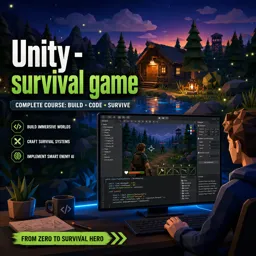
Free CourseUnity - survival game
5
(13)
11h23m
38 exercises

Free CourseGame Environment Art
5
(3)
2h37m
7 exercises
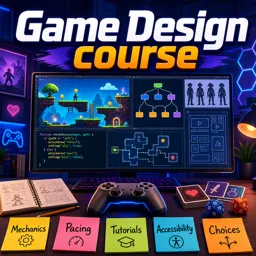
Free CourseGame Design course
5
(1)
10h16m
38 exercises

Free CourseAndroid - LibGDX - Super Mario Bros
4.8
(18)
5h08m
22 exercises
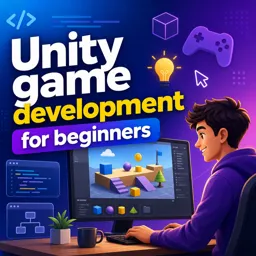
Free CourseUnity game development for beginners
4.8

(4)
7h24m
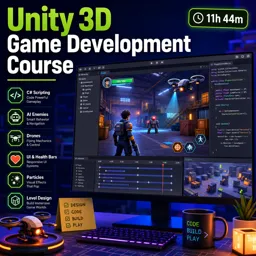
Free CourseUnity 3D Game Development Course
4.8
(4)
11h44m
45 exercises

Free CourseRPG in Unity
4.7
(10)
2h27m
11 exercises
Thousands of online courses in video, ebooks and audiobooks.
To test your knowledge during online courses
Generated directly from your cell phone's photo gallery and sent to your email

Download our app via QR Code or the links below:.



Carry knowledge in your pocket.
Download the Cursa app.
There are hundreds of free courses available, with a free certificate of completion that is saved in your mobile image gallery.
Download the app to access the Course Completion Certificate for Free.


+ 10 million
students

Free and Valid
Certificate

60 thousand free
exercises

4.8/5 rating in
app stores

Free courses in
video and ebooks