
Exercises
Put your HVAC knowledge to the test with this Refrigeration and Air Conditioning Basics quiz. Explore the essential principles behind cooling systems, including the purpose of the refrigeration cycle and the roles of the compressor, evaporator, condenser, and throttle valve. Questions cover heat absorption and rejection, refrigerant pressure and boiling points, heat-transfer properties, and issues caused by overcharging a system. Ideal for students, beginners, and anyone seeking a clear review of fundamental refrigeration and air conditioning concepts.
Answer the questions below and check the explanation for each answer.
0/10 answered
Auto audio on: the next questions will be read aloud when you click Continue.
The primary purpose of a refrigeration cycle is to remove heat from a designated area and discharge it to another area, usually outside the designated space.
The evaporator is the component of an air conditioning system that absorbs heat from the environment inside the space to be cooled, allowing the refrigerant to change from liquid to vapor.
Thermal conductivity is the property of a refrigerant that indicates its ability to transfer heat efficiently. Higher thermal conductivity means better heat transfer.
The compressor's role in a refrigeration system is to increase the pressure of the refrigerant vapor, which circulates the refrigerant through the system, enabling the cooling process.
The throttle valve, or expansion valve, in a refrigeration system functions to lower the refrigerant pressure, allowing it to expand and cool rapidly as it enters the evaporator.
The condenser's effect on the refrigerant in a cooling system is to condense the vapor into liquid by releasing absorbed heat to the surroundings.
Refrigerants are kept under high pressure in a cycle to enhance their heat transfer capability, allowing efficient absorption and release of energy during phase changes.
If a refrigeration system is overcharged, it can cause high head pressure, which increases the compressor workload and reduces overall system efficiency.
The evaporator absorbs heat from the environment to aid in cooling, whereas the condenser releases absorbed heat to the surrounding environment, completing the cycle.
Refrigerants with low boiling points are used in cooling systems to enable evaporation at lower temperatures, which is crucial for efficient heat absorption in the evaporator.
Free CourseRefrigeration and Air conditioning
5

(4)

9h11m

6 exercises
Free CourseRefrigeration and air-conditioning
5
(1)
17h58m
30 exercises
Free CourseFundamentals of HVAC
5
(2)
58m
6 exercises
Free CourseHVAC training
5
(3)
4h01m
8 exercises
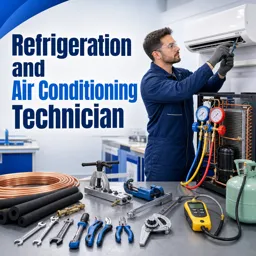
Free CourseRefrigeration and Air Conditioning Technician
4.8

(4)
1h18m
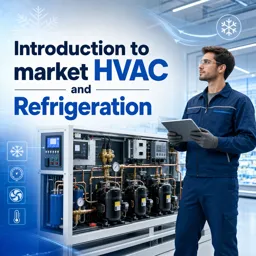
Free CourseIntroduction to market HVAC and Refrigeration
4.7
(3)
1h04m
6 exercises
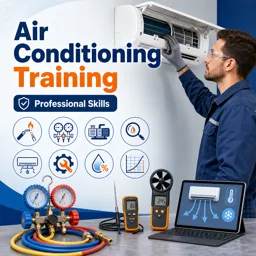
Free CourseAir Conditioning Training
4.7
(6)
10h15m
14 exercises
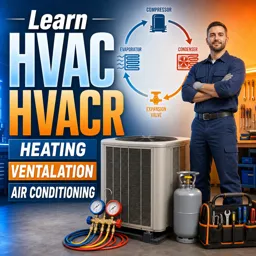
Free CourseLearn HVAC HVACR Heating Ventalation Air Conditioning
4.3
(7)
34h21m
43 exercises
Thousands of online courses in video, ebooks and audiobooks.
To test your knowledge during online courses
Generated directly from your cell phone's photo gallery and sent to your email

Download our app via QR Code or the links below:.



Carry knowledge in your pocket.
Download the Cursa app.
There are hundreds of free courses available, with a free certificate of completion that is saved in your mobile image gallery.
Download the app to access the Course Completion Certificate for Free.


+ 10 million
students

Free and Valid
Certificate

60 thousand free
exercises

4.8/5 rating in
app stores

Free courses in
video and ebooks