
Exercises
Explore the principles that connect chemical reactions with electrical energy. This quiz covers oxidation and reduction at electrodes, galvanic and electrolytic cells, electron flow, salt bridges, cell potentials, the Nernst equation, electroplating, concentration cells, and corrosion prevention. Questions range from foundational concepts to quantitative applications of Faraday's law.
Answer the questions below and check the explanation for each answer.
0/13 answered
Auto audio on: the next questions will be read aloud when you click Continue.
Oxidation always occurs at the anode, while reduction occurs at the cathode. In a galvanic cell, oxidation releases electrons that travel through the external circuit.
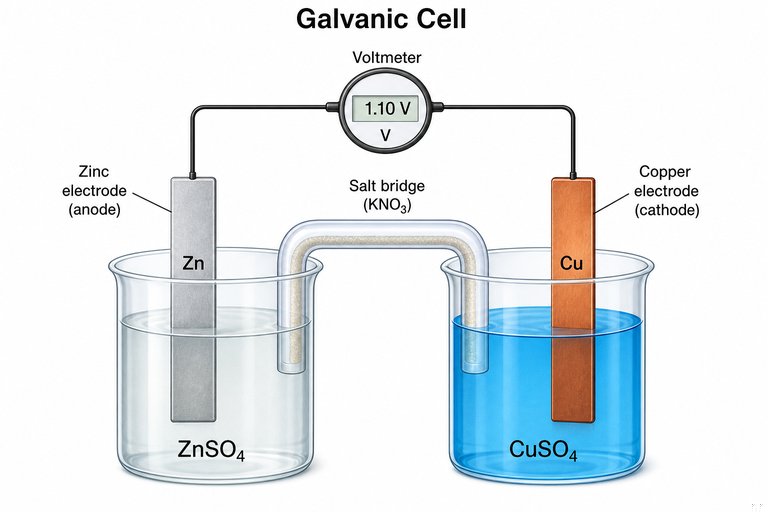
Zinc is oxidized and releases electrons, whereas copper ions are reduced at the copper electrode. Electrons therefore flow through the wire from zinc to copper.
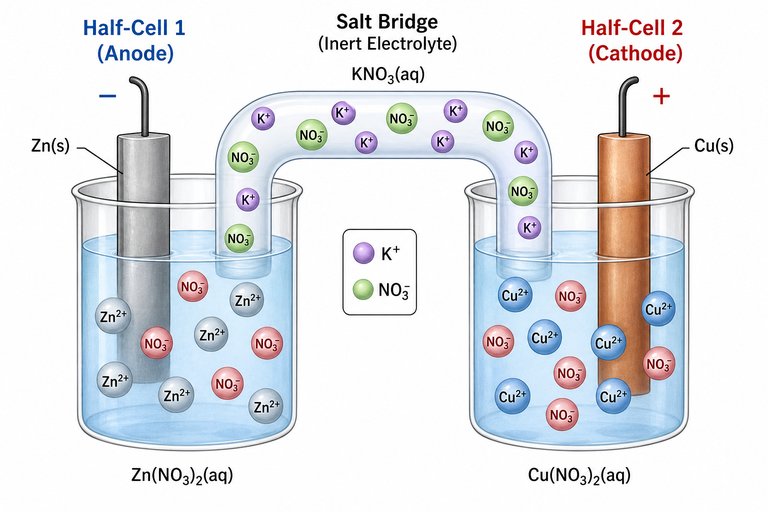
The salt bridge permits ions to move between the half-cells, preventing charge buildup and completing the internal circuit. Electrons travel through the external wire, not through the bridge.
When both tabulated values are reduction potentials, subtract the anode reduction potential from the cathode reduction potential: E°cell = E°cathode − E°anode.
A spontaneous electrochemical reaction has a positive cell potential. This corresponds to a negative standard Gibbs energy because ΔG° = −nFE°cell.
The Nernst equation is E = E° − (RT/nF)ln Q. As Q increases, the subtracted term becomes larger, so the cell potential decreases.
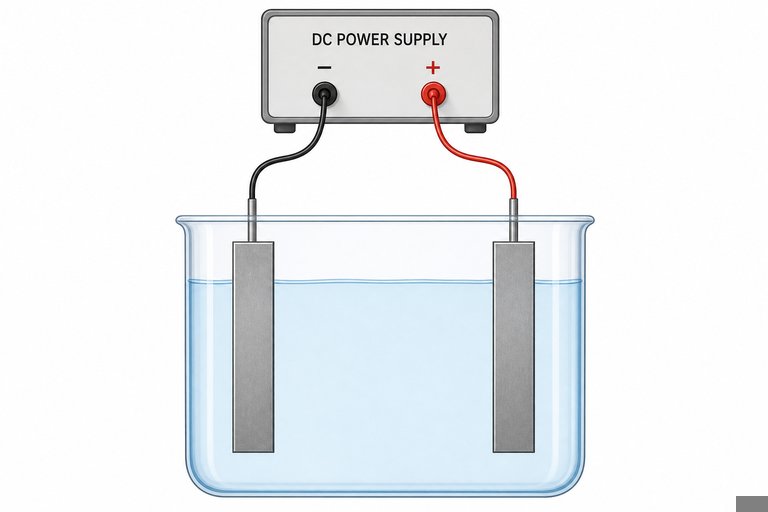
In an electrolytic cell, the cathode is connected to the negative terminal of the power supply, which supplies electrons for reduction. Reduction still occurs at the cathode.
19,300 C equals 0.200 mol e−. Because Cu2+ + 2e− → Cu, this deposits 0.100 mol Cu. Multiplying by 63.5 g/mol gives 6.35 g.
The standard hydrogen electrode is the reference against which other standard electrode potentials are measured. Its potential is defined as 0.00 V.
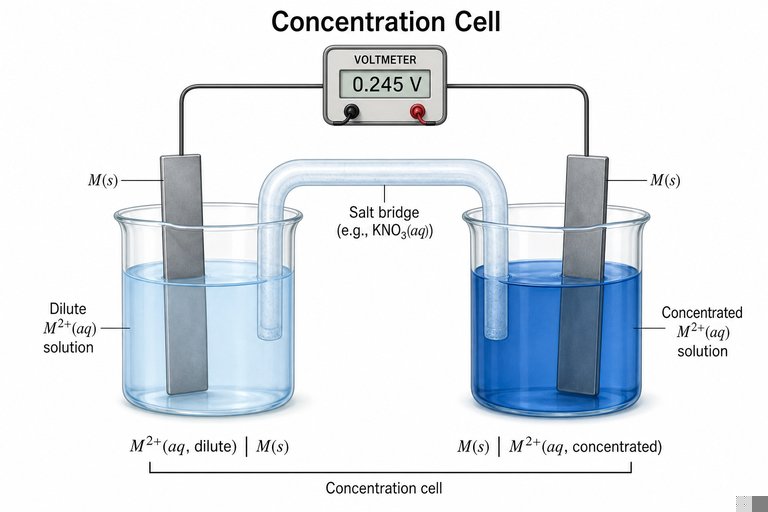
Oxidation occurs in the dilute half-cell, increasing its ion concentration. Reduction occurs in the concentrated half-cell, decreasing its concentration. Electrons flow from dilute to concentrated.

Copper ions gain electrons and become solid copper at the cathode. This deposits copper onto the copper electrode, increasing its mass, while the zinc electrode loses mass through oxidation.
Molten NaCl contains only Na+ and Cl− ions. Na+ is reduced to sodium at the cathode, while Cl− is oxidized to chlorine gas at the anode.

Magnesium is more easily oxidized than iron, so it acts as the sacrificial anode and corrodes preferentially. This keeps the steel hull cathodic and reduces its oxidation.

Free CoursePrinciples of Chemical Science
5

(3)

25h24m

28 exercises

Free CourseAdvanced Organic Chemistry
4.8

(4)
24h47m
24 exercises
Free CourseChemistry Basics
4.7
(34)
16h53m
44 exercises
Free CourseChemistry
4.5
(56)
26h09m
23 exercises
Free CourseChemistry full course
4.5
(4)
22h06m
30 exercises

Free CourseChemistry Course
4.4
(7)
6h32m
10 exercises
Free CourseOrganic Chemistry
4
(2)
130h28m
46 exercises
Thousands of online courses in video, ebooks and audiobooks.
To test your knowledge during online courses
Generated directly from your cell phone's photo gallery and sent to your email

Download our app via QR Code or the links below:.



Carry knowledge in your pocket.
Download the Cursa app.
There are hundreds of free courses available, with a free certificate of completion that is saved in your mobile image gallery.
Download the app to access the Course Completion Certificate for Free.


+ 10 million
students

Free and Valid
Certificate

60 thousand free
exercises

4.8/5 rating in
app stores

Free courses in
video and ebooks