
Exercises
This quiz assesses practical knowledge of Lean process improvement in business settings. It covers customer value, the eight wastes, takt time, bottlenecks, 5S, pull systems, value stream mapping, root-cause analysis, PDCA, mistake-proofing, standard work, Gemba, OEE, Kanban, and sustaining improvements. The questions combine core concepts with realistic visual scenarios to test how effectively you can recognize inefficiency and guide continuous improvement.
Answer the questions below and check the explanation for each answer.
0/15 answered
Auto audio on: the next questions will be read aloud when you click Continue.
Lean defines value from the customer's perspective. An activity is value-adding when it contributes something the customer needs and is willing to pay for.

Motion waste is unnecessary movement by people, such as excessive walking, reaching, or bending. Transportation waste instead refers mainly to unnecessary movement of materials or products.
Takt time equals available production time divided by customer demand: 420 ÷ 210 = 2 minutes per unit. This is the required production pace for meeting demand.
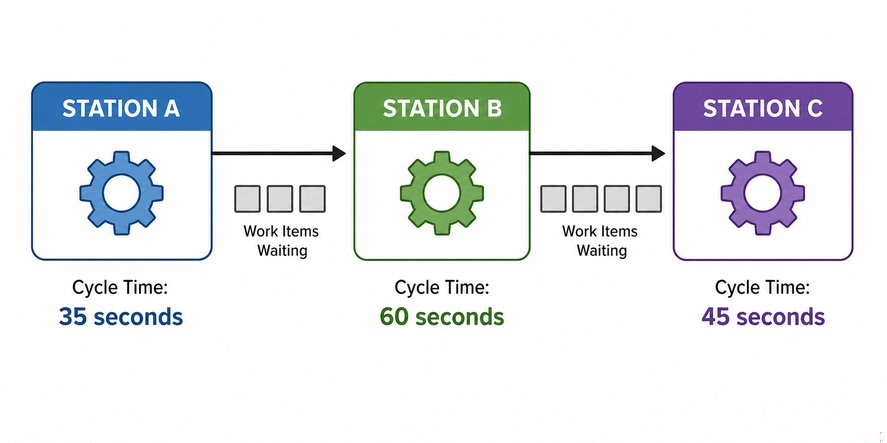
The bottleneck is the step with the lowest capacity, indicated here by the longest cycle time. Station B takes 60 seconds, so it constrains the overall flow.

Sort separates necessary items from unnecessary ones. Removing obsolete or broken items should occur before arranging, cleaning, or standardizing the workspace.
A pull system replenishes work in response to actual consumption. This helps limit excess inventory and aligns production more closely with real demand.
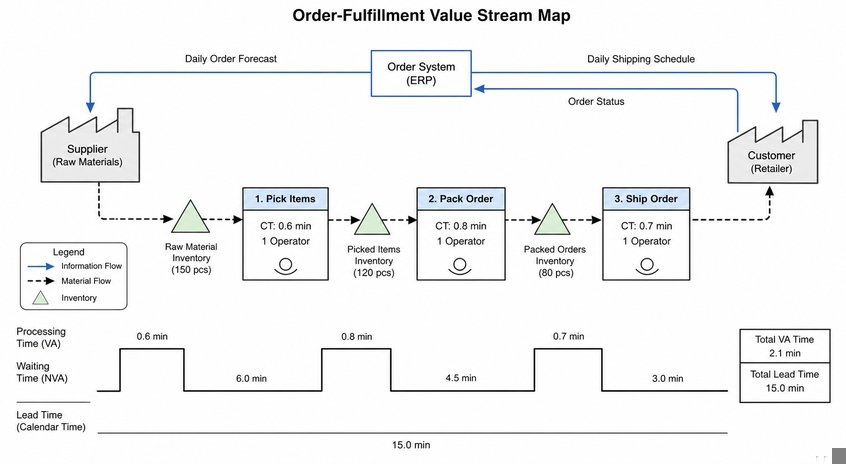
Separating the times reveals how much total lead time is spent processing the product and how much is lost to waiting or delay. This helps teams target major improvement opportunities.
The Five Whys technique traces a problem through successive cause-and-effect relationships. Its purpose is to identify an actionable root cause, not to assign blame.
In the Check phase, the team analyzes data from the trial and compares actual results with the target. It can then decide what action to take.

Poka-yoke means mistake-proofing. A fixture that physically prevents incorrect insertion stops a defect before it occurs rather than relying only on inspection.
Standard work defines the current best-known method for completing a task safely, consistently, and efficiently. It provides a baseline from which further improvement can occur.
Gemba means the actual place where value-creating work occurs. Leaders visit it to observe directly, understand conditions, and learn from the people doing the work.
OEE is calculated as availability × performance × quality. It captures losses caused by downtime, reduced operating speed, and defective output.
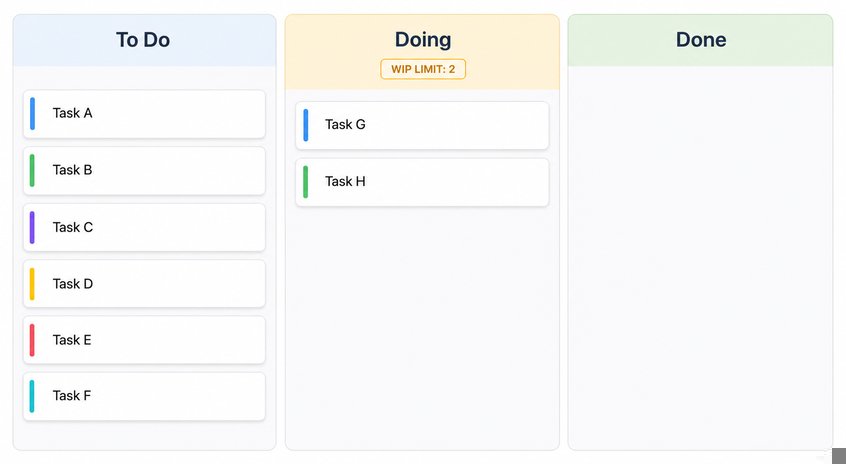
A Kanban WIP limit restricts how many items may be active at once. When the limit is reached, the team should focus on finishing existing work before starting more.
Improvements are more likely to last when the new method is incorporated into standard work, responsibility is assigned, and performance is monitored. These controls help detect and correct regression.

Free CourseImprove your Communication for Business
5

(10)

13h11m

43 exercises

Free CourseLeadership in Projects
5
(3)
8h40m
16 exercises

Free CourseSoft Skills for business
4.9
(13)
15h41m
43 exercises

Free CoursePublic Speaking
4.8
(13)
50m
13 exercises
Free CourseIntroduction to Human Communication
4.7

(13)
5h14m
30 exercises

Free CourseHow To Become A Master In The Art of Public Speaking
4.7
(3)
2h28m
2 exercises
Free CourseOrganizational Behaviour (OB) Masterclass: Motivation, Leadership, Communication and Team Dynamics
4
(2)
6h45m
41 exercises
Thousands of online courses in video, ebooks and audiobooks.
To test your knowledge during online courses
Generated directly from your cell phone's photo gallery and sent to your email

Download our app via QR Code or the links below:.



Carry knowledge in your pocket.
Download the Cursa app.
There are hundreds of free courses available, with a free certificate of completion that is saved in your mobile image gallery.
Download the app to access the Course Completion Certificate for Free.


+ 10 million
students

Free and Valid
Certificate

60 thousand free
exercises

4.8/5 rating in
app stores

Free courses in
video and ebooks