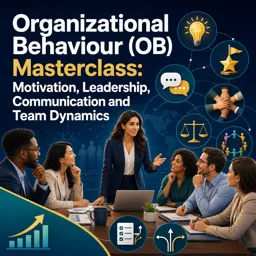
Free Course Image Organizational Behaviour (OB) Masterclass: Motivation, Leadership, Communication and Team Dynamics

Free online courseOrganizational Behaviour (OB) Masterclass: Motivation, Leadership, Communication and Team Dynamics

Duration of the online course: 6 hours and 45 minutes

New

Build leadership, motivation and communication skills with a free online course in organizational behavior—learn to influence teams and perform better at work.

In this free course, learn about

  • Foundations of OB: nature, environmental context (internal/external) and key influences
  • Impact of IT on behavior, efficiency, productivity, and organizational effectiveness
  • Globalization in OB and implications for managing across borders and markets
  • Workplace diversity: meaning, types, and how diversity shapes attitudes and outcomes
  • Organizational ethics: definition and major ethical issues affecting behavior at work
  • Organizational culture types (e.g., innovative cultures) and their effects on employees
  • Reward systems: intrinsic, extrinsic, and social rewards to drive performance
  • Perception in OB: perceptual selectivity, social perception factors, impression management
  • Attribution theories: cues, locus of control, and common attribution errors at work
  • Personality in OB: determinants, Big Five continuum, Johari Window, Transactional Analysis
  • Attitudes, job satisfaction, organizational commitment, motivation, ERG, and POB constructs
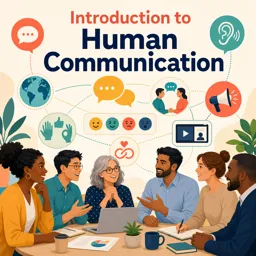
  • Communication: process steps, interactive communication, barriers, and improvement strategies
  • Decision-making: step sequence, participative and group methods (e.g., Delphi technique)
  • Stress, conflict, power, empowerment, groups/teams, job design, goals, QWL, reinforcement, leadership

Course Description

Strong leadership is not only about authority or experience. It is about understanding why people behave the way they do at work, what energizes them, how they interpret situations, and what helps teams collaborate under pressure. This free online course in Organizational Behaviour helps you develop a practical, workplace-ready mindset to navigate modern organizations with more clarity, empathy, and effectiveness.

You will learn to connect individual psychology to real business outcomes by exploring perception, personality, attitudes, job satisfaction, and commitment, then translating these ideas into better day-to-day decisions. As you strengthen your ability to read situations and people, you also build the foundation for influencing without friction, reducing misunderstandings, and creating trust across roles and backgrounds.

The course places strong emphasis on motivation and performance, helping you recognize what drives people and how reward systems, goal setting, job design, and reinforcement can shape behavior in sustainable ways. You will also gain tools to handle common organizational challenges such as stress, conflict, power dynamics, and empowerment, so you can respond thoughtfully rather than reactively when tensions rise or priorities collide.

Communication and teamwork are treated as core professional skills, not soft extras. You will deepen your understanding of the communication process, interactive exchange, common barriers, and practical ways to improve the flow of information. Along the way, you will learn how groups form, why teams sometimes underperform, what roles emerge informally, and how healthy team dynamics can be supported in a modern workspace.

To make learning stick, the course includes knowledge checks throughout, allowing you to test your understanding as you progress and build confidence with key concepts. By the end, you will be better prepared to lead conversations, support high performance, and contribute to a positive culture—whether you are a new manager, an aspiring leader, a business student, or a professional looking to grow your influence at work.

Course content

  • Video class: 1. Introduction To Organizational Behaviour, Nature 12m
  • Video class: 2. Environmental and Organizational Context in OB, Types Of Environment |OB| 08m
  • Exercise: Which option correctly matches the two main types of organizational environment and what they refer to?
  • Video class: 3. Impact Of IT on Organizational Behaviour |OB| 06m
  • Exercise: How does modern technology mainly improve organizational efficiency and productivity?
  • Video class: 4. Globalization in Organizational Behaviour |OB| 05m
  • Exercise: Which statement best defines globalization in organizational behavior?
  • Video class: 5. Diversity and its Types in Organizational Behaviour |OB| 04m
  • Exercise: In Organizational Behaviour, what does diversity in an organization primarily refer to?
  • Video class: 6. Ethics and biggest ethical issues in Organizational Behaviour |OB| 07m
  • Exercise: Which statement best defines organizational ethics?
  • Video class: 7. Culture and Types Of Culture in Organizational Behaviour |OB| 08m
  • Exercise: Which type of organizational culture is mainly defined by risk-taking and innovation, where employees are encouraged to share creative ideas?
  • Video class: 8. Reward System, Types Of Rewards in Organizational Behaviour |OB| 11m
  • Exercise: In Organizational Behaviour, what are the three main forms of rewards used to encourage employee performance?
  • Video class: 9. Perception, Nature 11m
  • Exercise: In organizational behaviour, why should managers be aware of employees’ perceptions?
  • Video class: 10. Perceptual Selectivity 10m
  • Exercise: What best describes perceptual selectivity in organizational behaviour?
  • Video class: 11. Social Perception in OB, Factors Effecting |OB| 07m
  • Exercise: Which set correctly lists the three main factors that influence social perception?
  • Video class: 12. Attribution, Attribution Theories in Organizational Behaviour |OB| 09m
  • Exercise: In attribution theory, which set of three cues is used to examine and explain another person’s behavior?
  • Video class: 13. Locus Of Control 05m
  • Exercise: Which statement best describes an internal locus of control?
  • Video class: 14. Attribution Errors and its Types in Organizational Behaviour |OB| 07m
  • Exercise: Which situation best illustrates a fundamental attribution error in the workplace?
  • Video class: 15. Impression Management 07m
  • Exercise: In Organizational Behaviour, what best defines impression management?
  • Video class: 16. Personality 09m
  • Exercise: Which set correctly lists the five factors that influence personality?
  • Video class: 17. Personality as A Continuum - Big 5 Model Of Personality |OB| 11m
  • Exercise: In the Big Five personality model, why is personality described as a continuum?
  • Video class: 18. Johari Window - Method for Self Awareness in Organizational Behaviour |OB| 06m
  • Video class: 19. Transactional Analysis - Types and Ego States |OB| 11m
  • Exercise: In Transactional Analysis, what is a complementary (parallel) transaction?
  • Video class: 20. Attitudes - Nature and Dimensions Of Attitude in OB |OB| 07m
  • Video class: 21. Job Satisfaction, Factors , Outcomes 09m
  • Exercise: Which option is described as a factor influencing job satisfaction in an organization?
  • Video class: 22. Organizational Commitment, Factors , Outcomes 06m
  • Exercise: Which option best describes organizational commitment?
  • Video class: 23. Motivation, Process, Work Motivation Theories in OB |OB| 09m
  • Exercise: Which option best describes motivation in Organizational Behaviour?
  • Video class: 24. Alderfers Modified need Hierarchy Theory |OB| 05m
  • Video class: 25. Positive Organization Behaviour - Optimism, Emotional Intelligence, Self Efficacy |OB| 06m
  • Exercise: Which set lists the forms of Positive Organizational Behavior (POB) discussed?
  • Video class: 26. Communication - Process 08m
  • Exercise: In the communication process, what step happens immediately after the sender encodes the message?
  • Video class: 27. Interactive Communication 07m
  • Exercise: Which option best defines interactive communication in an organizational setting?
  • Video class: 28. Barriers for Communication 13m
  • Video class: 29. Strategies To Improve the Flow Of Communication in OB |OB| 05m
  • Exercise: Which strategy reduces information loss by avoiding a long chain of communication levels?
  • Video class: 30. Decision making - Steps Involved, Participative Decision Making in OB |OB| 07m
  • Exercise: In organizational decision making, what is the correct sequence of steps?
  • Video class: 31. Group Decision Making 09m
  • Exercise: Which group decision-making technique involves experts giving independent answers (without interacting) to help forecast future events?
  • Video class: 32. Stress 08m
  • Video class: 33. Effects Of Stress 08m
  • Exercise: Which option is an organizational-level strategy to cope with stress?
  • Video class: 34. Conflict - Meaning, Types, Effects 13m
  • Exercise: Which type of conflict occurs when two departments (e.g., software and hardware teams) depend on each other and disagree due to task interdependence?
  • Video class: 35. Power 09m
  • Exercise: Which type of power is based on a person’s skill, knowledge, and experience in a particular domain?
  • Video class: 36. Empowerment - definition and Types of empowerment in OB |L 36||OB| 06m
  • Exercise: Which type of empowerment involves employees being included in all aspects of organizational performance, with information shared equally at the same time?
  • Video class: 37. Groups VS Teams, Types of Groups 07m
  • Video class: 38. Nature Of Groups, Stages Of Group Formation in OB |L 38||OB| 07m
  • Exercise: In the stages of group development, which stage is characterized by many confusions and disagreements about tasks, roles, and purpose?
  • Video class: 39. Dynamics Of Informal Groups - Roles and Rules in Informal Groups|L 39||OB| 08m
  • Exercise: In an informal group, which role mainly acts as a bridge when people or subgroups cannot communicate effectively?
  • Video class: 40. Dysfunctions Of Groups 09m
  • Exercise: Which of the following is listed as a possible dysfunction of groups and teams?
  • Video class: 41. Teams in Modern Workspace - Functions 07m
  • Exercise: Which set correctly lists the five key functions of a team?
  • Video class: 42. Job Design For High Performance - Techniques in OB |L 42||OB| 08m
  • Exercise: Which job design technique involves shifting an employee from one task/job to another at fixed time intervals to reduce boredom and build different skills?
  • Video class: 43. Goal Setting For High Performance - Techniques in OB |L 43||OB| 06m
  • Exercise: According to goal-setting theory, which type of goals tend to improve performance?
  • Video class: 44. Quality Of Work Life, Work Life Balance - Methods, Benefits |L 44||OB| 09m
  • Exercise: In Organizational Behaviour, what best defines Quality of Work Life (QWL)?
  • Video class: 45. Socio Technical design and High performance work practices |L 45||OB| 05m
  • Exercise: What best describes sociotechnical design in an organization?
  • Video class: 46. Behavioural Performance Management - Reinforcement 10m
  • Exercise: In behavioral performance management, what does reinforcement primarily aim to do?
  • Video class: 47. Process Of Behavioural Modification - Steps Involved in OB |L 47||OB| 08m
  • Exercise: In the behavioral modification process in Organizational Behaviour, what is the correct sequence of the five steps?
  • Video class: 48. Leadership Theories - skills 08m
  • Exercise: Which leadership theory states that leadership ability is inherent and leaders are born, not made?

This free course includes:

6 hours and 45 minutes of online video course

Digital certificate of course completion (Free)

Exercises to train your knowledge

100% free, from content to certificate

Ready to get started?Download the app and get started today.

Install the app now

to access the course
Icon representing technology and business courses

Over 5,000 free courses

Programming, English, Digital Marketing and much more! Learn whatever you want, for free.

Calendar icon with target representing study planning

Study plan with AI

Our app's Artificial Intelligence can create a study schedule for the course you choose.

Professional icon representing career and business

From zero to professional success

Improve your resume with our free Certificate and then use our Artificial Intelligence to find your dream job.

You can also use the QR Code or the links below.

QR Code - Download Cursa - Online Courses

More free courses at Leadership and Business Skills

Free Ebook + Audiobooks! Learn by listening or reading!

Download the App now to have access to + 5000 free courses, exercises, certificates and lots of content without paying anything!

  • 100% free online courses from start to finish

    Thousands of online courses in video, ebooks and audiobooks.

  • More than 60 thousand free exercises

    To test your knowledge during online courses

  • Valid free Digital Certificate with QR Code

    Generated directly from your cell phone's photo gallery and sent to your email

Cursa app on the ebook screen, the video course screen and the course exercises screen, plus the course completion certificate