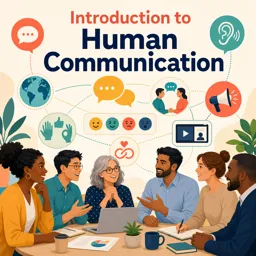
Free online course Introduction to Human Communication
Duration of the online course: 5 hours and 14 minutes
5
(10)
Build clearer messages, stronger relationships, and workplace leadership skills in this free communication course—learn listening, conflict, culture, and influence.
In this free course, learn about
Core definition and process of human communication; how meaning is constructed
Role of context and perception in interpreting messages; attribution errors
Communication competence: appropriateness, effectiveness, and skill development
How identity and culture shape communication behaviors and expectations
Intercultural challenges: power distance, high/low context, directness, emotion norms
Power and status dynamics and how they influence interaction and outcomes
Conflict management styles (e.g., compromising) and choosing strategies by situation
How language is built (phonology, morphology, semantics, syntax) and what syntax is
Linguistic relativity: how language influences perception (e.g., time concepts)
Listening process stages and barriers; how to listen effectively
Relationship building: halo effect, self-disclosure, social penetration theory
Relationship development models: Knapp’s stages and relational dialectics contradictions
Healthy relationships and workplace communication: Gottman’s Four Horsemen, team skills
About the free online course
Great leadership and business results often come down to one skill: communicating in a way other people can understand, trust, and act on. This free online course helps you strengthen everyday communication in professional and personal settings by explaining how meaning is created, how messages are interpreted, and why misunderstandings happen even when intentions are good. You will learn to express ideas with more clarity, choose the right channel for your message, and adjust your approach based on context, audience, and goals.
The course explores what competent communication looks like in real life: not just speaking well, but being both effective and appropriate. You will see how identity, culture, and power shape conversations, from small team interactions to cross-cultural work environments. By understanding perception and common attribution errors, you can reduce snap judgments and respond more thoughtfully when tensions rise. This becomes especially valuable in leadership and business settings where trust, credibility, and psychological safety influence performance.
Communication is also emotional and relational. You will practice recognizing different conflict styles and choosing responses that keep discussions productive rather than personal. You will also examine how language is built and how words influence perception, helping you spot framing effects and communicate more strategically. Just as important, the course strengthens listening as an active process so you can gather better information, ask smarter questions, and respond in ways that move conversations forward.
Nonverbal cues play a major role in what others believe you mean, so you will learn how gestures, facial expressions, space, touch, and time expectations can support or contradict spoken words. You will also explore how relationships form and change, and how thoughtful self-disclosure, healthy boundaries, and constructive conflict habits contribute to stronger connections. By the end, you will be better equipped to communicate across differences, collaborate more smoothly at work, and build healthier, more resilient relationships—skills that translate directly into leadership and business success.
Course content
Video class: Preview: Intro to Human Communication | Study Hall03m
Exercise: Which of the following communication methods involves the use of physical actions, such as gestures or facial expressions, to convey a message?
Video class: Introduction and Definition of Communication | Human Communication | Study Hall08m
Exercise: In the process of human communication, which factor influences the meaning derived from a message the most?
Video class: Working Toward Competent Communication | Human Communication | Study Hall10m
Exercise: Which of the following statements best describes the concept of communication competence as discussed in the text?
Video class: Identity and Culture in Communication | Human Communication | Study Hall07m
Exercise: How do identity and culture influence our communication according to the text?
Video class: Perception | Human Communication | Study Hall10m
Exercise: What concept explains the errors we make in assigning causes to behaviors, as described in the text?
Video class: Cross Cultural Communication Challenges | Intro to Human Communication | Study Hall09m
Exercise: In intercultural communication, what is a key element to consider for effective interaction?
Video class: How Power Affects Communication | Intro to Human Communication | Study Hall10m
Exercise: In the context of power distance cultures, how might the acceptance of power inequality differ between high power distance and low power distance cultures?
Video class: Being Direct or Getting Emotional | Intro to Human Communication | Study Hall08m
Exercise: What is a characteristic of high-context cultures in terms of communication?
Video class: What Is Your Conflict Style? | Intro to Human Communication | Study Hall10m
Exercise: In a situation where two friends are trying to decide on a dinner spot and potential conflict arises, which conflict management style would involve finding a middle ground where both might have to give up something to gain a bit of what they want?
Video class: How is Language Built? | Intro to Human Communication | Study Hall09m
Exercise: When learning a new language, what aspect of language does 'syntax' refer to?
Video class: How Verbal Communication affects Perception | Intro to Human Communication | Study Hall10m
Exercise: According to the concept of linguistic relativity discussed, how might people who speak a language without words for time management perceive time differently?
Video class: Listening | Intro to Human Communication | Study Hall09m
Exercise: Listening is a crucial component of communication as it involves multiple steps to effectively understand and respond to a message. Which of the following is not one of the primary stages in the listening process?
Video class: Nonverbal Communication | Intro to Human Communication | Study Hall11m
Exercise: Which of the following best describes how nonverbal communication can impact a verbal message during a conversation?
Video class: Nonverbal Cues and the Use of Space, Touch, and Time | Intro to Human Communication | Study Hall08m
Exercise: Which of the following is not a key concept related to non-verbal communication?
Video class: Creating and maintaining strong, healthy relationships | Intro to Human Communication | Study Hall08m
Exercise: What is the 'halo effect' as described in communication studies?
Video class: Social Penetration Theory (Ogres Are Like Onions) | Intro to Human Communication | Study Hall11m
Exercise: What is the primary function of self-disclosure in building human relationships?
Video class: Creating Bonds: Knapp’s Relationship Development Model | Intro to Human Communication | Study Hall11m
Exercise: According to Knapp's relational development model, what is the final stage in the coming together phase of a relationship?
Video class: Relational Dialectics | Intro to Human Communication | Study Hall11m
Exercise: What is a contradiction in the context of human relationships, according to the theory of relational dialectics?
Video class: Creating Healthy Relationships | Intro to Human Communication | Study Hall11m
Exercise: Which of the following behaviors is NOT one of John Gottman's Four Horsemen, as a negative conflict management behavior?
Video class: The Importance of Communication in the Workplace | Intro to Human Communication | Study Hall09m
Exercise: Which of the following skills is essential for effectively communicating within a workplace team structure?
Video class: Organizational Structure | Intro to Human Communication | Study Hall11m
Exercise: In a typical organization hierarchy, which type of communication occurs when a manager gives instructions to their team?
Video class: Impression Management and Self-Monitoring | Intro to Human Communication | Study Hall08m
Exercise: What is 'impression management' primarily used for in human communication?
Video class: Business Apologies: How to spot the fakes | Intro to Human Communication | Study Hall11m
Exercise: Why is issuing an apology important for organizations, particularly when maintaining relationships with external stakeholders?
Video class: Introducing Persuasion | Intro to Human Communication | Study Hall10m
Exercise: In the context of human communication, which scenario best illustrates the concept of 'pure persuasion'?
Video class: Learning the Principles of Persuasion | Intro to Human Communication | Study Hall13m
Exercise: According to the text, which principle of persuasion describes the tendency to follow the actions of others in a given situation?
Video class: The Ways We Can Be Swayed | Intro to Human Communication | Study Hall12m
Exercise: Which of the following principles is demonstrated when businesses use phrases like 'limited time offer' to encourage consumers to make immediate purchases?
Video class: History of Mass Media | Intro to Human Communication | Study Hall13m
Exercise: What was one of the significant impacts of the invention of the printing press on mass media?
Video class: Why Do We Respond Differently to the Same Media? | Intro to Human Communication | Study Hall11m
Exercise: Which component of the Differential Susceptibility to Media Effects Model explains how personal experiences and characteristics influence reactions to media content?
Video class: Why you’re a different version of yourself online | Intro to Human Communication | Study Hall14m
Exercise: What aspect of online interactions explains why Jamal feels he can post movie spoilers without facing consequences?
Video class: Two Sides of Social Media | Intro to Human Communication | Study Hall14m
Exercise: What is described as the feeling of stress when one feels the need to constantly check and respond to social media messages to avoid missing out on anything important?
This free course includes:
5 hours and 14 minutes of online video course
Digital certificate of course completion (Free)
Exercises to train your knowledge
100% free, from content to certificate
What topics are covered in an Introduction to Human Communication course?
The course covers verbal and nonverbal communication, listening, perception, culture and identity, conflict styles, relationships, workplace communication, and power dynamics.
How do high-context and low-context cultures communicate differently?
High-context cultures often rely on shared context, indirect language, and nonverbal cues, while low-context cultures tend to value explicit, direct messages.
What are the stages of Knapp's relationship development model?
The coming-together stages are initiating, experimenting, intensifying, integrating, and bonding; relationships may later differentiate, circumscribe, stagnate, avoid, or terminate.
Ready to get started?Download the app and get started today.






















Course comments: Introduction to Human Communication
Am Cooke
This course was so helpful to opening my eyes as to how much communication is important and what values are placed on communicationsm
Subrata Sahoo
i have learned a lot from this app thank you
Tami Agosto
I enjoyed this course. The presenter was easy to listen to. Course was informative.