
Exercises
Explore the foundations of scalable backend development with this quiz on modern architecture patterns. Test your understanding of microservices, service-to-service communication, load balancing, reverse proxies, stateless applications, distributed data storage, and database choices for high-growth systems. You will also review the benefits and trade-offs of microservice architectures, including their role in system evolution and operational complexity. Ideal for backend developers, software engineers, and students who want to strengthen their knowledge of designing reliable, flexible, and scalable applications.
Answer the questions below and check the explanation for each answer.
0/10 answered
Auto audio on: the next questions will be read aloud when you click Continue.
Microservices allow each service to be scaled independently for improved performance, making the system more flexible and adaptable to varying loads.
A service mesh provides a dedicated infrastructure layer for handling service-to-service communication, ensuring reliability and security.
Load balancing aims to distribute workloads evenly, which enhances performance and prevents any single server from becoming a bottleneck.
Microservices architecture allows for more flexible, independent scaling and development, which facilitates easier evolution of systems over time.
A reverse proxy forwards requests to backend services, which helps in routing, load balancing, and providing an additional layer of security.
Sharding involves distributing data across multiple machines to improve load balancing and increase the availability and reliability of the database.
Stateless applications treat each request independently without relying on stored session data, making them easier to scale and manage.
Service-oriented architecture (SOA) is a design pattern that structures applications as collections of loosely coupled services to enhance flexibility and reusability.
Microservice architectures typically introduce more complexity due to the need for efficient communication and data management among different services.
Distributed databases are often preferred for scalable architectures because they can handle large volumes of data and distribute processing across multiple servers.
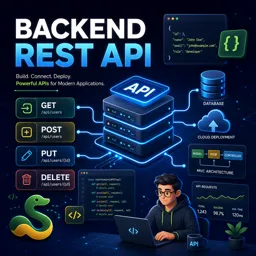
Free CourseBackend REST API
5

(9)

5h24m

25 exercises

Free CourseNodeJS complete
5
(1)
1h30m
12 exercises

Free CourseAPIs
5
(5)
4h32m
20 exercises

Free CourseFlask
5
(1)
8h50m
14 exercises

Free CourseDjango for Everybody
5
(1)
18h32m

Free CoursePython Django Full Stack Developer
5
(2)
14h23m
27 exercises

Free CourseMaster Vue JS API
5
(-4)
6h14m
6 exercises

Free CoursePython Fast API
4.8
(5)
1h34m
14 exercises
Thousands of online courses in video, ebooks and audiobooks.
To test your knowledge during online courses
Generated directly from your cell phone's photo gallery and sent to your email

Download our app via QR Code or the links below:.



Carry knowledge in your pocket.
Download the Cursa app.
There are hundreds of free courses available, with a free certificate of completion that is saved in your mobile image gallery.
Download the app to access the Course Completion Certificate for Free.


+ 10 million
students

Free and Valid
Certificate

60 thousand free
exercises

4.8/5 rating in
app stores

Free courses in
video and ebooks