
Exercises
Explore how astronomers discover and investigate planets beyond the Solar System. This quiz covers transit light curves, radial-velocity measurements, gravitational microlensing, direct imaging, astrometry, orbital properties, atmospheric spectroscopy, false positives, and observational biases. Questions range from foundational concepts to interpretation of realistic astronomical data.
Answer the questions below and check the explanation for each answer.
0/20 answered
Auto audio on: the next questions will be read aloud when you click Continue.
The transit method detects the slight dimming that occurs when a planet crosses in front of its host star from the observer's perspective.
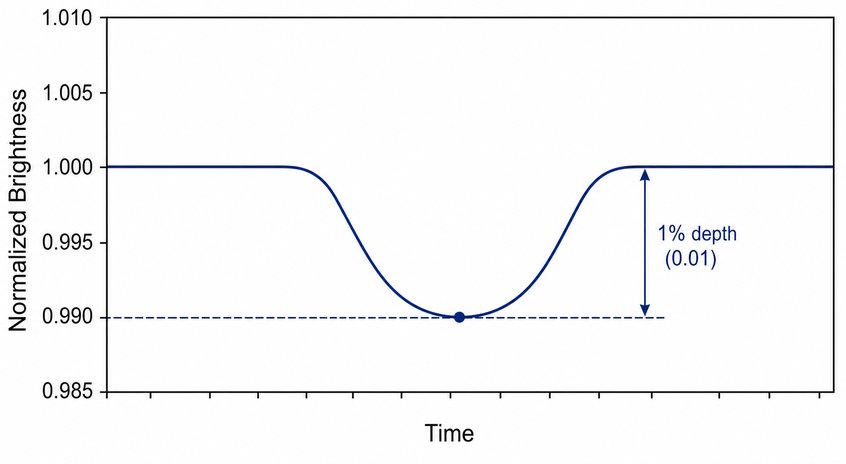
Transit depth is approximately (planet radius/star radius)². A 1% depth gives a radius ratio of 0.1, which is close to the radius ratio of Jupiter and the Sun.
An orbiting planet gravitationally pulls its star back and forth. This motion produces periodic redshifts and blueshifts in the star's spectral lines.
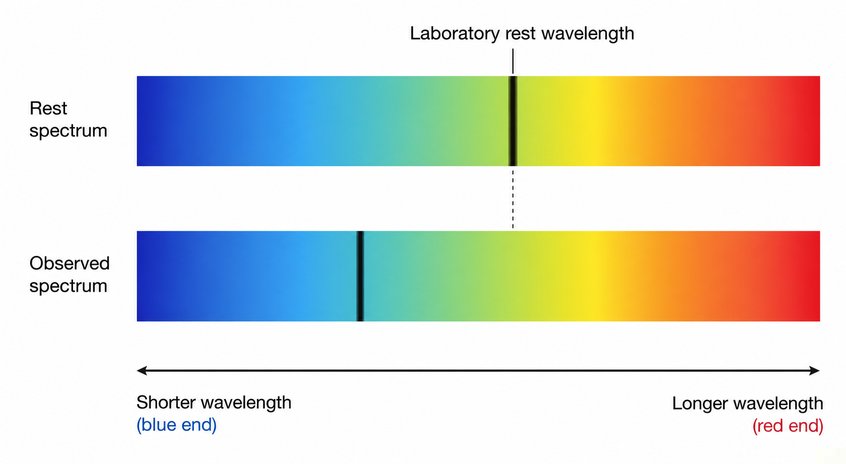
A shift toward shorter wavelengths is a blueshift, indicating that the light source has a component of motion toward the observer.
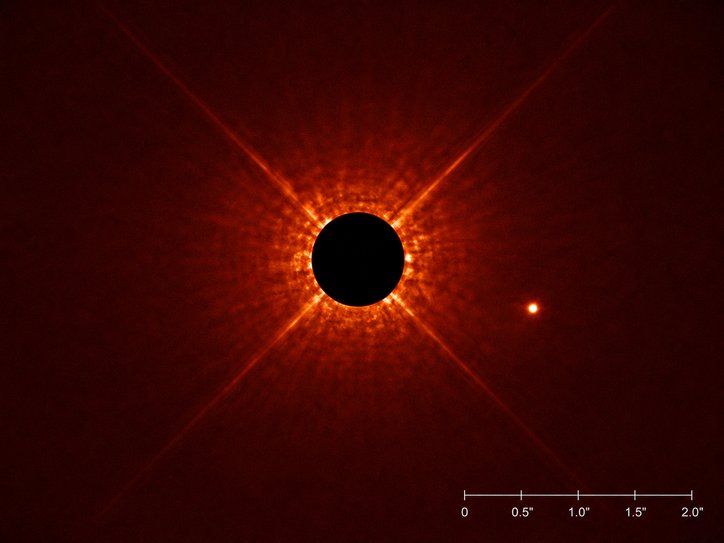
Young, massive planets emit relatively strong infrared radiation, while a wide orbit gives greater angular separation from the host star. Both factors make direct imaging easier.
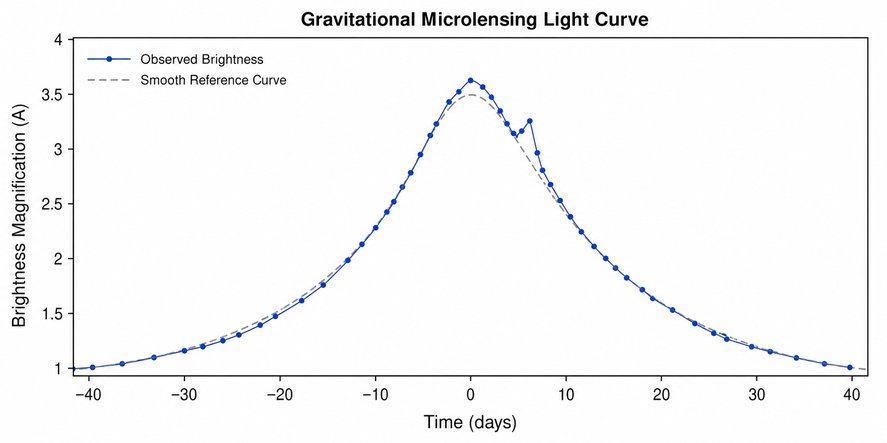
A single lens star creates a relatively smooth brightening curve. A planet can add a brief deviation or anomaly when its gravitational influence affects the magnification.
Successive transits occur once per orbit when the geometry remains aligned. Therefore, the interval between corresponding transit events gives the planet's orbital period.
Radial velocity measures only motion along the line of sight, producing a mass estimate proportional to M sin i. Without the inclination i, only a minimum mass is known.
Mass and radius determine average density through density = mass/volume. Density helps distinguish rocky planets, volatile-rich worlds, and gas giants.
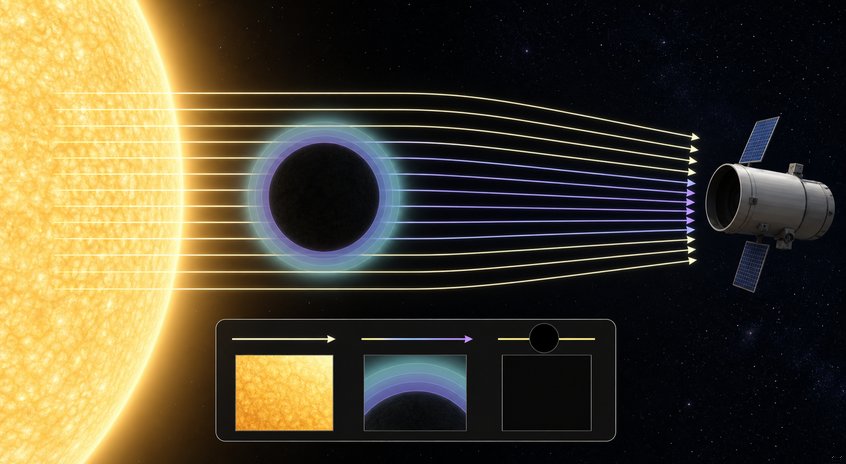
During transit, a small fraction of starlight passes through the planet's atmospheric limb. Atmospheric gases absorb selected wavelengths, producing a transmission spectrum.
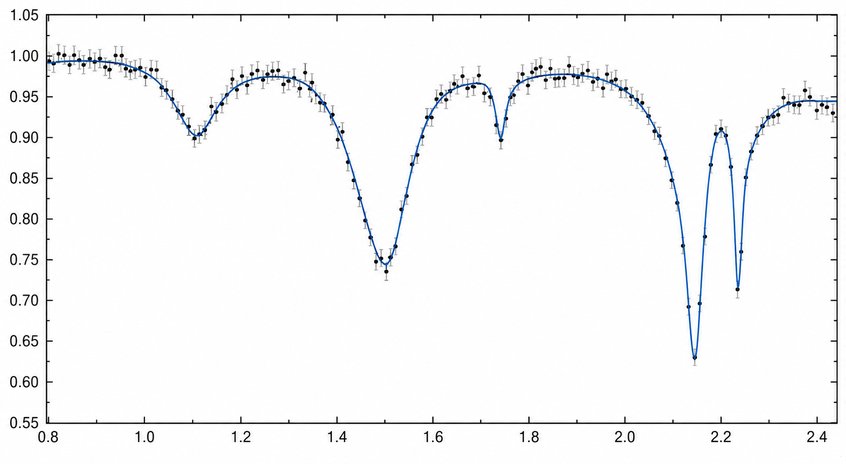
Molecules have quantized energy transitions and absorb light in characteristic wavelength bands. Astronomers compare these features with laboratory spectra to investigate atmospheric composition.
The habitable zone is based on the possibility of surface liquid water, assuming appropriate atmospheric conditions. Being in this zone does not demonstrate that a planet is inhabited.
An eclipsing binary can produce periodic dips resembling planetary transits, especially when its light is blended with another star. Follow-up observations are needed for validation.
Planets perturb one another gravitationally, causing transits to occur slightly earlier or later than a fixed schedule predicts. These variations can reveal and constrain other planets.
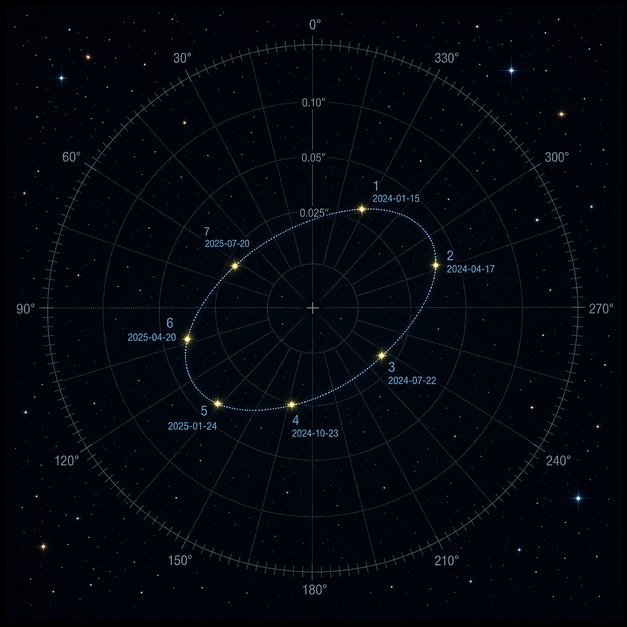
Astrometry measures small changes in a star's position on the sky. An orbiting planet causes the star to trace a tiny path around the system's common center of mass.
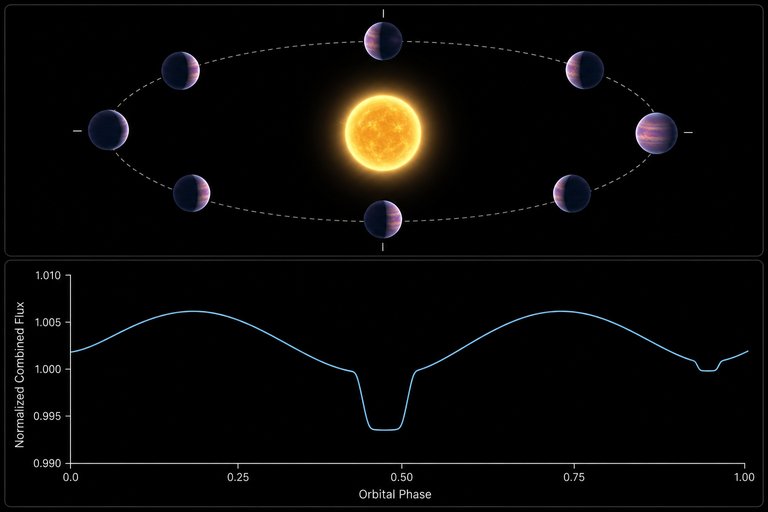
Different portions of the planet's illuminated hemisphere face the observer during an orbit. The changing flux can constrain day-night temperature contrasts and the location of bright or hot regions.
Just before secondary eclipse, both star and planet are visible. During eclipse, the star hides the planet, so the flux difference isolates the planet's dayside contribution.
Large planets block more light, while close-in planets transit more often and are more likely to have the required alignment. This creates an important observational selection bias.
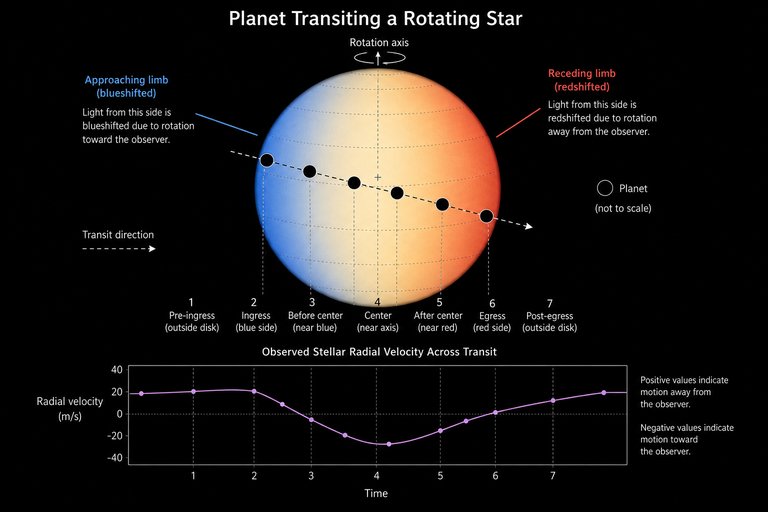
As a planet blocks different portions of a rotating stellar disk, it distorts the measured spectral line profile. The resulting velocity anomaly constrains the projected spin-orbit angle.
A combination of gases maintained far from chemical equilibrium can be more informative than one molecule. Even then, stellar activity, geology, photochemistry, and measurement errors must be excluded.
Free CourseAstronomy 101 complete lessons
5

(4)

9h07m

12 exercises
Free CourseCosmology
5
(1)
5h18m
17 exercises
Free CourseExoplanets and the search for Life in the Universe
5
(1)
49m
6 exercises
Free CourseIntroduction to Astronomy - Solar System, Stars and Cosmology
5
(2)
25h55m
49 exercises
Free CourseRocket Science for Everyone
5
(1)
3h31m
23 exercises
Free CourseAstronomy
4.7

(58)
2h56m
24 exercises
Free CourseHow the Universe works
4.7
(7)
43m
8 exercises
Free CourseGeneral Astronomy
New
15h56m
29 exercises
Thousands of online courses in video, ebooks and audiobooks.
To test your knowledge during online courses
Generated directly from your cell phone's photo gallery and sent to your email

Download our app via QR Code or the links below:.



Carry knowledge in your pocket.
Download the Cursa app.
There are hundreds of free courses available, with a free certificate of completion that is saved in your mobile image gallery.
Download the app to access the Course Completion Certificate for Free.


+ 10 million
students

Free and Valid
Certificate

60 thousand free
exercises

4.8/5 rating in
app stores

Free courses in
video and ebooks