Duration of the online course: 6 hours and 48 minutes
New
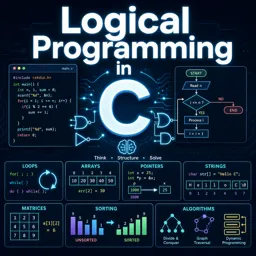
Sharpen C problem-solving fast with this free online course: algorithms, loops, arrays, strings, pointers, and classic logic programs to boost your coding skills.
In this free course, learn about
Meaning of logical programming in C and how it applies to problem solving
Algorithm basics and ways to represent algorithms (steps, flowchart, etc.)
Flowchart symbols and designing flowcharts for conditional/loop problems
Using if/else, nested-if, &&, and conditional operator (?:) for max-of-2/3 logic
Swapping numbers with and without a temporary variable
while vs do-while loops; generating sequences like even numbers and tables
Implementing number programs: leap year, prime, perfect, Armstrong, factors, digits
Working with arrays: input/output, sum, even-sum, max element, insertion, merge
Searching and sorting: linear search, bubble sort, selection sort, insertion sort
String programs: removing spaces, common string logic, pointers with strings
2D arrays and accessing matrix elements (e.g., transpose) using pointers
About the free online course
Strong C developers don’t just memorize syntax, they learn to think logically. This free online course helps you build that mindset step by step, turning everyday programming ideas into clear, working solutions. You will practice translating problems into algorithms, understanding how decisions are made, and choosing the right control flow so your code behaves predictably in real scenarios.
You start by strengthening core reasoning: representing an algorithm, using flowcharts, and writing clean conditional logic to compare values, validate rules, and handle edge cases. From there, you move into loop-driven thinking, where repetition becomes a tool for accuracy and efficiency. As you work through typical logical challenges, you’ll gain confidence with tasks like counting, summing, generating tables, checking numeric properties, and building programs that depend on precise conditions rather than trial and error.
As your skills grow, the course guides you into working with arrays and practical data handling: reading input sets, finding maximum values, inserting and merging elements, and solving problems that require scanning, sorting, or reorganizing data. These exercises mirror the kind of logic used in coding interviews and entry-level programming tasks, helping you develop habits that make your solutions easier to debug and improve.
You’ll also spend time on strings and pointer concepts, a common stumbling block for beginners. By connecting memory ideas to hands-on programs, you’ll learn how pointer operations affect what your program reads and writes, and how to reason about character data safely and effectively. Along the way, you’ll encounter classic patterns like searching and sorting, plus matrix-style thinking, building a broad foundation in programming fundamentals.
By the end, you won’t just have solved a set of problems; you’ll have a reusable approach to breaking down new challenges in C. If you’re preparing for interviews, strengthening fundamentals for future courses, or returning to C to solidify your basics, this course gives you the practical logic practice that turns confusion into confident problem-solving.
Course content
Video class: What is Logical Programming? | Logical Programming in C Language | Naresh IT02m
Video class: Algorithms in C Language | Logical Programming in C | Naresh IT05m
Exercise: In how many ways can an algorithm typically be represented?
Video class: Flow Chart in C Language | Logical Programming in C | Naresh IT07m
Exercise: Which symbol is used in a flow chart to represent decision-making or conditional processing?
Video class: Biggest of 2 using Conditional Operation | Logical Programming in C | Naresh IT03m
Exercise: How to find the biggest of two numbers using a conditional operator?
Video class: Even or Odd Number | Logical Programming in C | Naresh IT03m
Video class: Swapping of 2 Numbers | Logical Programming in C | Naresh IT03m
Exercise: How can you swap two numbers using a temporary variable in C?
Video class: Biggest of 2 Integers | Logical Programming in C | Naresh IT06m
Video class: Sum of first N Numbers | Logical Programming in C | Naresh IT04m
Video class: Biggest of 3 Numbers using Conditional Operator | Logical Programming in C | Naresh IT04m
Video class: Display Even Numbers from 1 to 10 using While Loop | Logical Programming in C | Naresh IT05m
Video class: Biggest of 3 Numbers | Logical Programming in C | Naresh IT07m
Exercise: In the context of determining the largest of three integers using if-else statements in C, which logical operator is typically used to combine multiple conditional expressions?
Video class: if else statement in C | Logical Programming in C | Naresh IT05m
Video class: Flow Chart to Display Even Numbers | Logical Programming in C | Naresh IT05m
Video class: Swapping of 2 Numbers Part-2 | Logical Programming in C | Naresh IT03m
Exercise: How can two numbers be swapped without using a temporary variable?
Video class: While loop | Logical Programming in C | Naresh IT04m
Exercise: What characteristic of a 'while loop' makes it distinct in logical programming?
Video class: Do While Loop | Logical Programming in C | Naresh IT05m
Video class: Return type of Main Function | Logical Programming in C | Naresh IT05m
Video class: Compound Assignment Operators in C | Logical Programming in C | Naresh IT06m
Exercise: What statement is most associated with compound assignment operators?
Video class: Flow of Nested If in C Programming | Logical Programming in C | Naresh IT04m
Exercise: In a logical program to determine the largest of three numbers using a nested-if structure, what is the first condition that should be checked to determine if variable 'a' is the largest?
Video class: Find Largest Number without Array | Logical Programming in C | Naresh IT06m
Exercise: How can you find the largest number from input values without using arrays?
Video class: Leap Year Program | Logical Programming in C | Naresh IT07m
Exercise: Based on logical programming for checking leap years, which of the following years is considered a leap year?
Video class: Printing Multiplication Table | Logical Programming in C | Naresh IT04m
Video class: Character System | Logical Programming in C | Naresh IT06m
Video class: Display ASCII Set | Logical Programming in C | Naresh IT03m
Video class: Find the Factors of Given Number | Logical Programming in C | Naresh IT05m
Exercise: When programming a loop in C to count the number of factors of a given number, what condition should be used within the loop to check if the current number is a factor?
Video class: Perfect Number Program | Logical Programming in C | Naresh IT05m
Video class: Prime Number Program | Logical Programming in C | Naresh IT05m
Video class: Display ASCII Value of Specified Character | Logical Programming in C | Naresh IT04m
Video class: Armstrong Number Program | Logical Programming in C | Naresh IT06m
Video class: Count Digits in the Given Number | Logical Programming in C | Naresh IT05m
Video class: Sum of Digits in the Given Number | Logical Programming in C | Naresh IT05m
Video class: Armstrong Number Program | Logical Programming in C | Naresh IT06m
Video class: Programs on Nested While Loop | Logical Programming in C | Naresh IT05m
Video class: Programs on Nested while loop Example | Logical Programming in C | Naresh IT04m
Video class: Print Perfect Numbers in Given Range | Logical Programming in C | Naresh IT08m
Video class: Program to Display Multiplication Tables in the Given Range | Logical Programming in C | Naresh IT05m
Video class: Read and Display Array Elements | Logical Programming in C | Naresh IT07m
Video class: Sum of Array Elements | Logical Programming in C | Naresh IT04m
Video class: Sum of Even Numbers in an Array | Logical Programming in C | Naresh IT05m
Exercise: What is the correct approach to sum only the even numbers in an integer array?
Video class: Find Biggest Element in Array | Logical Programming in C | Naresh IT05m
Video class: Passing Array as a Parameter to the Function | Logical Programming in C | Naresh IT07m
Video class: Insert Element into Array | Logical Programming in C | Naresh IT07m
Video class: Insert Element into Array | Logical Programming in C | Naresh IT07m
Video class: Merge Two Arrays | Logical Programming in C | Naresh IT05m
Video class: Procedure Oriented vs Object Oriented | C Logical Programming Naresh IT07m
Exercise: What is the main reason for the lack of security in procedure-oriented programming languages like C compared to object-oriented programming languages?
Video class: Linear Search | Logical Programming in C | Naresh IT08m
Video class: Pair of Array Elements Generate Required SUM | Logical Programming in C | Naresh IT10m
Video class: Arrange Even and Odd Numbers in the Randam Array | Logical Programming in C | Naresh IT10m
Video class: Bubble Sort | Logical Programming in C | Naresh IT11m
Video class: Selection Sort | Logical Programming in C | Naresh IT10m
Video class: Insertion Sort | Logical Programming in C | Naresh IT09m
Video class: Merging Elements of 2 Arrays Alternatively | Logical Programming in C | Naresh IT11m
Video class: Remove Spaces from String | Logical Programming in C | Naresh IT07m
Video class: Transpose of Matrix | Logical Programming in C | Naresh IT06m
Video class: Code Programs on Strings 04m
Video class: Code Programs on Strings 03m
Exercise: When using pointers and strings in C programming, what happens if you have a character pointer pointing to the first character of a string and you increment the pointer by three?
Video class: Array of Pointers | Logical Programming in C | Naresh IT05m
Video class: Code Programs on Strings 03m
Exercise: In the context of using strings and pointers in C programming, if a character pointer points to a string 'Hello', and you perform the arithmetic operation *(ptr + 2), what will be the result?
Video class: Code Programs on Strings 04m
Video class: Memory allocation for Array of Strings - 9 | Logical Programming in C | Naresh IT04m
Exercise: In C programming, when dealing with an array of strings, how is memory allocated for the strings within the array?
Video class: Size of Pointer | Logical Programming in C | Naresh IT05m
Video class: Size of Pointer Program | Logical Programming in C | Naresh IT05m
Video class: Code Programs on Pointers - 1 | Logical Programming in C | Naresh IT05m
Exercise: Given the following C code snippet, what is the final value of 'result' after execution? Assume the base address of an integer pointer 'intPtr' is 1000 and the initial value at that address is 20. The code snippet is:
```c
int *intPtr = (int *)1000;
*intPtr = 20;
int result = 0;
result = (++(*intPtr)) + 5 - 2;
```
Which of the following is the correct output for 'result'?
Video class: Code Programs on Pointers - 2 | Logical Programming in C | Naresh IT03m
Video class: Code Programs on Pointers - 3 | Logical Programming in C | Naresh IT03m
Video class: Pointer Modify Increment : Decrement | Logical Programming in C | Naresh IT05m
Video class: Code Programs on Pointers - 4 | Logical Programming in C | Naresh IT03m
Exercise: In C programming, when evaluating expressions within a printf function that involves a stack rule like last-in, first-out, which order does the program use to evaluate and print values?
Video class: Technical codes on Pointers | Logical Programming in C | Naresh IT05m
Video class: Access Elements of 2 Dimensional Array using Poinetrs | Logical Programming in C | Naresh IT07m
This free course includes:
6 hours and 48 minutes of online video course
Digital certificate of course completion (Free)
Exercises to train your knowledge
100% free, from content to certificate
How do you find the largest of three numbers in C using if-else statements?
Compare one number against the other two with && conditions, then use else-if branches for the remaining cases.
How can two numbers be swapped in C without using a temporary variable?
Use arithmetic operations, such as a = a + b; b = a - b; a = a - b;, provided overflow is not a concern.
How do you check whether a number is prime in C?
Test whether the number is divisible by any integer from 2 up to its square root; if none divide evenly, it is prime.
Ready to get started?Download the app and get started today.