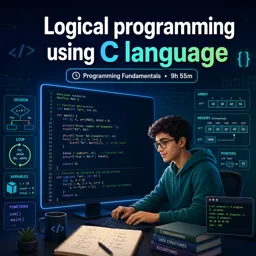
Free Course Image Logical programming using C language

Free online courseLogical programming using C language

Duration of the online course: 9 hours and 55 minutes

4.67

StarStarStarStarHalf star

(3)

Learn C programming with this free online course! Covers basics to advanced topics like variables, loops, arrays, pointers, and more in 30 comprehensive lessons. Perfect for beginners!

In this free course, learn about

  • Introduction and Basics of C Programming
  • Control Flow in C
  • Functions, Scope, and Recursion
  • Arrays, Strings, and Memory
  • Pointers, Structs, and Enums
  • Advanced C Concepts and File Handling

Course Description

Welcome to the course "Logical Programming using C Language," an essential offering in the realm of Information Technology, specifically crafted for those intrigued by Programming Logic. With a comprehensive duration of 9 hours and 55 minutes, this course promises to provide a thorough grounding in C programming, ideal for beginners and those looking to refine their coding skills. Garnering a commendable average rating of 5 stars, it stands as a testament to the value and quality of the instruction provided.

Coding is often seen as a complex challenge, but this course breaks it down into digestible modules that progressively build your understanding and skills in C programming. You will embark on a journey starting with the very fundamentals of C programming, gradually advancing to more sophisticated concepts, ensuring a solid foundation and thorough comprehension of each topic.

The course begins with an introduction to C programming, establishing a foundational understanding essential for any aspiring coder. You will learn how to manage C variables and print output, ensuring you can bring your programs to life with effective communication between code and user. As you move forward, the course delves into data types and how to handle user input, setting the stage for more complex operations.

Understanding how to include comments in your code is crucial for both personal clarity and collaborative projects. This course emphasizes the importance of clear documentation before moving on to essential mathematical and logical operations with C operators. Type conversion is another pivotal concept you'll master, enabling smooth transitions between data types through implicit and explicit conversions.

The logical structure of programming is brought to light with lessons on Boolean and comparison operators, if else statements, and the ternary operator. Control structures like switch statements and loops (while and for loops) are given ample attention, teaching you how to create efficient, repeatable code blocks.

Concepts such as breaking out of loops and continuing with the next iteration are neatly covered to enhance your control over the flow of your programs. Function creation and utilization is another cornerstone of this course, including variable scope and standard library functions, further enriching your coding toolkit.

Recursion and arrays, both single-dimensional and multi-dimensional, open up opportunities for handling complex data structures, while string manipulation and string functions will help you manage and modify text data effectively. Mastery of pointers and their relationships to arrays and functions will deepen your understanding of memory management in C.

Complex data types are introduced with structures ("struct") and enumerations ("enums"), adding to your ability to organize and manage data within your programs. Dynamic memory allocation and file handling are critical skills for advanced projects, ensuring you can deal with memory efficiently and handle persistent data storage.

Lastly, the course covers preprocessor directives and macros, equipping you with the tools to write more flexible and reusable code. By the end of this course, you will have traveled a comprehensive path from C fundamentals to a robust comprehension of advanced concepts, fully prepared to tackle real-world programming challenges.

Join "Logical Programming using C Language" to cultivate your programming logic and open doors to new possibilities in the ever-evolving tech landscape.

Course content

  • Video class: #1: Getting Started with C Programming | C Programming for Beginners 06m
  • Exercise: What is a key reason to learn C programming?
  • Video class: #2: C Variables and Print Output | C Programming for Beginners 09m
  • Exercise: What is a key rule in naming variables in C programming?
  • Video class: #3: Data Types in C Programming | C Programming for Beginners 10m
  • Exercise: What is a key difference between float and double in C programming?
  • Video class: #4: Get User Input in C Programming 07m
  • Exercise: What function is used to take user input in C programming?
  • Video class: #5: Comments in C Programing | C Programming for Beginners 07m
  • Exercise: _What are comments in C programming and why are they important?
  • Video class: #6: C Operators | C Programming for Beginners 11m
  • Exercise: What is the result of the given arithmetic expression?
  • Video class: #7: Type Conversion in C | Implicit and Explicit Type Conversion 09m
  • Exercise: _What is the output of the following code?
  • Video class: #8: Boolean and Comparison Operators in C Programming 14m
  • Exercise: Which C code evaluates to false?
  • Video class: #9: If Else Statements in C | C Programming for Beginners 12m
  • Exercise: _What is the syntax of the if statement in C programming?
  • Video class: #10: Ternary Operator in C | C Programming for Beginners 06m
  • Exercise: What is the purpose of the ternary operator in C programming?
  • Video class: #11: Switch Statement in C | C Programming for Beginners 11m
  • Exercise: _What is the purpose of using a switch statement in C programming?
  • Video class: #12: while Loop in C Programming | C Programming for Beginners 12m
  • Exercise: Which condition causes an infinite loop in a C program?
  • Video class: #13: for Loop in C Programming | C Programming for Beginners 10m
  • Video class: #14 : break and continue in C | C Programming for Beginners 10m
  • Exercise: Which keyword is used to skip the current iteration of a loop in C programming?
  • Video class: #15 C Functions | C Programming for Beginners 17m
  • Exercise: _What is the purpose of creating functions in C programming?
  • Video class: #16 C Variable Scope | C Programming For Beginners 04m
  • Exercise: What is a key difference between local and global variables in C programming?
  • Video class: #17 C Standard Library Functions | C Programming For Beginners 10m
  • Exercise: _Which of the following is a correct statement about standard library functions in C programming?
  • Video class: #18 C Recursion | C Programming For Beginners 05m
  • Exercise: What is the purpose of using IF-ELSE statements in recursive functions?
  • Video class: #19 C Arrays | C Programming For Beginners 13m
  • Exercise: _What is an array in C programming?
  • Video class: #20 C Multidimensional Arrays | C Programming For Beginners 10m
  • Exercise: What is the output of arr[1][2] in the given multi-dimensional array?
  • Video class: #21 C Strings | C Programming For Beginners 10m
  • Exercise: _What is a string in C programming?
  • Video class: #22 C String Functions | C Programming For Beginners 09m
  • Video class: #23 C Pointers | C Programming For Beginners 11m
  • Exercise: _What is the purpose of the ampersand symbol in C programming?
  • Video class: #24 C Pointers and Arrays | C Programming For Beginners 09m
  • Video class: #25 C Pointers and Functions | C Programming For Beginners 10m
  • Exercise: _What is the purpose of the "find value" function in the given code?
  • Video class: #26 C Struct | C Programming for Beginners 13m
  • Video class: #27: Enumerations(enums) in C | C Programming for Beginners 08m
  • Exercise: _What is an enum in C programming?
  • Video class: #28: Dynamic Memory Allocation in C | C Programming for Beginners 12m
  • Video class: #29: C File Handling | C Programming for Beginners 11m
  • Exercise: _What are the three steps involved while working with files in C programming?
  • Video class: #30: Preprocesor and Macros | C Programming for Beginners 09m
  • Video class: C Programming Full Course for Beginners - Learn C in 2022 4h45m
  • Exercise: _What is the purpose of learning C programming language?

This free course includes:

9 hours and 55 minutes of online video course

Digital certificate of course completion (Free)

Exercises to train your knowledge

100% free, from content to certificate

Ready to get started?Download the app and get started today.

Install the app now

to access the course
Icon representing technology and business courses

Over 5,000 free courses

Programming, English, Digital Marketing and much more! Learn whatever you want, for free.

Calendar icon with target representing study planning

Study plan with AI

Our app's Artificial Intelligence can create a study schedule for the course you choose.

Professional icon representing career and business

From zero to professional success

Improve your resume with our free Certificate and then use our Artificial Intelligence to find your dream job.

You can also use the QR Code or the links below.

QR Code - Download Cursa - Online Courses

Course comments: Logical programming using C language

Anant Rathore

error

Anant Rathore

//

Anant Rathore

scanf("%lf",

More free courses at Programming logic

Download the App now to have access to + 3300 free courses, exercises, certificates and lots of content without paying anything!

  • 100% free online courses from start to finish

    Thousands of online courses in video, ebooks and audiobooks.

  • More than 48 thousand free exercises

    To test your knowledge during online courses

  • Valid free Digital Certificate with QR Code

    Generated directly from your cell phone's photo gallery and sent to your email

Cursa app on the ebook screen, the video course screen and the course exercises screen, plus the course completion certificate

+ 9 million
students

Free and Valid
Certificate

60 thousand free
exercises

4.8/5 rating in
app stores

Free courses in
video and ebooks