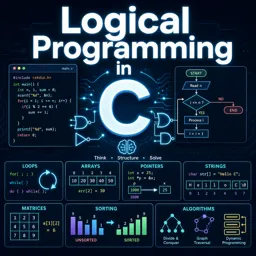

A free ebook on programming logic, algorithms, control flow, correctness, edge cases, and complexity for aspiring programmers.
Free ebook content
-

Thinking Like a Programmer: From Real-World Tasks to Precise Procedures
+ Exercise: Which rewrite best applies programming logic to turn a vague goal into a checkable task?
-
Problem Decomposition and Subproblems in Programming Logic
+ Exercise: Which decomposition choice best reduces coupling and improves testability when building a receipt calculator (subtotal, tax, tip, total)?
-
Inputs, Outputs, and Constraints: Specifying the Problem Precisely
+ Exercise: In a “two-sum” style problem (determine whether any two distinct elements sum to a target), which approach best fits when n can be as large as 200,000 with a strict time limit and moderate memory?
-
Algorithms vs. Programs: Expressing Solutions Without a Language
+ Exercise: When turning an algorithm into a program, which aspect must become concrete because the code runs on a specific system with constraints like memory, permissions, and device inputs?


-
Control Flow Foundations: Sequence, Selection, and Repetition
+ Exercise: In the checkout procedure, which statement correctly describes how discount and shipping are determined before computing tax and total?
-
Determinism, State, and Tracing: Predicting What an Algorithm Will Do
+ Exercise: When tracing an algorithm by hand, which situation most clearly indicates that the procedure is not deterministic and needs clarification or added inputs?
-
Correctness Reasoning: Preconditions, Postconditions, and Invariants
+ Exercise: In a loop-based correctness proof, what must you show to conclude that the algorithm’s result satisfies the postcondition when the loop stops?
-
Edge Cases and Robust Logic: Handling the Unusual but Valid Inputs
+ Exercise: When revising an algorithm to be robust against edge cases, what is the best way to handle an allowed empty input that would otherwise cause a failure (like indexing into the first element or dividing by zero)?
-
Complexity Intuition: Comparing Approaches by Work and Resources
+ Exercise: You must answer q membership queries (“Is X in the list?”) on a list of n IDs. Which strategy scales best as q becomes very large, and why?
About the free ebook
Programming Logic Foundations: Thinking Like a Programmer
Build the reasoning habits behind clear, reliable software with this free ebook on programming fundamentals. Instead of focusing on the syntax of one language, it develops the logical thinking used to turn real-world needs into precise, testable procedures.
Move from ideas to algorithms
Learn to define a problem through its inputs, outputs, and constraints, then divide complex tasks into manageable subproblems. The ebook explains how algorithms differ from programs and how to express a solution before choosing a programming language.
Understand how procedures behave
Explore the core control-flow patterns behind most programs: sequence, selection, and repetition. You will also practice tracing state step by step to predict results, identify mistakes, and understand why deterministic procedures produce consistent outcomes for the same input.
Design logic you can trust
Strong solutions must work beyond the obvious examples. This ebook introduces preconditions, postconditions, invariants, edge cases, and robust handling of valid but unusual inputs. These concepts help you reason about whether a procedure meets its specification.
Compare and improve solutions
Develop practical intuition for computational complexity by comparing approaches according to the work and resources they require. A final logic workshop brings the concepts together, guiding you from a written specification to a verified procedure.
What you will gain
- A structured method for analyzing programming problems
- Confidence with algorithmic control flow and state tracing
- Tools for checking correctness and anticipating edge cases
- A language-independent foundation for future coding study
What is the difference between an algorithm and a program?
An algorithm is a language-independent procedure for solving a problem; a program is that procedure implemented in code.
How do preconditions and postconditions help verify an algorithm?
Preconditions state what must be true before execution, while postconditions define the result that must be true afterward.
Why are edge cases important in programming logic?
Edge cases expose assumptions in a solution and help ensure it handles unusual but valid inputs correctly.
This ebook includes:

10 content chapters

Digital certificate of course completion (Free)

Exercises to train your knowledge

100% free, from content to certificate
Ready to get started?

 recommended
In the app you will also find...

Over 5,000 free courses
Programming, English, Digital Marketing and much more! Learn whatever you want, for free.

Study plan with AI
Our app's Artificial Intelligence can create a study schedule for the course you choose.

From zero to professional success
Improve your resume with our free Certificate and then use our Artificial Intelligence to find your dream job.
You can also use the QR Code or the links below.