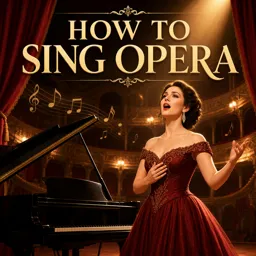
A free ebook introducing opera singing basics, including breath support, resonance, diction, legato, safe practice, and beginner repertoire.
Free ebook content
-

Opera Singing Foundations: What Makes the Style Distinct (Without Forcing Volume)
+ Exercise: A beginner wants to “sound more operatic” but notices their tone gets unstable and tight when they take a huge breath and push. Which adjustment best matches the foundational approach described?
-
Opera Singing Posture and Alignment for Free Sound
+ Exercise: Which approach best supports “free sound” in beginning opera singing?
-
Opera Singing Breath: Appoggio-Inspired Support Without Strain
+ Exercise: Which approach best describes appoggio-inspired breath support when starting a sung tone?
-
Opera Singing Tone Ideals: Resonance, Ring, and Warmth
+ Exercise: Which approach best helps create opera-style resonance and ring without forcing the throat?


-
Opera Singing Vowels: Classical Shapes in English as a Starting Point
+ Exercise: When sustaining an English diphthong vowel in a classical style (such as in “day,” “go,” or “my”), what is the recommended approach?
-
Opera Singing Consonants and Diction: Clear Text Without Chopping the Line
+ Exercise: When singing a legato operatic phrase, which approach best keeps the text clear without chopping the musical line?
-
Opera Singing Legato: Building the Continuous Line
+ Exercise: Which approach best builds operatic legato when practicing a slurred scale?
-
Opera Singing Onsets and Releases: Clean Beginnings, Easy Endings
+ Exercise: A singer hears a brief click at the start of a vowel after an easy “mm” hum. According to the drills, what adjustment best helps create a cleaner, more coordinated onset?
-
Opera Singing Dynamics: Pianissimo to Forte Without Pushing
+ Exercise: When practicing a beginner crescendo from mezzo-piano to mezzo-forte, which approach best increases loudness without “pushing”?
-
Opera Singing Vibrato: Understanding Natural Oscillation and Stability
+ Exercise: Which approach best supports healthy operatic vibrato for a beginner?
-
Opera Language Basics: Italian, Latin, and Intro-Level Lyric Pronunciation
+ Exercise: When practicing clean syllable timing in Italian or Latin singing, what should carry the note value so the rhythm stays intact?
-
Opera Singing Style Expectations: Ornamentation, Portamento, and Tasteful Expression
+ Exercise: A beginner wants to make a phrase sound more operatic while staying tasteful. Which approach best matches the recommended style practice?
-
Opera Singing Repertoire Entry Points: Choosing Beginner-Safe Arias and Art Songs
+ Exercise: A beginner singer can reach the highest note of a piece, but their throat tightens after 30–60 seconds when humming the melody gently on “oo.” What is the best conclusion?
-
Opera Singing Practice Safety: Recognizing Strain and Protecting the Voice
+ Exercise: During a beginner opera practice session, you feel throat burning and the voice starts to sound hoarse. What is the safest immediate response?
-
Opera Singing Performance Skills: Presence, Listening, and Musical Collaboration
+ Exercise: When preparing an entrance with accompaniment, what approach best supports accurate timing and healthy coordination?
About the free ebook
Opera Singing for Beginners: A Gentle Introduction to the Style
This free ebook introduces the foundations of classical and operatic singing with a calm, healthy approach. It focuses on building coordination rather than forcing loudness, helping new singers explore a fuller, freer sound while respecting the natural limits of the voice.
Develop a supported, expressive classical sound
Learn how posture, alignment, breath management, vowel clarity, resonance, and legato work together. The lessons explain appoggio-inspired support in practical terms and encourage an easy, balanced connection between breath and tone.
You will explore the qualities often associated with operatic singing: warmth, carrying resonance, clean onsets, flexible dynamics, natural vibrato, and clear diction. Guidance on Italian, Latin, and introductory lyric pronunciation helps make unfamiliar texts more approachable without losing musical flow.
Build technique without strain
Classical singing is not about imitating a huge voice. It is about developing efficient coordination over time. This ebook highlights signs of tension, useful practice habits, and ways to approach higher or louder passages without pushing.
- Encourage a released jaw, neck, and shoulders
- Connect vowels smoothly through a musical phrase
- Use consonants clearly without interrupting legato
- Explore dynamics while maintaining steady support
- Choose early repertoire that suits your present range and skill
Bring musicality to every phrase
Beyond vocal mechanics, opera singing requires listening, language awareness, imagination, and collaboration. Discover beginner-friendly ways to use portamento, ornamentation, expression, and stage presence with good taste. The ebook also offers practical direction for selecting accessible arias and art songs and preparing them safely.
A supportive first step into classical voice
Whether you sing at home, in a choir, or with a teacher, this ebook provides a clear starting point for understanding the operatic style. Work patiently, rest when needed, and seek guidance from a qualified voice professional for individual technical or health concerns.
How can I create an operatic sound without singing too loudly?
Prioritize balanced breath support, open vowels, and resonance rather than pushing extra air or volume.
What does appoggio mean in beginner opera singing?
Appoggio is a coordinated feeling of breath support and controlled release that helps the tone remain steady and free.
Which songs are appropriate for a beginning opera singer?
Start with teacher-approved art songs, simple Italian pieces, or short arias that fit your comfortable range and current technique.
This ebook includes:

15 content chapters

Digital certificate of course completion (Free)

Exercises to train your knowledge

100% free, from content to certificate
Ready to get started?

 recommended
In the app you will also find...

Over 5,000 free courses
Programming, English, Digital Marketing and much more! Learn whatever you want, for free.

Study plan with AI
Our app's Artificial Intelligence can create a study schedule for the course you choose.

From zero to professional success
Improve your resume with our free Certificate and then use our Artificial Intelligence to find your dream job.
You can also use the QR Code or the links below.