

Free ebook on logical reasoning: identify premises and conclusions, uncover assumptions, map arguments, and evaluate support.
Free ebook content
-

Logical Reasoning Foundations: What an Argument Is (and Isn’t)
+ Exercise: Which passage is best labeled as an argument (rather than an explanation, description, or mere disagreement) because it offers reasons to support a conclusion?
-
Logical Reasoning Foundations: Claims, Reasons, Premises, and Conclusions
+ Exercise: In an argument, what is the relationship between premises and a conclusion?
-
Logical Reasoning Foundations: Indicator Words and Argument Signals
+ Exercise: When you see a potential indicator word like "so" or "since" in a sentence, what should you do to decide whether it actually signals an argument?
-
Logical Reasoning Foundations: Finding the Main Conclusion in Messy Writing
+ Exercise: In a messy argument, which claim is most likely the main conclusion rather than a subsidiary conclusion or background detail?


-
Logical Reasoning Foundations: Hidden Assumptions and Missing Premises
+ Exercise: When proposing a missing premise for an enthymeme, which candidate best follows the recommended three-test method?
-
Logical Reasoning Foundations: Clarifying Language and Avoiding Misreadings
+ Exercise: An argument says: “The training program was successful because participants reported higher confidence afterward.” What is the best evaluation of this support?
-
Logical Reasoning Foundations: Argument Mapping with Boxes and Arrows
+ Exercise: When mapping an argument, when should two premises be marked as linked (co-premises) rather than convergent?
-
Logical Reasoning Foundations: Does the Conclusion Follow from the Support?
+ Exercise: When an argument’s conclusion uses words like “must,” “cannot,” or claims about “all/none,” which check is most appropriate to evaluate whether the conclusion truly follows from the premises?
-
Logical Reasoning Foundations: Common Support Problems in Real-World Arguments
+ Exercise: A manager argues: “We can’t adopt the new tool unless you can guarantee it won’t cause any delays. But we should keep the current tool because there’s no evidence it’s causing delays.” What support problem best describes the weak step?
-
Logical Reasoning Foundations: Building and Revising Better Arguments
+ Exercise: When revising an argument, which change best improves the conclusion by making it precise and easier to support?
About the free ebook
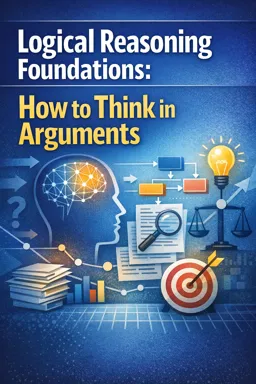
Logical Reasoning Foundations: How to Think in Arguments
This free ebook develops the practical skills needed to read, assess, and construct arguments with clarity. Learn to distinguish an argument from explanation, description, or persuasion, then identify the claims and reasons that make up everyday reasoning.
Read arguments more accurately
Clear thinking starts with seeing an argument’s structure. The ebook explains how to spot premises and conclusions, use indicator words carefully, and locate the main conclusion even when writing is disorganized or indirect.
- Separate claims, evidence, reasons, and conclusions.
- Recognize common conclusion and premise signals.
- Identify unstated assumptions and missing premises.
- Clarify ambiguous language before evaluating a claim.
Test whether support is strong
Not every set of reasons supports its conclusion. Explore how argument maps use boxes and arrows to make relationships visible, helping you decide whether a conclusion actually follows from the support offered.
Apply logical reasoning in real situations
Practice diagnosing weak support in real-world arguments, including irrelevant reasons, unsupported leaps, and unclear terms. You will also learn how to revise your own arguments so that each premise has a clear role and the conclusion is appropriately supported.
| Skill | Purpose |
|---|---|
| Argument mapping | Make reasoning structure visible |
| Assumption checking | Find gaps between premises and conclusions |
| Argument revision | Improve clarity and support |
Logical Reasoning Foundations is a useful resource for students who want to analyze written arguments, avoid misreadings, and present their ideas more convincingly.
How can I identify the conclusion of an argument?
Look for the claim the writer is trying to establish and ask which statement the other reasons are meant to support.
What is the difference between a premise and an assumption?
A premise is stated as support, while an assumption is an unstated idea needed for the reasoning to work.
How does argument mapping help evaluate reasoning?
It visually connects premises to conclusions, making missing links, irrelevant reasons, and unsupported conclusions easier to detect.
This ebook includes:

10 content chapters

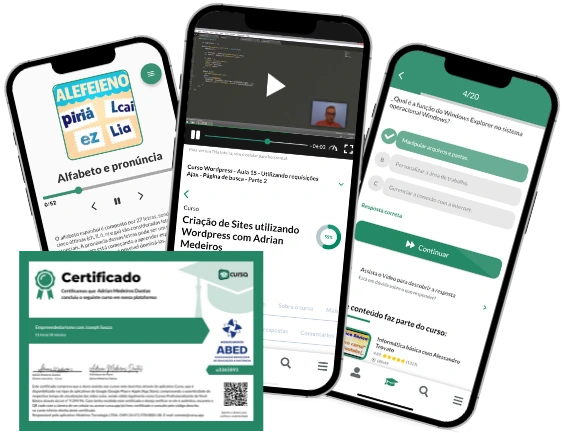
Digital certificate of course completion (Free)

Exercises to train your knowledge

100% free, from content to certificate
Ready to get started?

 recommended
In the app you will also find...

Over 5,000 free courses
Programming, English, Digital Marketing and much more! Learn whatever you want, for free.

Study plan with AI
Our app's Artificial Intelligence can create a study schedule for the course you choose.

From zero to professional success
Improve your resume with our free Certificate and then use our Artificial Intelligence to find your dream job.
You can also use the QR Code or the links below.