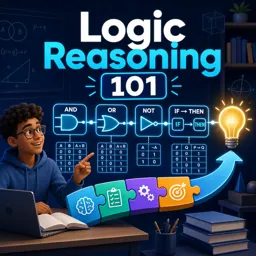
Free Course Image Logic Reasoning 101

Free online courseLogic Reasoning 101

Duration of the online course: 4 hours and 48 minutes

New

Build sharp logic skills with a free online course: master conditionals, truth tables, and clear reasoning for school, work, and tests—plus practice.

In this free course, learn about

  • Why formal logic matters and how it benefits many professions
  • Identify simple sentences (atomic propositions) within everyday statements
  • Represent propositions with letters and build symbolic logical expressions
  • Use negation (NOT) correctly, including double negation
  • Understand inclusive OR (disjunction) and avoid ambiguity with grouping/parentheses
  • Use AND (conjunction) to form compound statements and evaluate their truth
  • Work with conditionals (IF–THEN), material implication, and vacuous truth
  • Use biconditionals (IFF) to express “exactly when” relationships
  • Construct and interpret truth tables to evaluate compound statements
  • Solve truth table practice problems with mixed operators and precedence
  • Understand exclusive OR (XOR) and express it using basic connectives
  • Apply contraposition to rewrite conditionals into equivalent forms
  • Apply DeMorgan’s Laws to simplify negations of conjunctions/disjunctions
  • Recognize why full truth tables can be inefficient for complex expressions

Course Description

Logical reasoning is a practical skill that improves how you think, argue, and solve problems. This free online course helps you turn everyday statements into clear, testable forms so you can spot errors, avoid ambiguity, and make decisions with confidence. Whether you are strengthening school foundations, preparing for exams, or aiming to communicate more precisely at work, you will learn to analyze ideas the way mathematicians, programmers, scientists, and strong critical thinkers do.

You will start by learning how to recognize simple statements and represent them in a compact way, which makes complex arguments easier to handle. From there, you will build powerful tools step by step: negation, disjunction and conjunction, and the core relationships behind if-then reasoning and if and only if statements. Along the way you will see how small wording differences change meaning, why certain expressions can become ambiguous, and how symbolic notation helps keep your thinking consistent and precise.

A major focus is understanding truth conditions. You will use truth tables to evaluate whether statements hold under different scenarios, practice analyzing combinations, and develop intuition for patterns that repeatedly appear in logical problems. You will also learn why some implications are considered true even when their starting condition is false, a concept that often surprises beginners but becomes clear once you work with the formal definitions.

As you progress, you will learn efficient transformations that let you simplify and reframe expressions without recalculating everything. You will work with exclusive or, double negation, material implication, contraposition, and DeMorgan’s laws, all of which help you rewrite statements into equivalent forms that are easier to check and use. By the end, you will be able to translate complicated sentences into logic, verify reasoning reliably, and apply these skills to school subjects, structured writing, and analytical tasks in many professions.

Course content

  • Video class: Logic 101 (#1): Introduction

    08m

  • Exercise: Why is learning logic beneficial across various professions?

  • Video class: Logic 101 (#2): Overview

    06m

  • Exercise: What is the focus of Topic 1 in the Logic 101 course?

  • Video class: Logic 101 (#3): Finding Simple Sentences

    07m

  • Exercise: How many simple sentences are in this statement?

  • Video class: Logic 101 (#4): Representing Simple Sentences

    04m

  • Exercise: Why use single letters to represent simple sentences in logic?

  • Video class: Logic 101 (#5): Negation

    05m

  • Exercise: What is the primary function of the negation operation in logic?

  • Video class: Logic 101 (#6): OR/Disjunction

    05m

  • Exercise: What does the inclusive 'or' represent in logic?

  • Video class: Logic 101 (#7) Compound Sentences

    05m

  • Exercise: What can cause ambiguity in logical expressions involving disjunctions?

  • Video class: Logic 101 (#8): AND/Conjunction

    05m

  • Exercise: How does the 'and' conjunction function in logic?

  • Video class: Logic 101 (#9): Conditional (If-Then) Statements

    08m

  • Exercise: Understanding the Conditional Logic Operator

  • Video class: Logic 101 (#10): Biconditional (IF AND ONLY IF)

    04m

  • Exercise: What is the function of the biconditional logical operator?

  • Video class: Logic 101 (#11): Truth Tables

    05m

  • Exercise: Why are truth tables useful in logic?

  • Video class: Logic 101 (#12): Truth Table Practice

    04m

  • Exercise: What is the correct fifth column value for 'not P or P and Q' given P true and Q false?

  • Video class: Logic 101 (#13): Why Are "Vacuously True" Statements True?

    08m

  • Exercise: What is the truth value of the implication "If P then Q" when the antecedent P is false?

  • Video class: Logic 101 (#14): Exclusive OR

    05m

  • Exercise: What does the expression 'P or Q and not P and Q' represent?

  • Video class: Logic 101 (#15): Complicated Truth Tables

    09m

  • Exercise: Why is calculating truth tables considered inefficient?

  • Video class: Logic 101 (#16): Double Negation

    04m

  • Exercise: What is Double Negation in Logic?

  • Video class: Logic 101 (#17): Material Implication

    05m

  • Exercise: What is material implication in logic?

  • Video class: Logic 101 (#18): Contraposition

    05m

  • Exercise: What is the rule of contraposition in logic?

  • Video class: Logic 101 (#19): DeMorgan's Law, Part 1

    06m

  • Exercise: What is the simplified form of '(not P or not Q) using de Morgan's law?

  • Video class: Logic 101 (#20): DeMorgan's Law, Part 2

    04m

  • Exercise: What is the simplified form of 'not not P and not Q' according to de Morgan's Rule?

This free course includes:

4 hours and 48 minutes of online video course

Digital certificate of course completion (Free)

Exercises to train your knowledge

100% free, from content to certificate

Ready to get started?Download the app and get started today.

Install the app now

to access the course
Icon representing technology and business courses

Over 5,000 free courses

Programming, English, Digital Marketing and much more! Learn whatever you want, for free.

Calendar icon with target representing study planning

Study plan with AI

Our app's Artificial Intelligence can create a study schedule for the course you choose.

Professional icon representing career and business

From zero to professional success

Improve your resume with our free Certificate and then use our Artificial Intelligence to find your dream job.

You can also use the QR Code or the links below.

QR Code - Download Cursa - Online Courses

Course comments: Logic Reasoning 101

MN

muhammad nadeem khan

StarStarStarStar

good

MN

muhammad nadeem khan

StarStarStarStar

it is great and skillful

More free courses at Logical Reasoning

Free Ebook + Audiobooks! Learn by listening or reading!

Free Ebook cover Logical Reasoning Foundations: How to Think in Arguments

New

Download the App now to have access to + 5000 free courses, exercises, certificates and lots of content without paying anything!

  • 100% free online courses from start to finish

    Thousands of online courses in video, ebooks and audiobooks.

  • More than 60 thousand free exercises

    To test your knowledge during online courses

  • Valid free Digital Certificate with QR Code

    Generated directly from your cell phone's photo gallery and sent to your email

Cursa app on the ebook screen, the video course screen and the course exercises screen, plus the course completion certificate