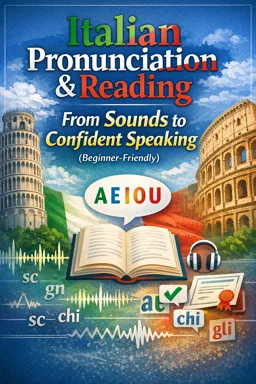

Free ebook on Italian pronunciation and reading, covering vowels, stress, double consonants, key spelling patterns, and natural rhythm.
Free ebook content
-

Italian Pronunciation Foundations: How Italian Spelling Matches Sound
+ Exercise: When you hesitate on a longer Italian word like "telefono", what is the recommended way to practice it?
-
Italian Vowels: Pure Sounds in Every Word
+ Exercise: Quale pratica aiuta a verificare che una vocale italiana resti “pura” e non scivoli verso un secondo suono?
-
Reading Syllables Smoothly: Connecting Sounds Without Strain
+ Exercise: Quando leggi una frase in italiano per migliorare la fluidità, quale strategia è consigliata per collegare le parole senza “mangiare” i suoni?
-
Double Consonants: The Key to Clear Meaning (Fatto vs Fato)
+ Exercise: Qual è l’idea chiave per pronunciare correttamente una consonante doppia in italiano (es. fatto vs fato)?
-
Stress and Accent: Where the Voice Naturally Lands
+ Exercise: In Italian pronunciation practice, what is the main purpose of using one clear stressed syllable (the “stronger beat”) in each word?
-
Rhythm and Melody: Sounding Natural in Short Sentences
+ Exercise: Quando leggi una domanda sì/no in italiano (es. “Sei pronto?”), quale indicazione è coerente con il ritmo e l’intonazione descritti?


-
C + I/E vs C + H + I/E: ci/ce and chi/che Made Easy
+ Exercise: While reading Italian, which spelling cue tells you to pronounce C as a hard /k/ sound before I or E?
-
G + I/E vs G + H + I/E: gi/ge and ghi/ghe for Accurate Reading
+ Exercise: When reading Italian words with G before I or E, what does the letter H indicate in sequences like ghi/ghe?
-
GLI and GN: Two Signature Italian Sounds
+ Exercise: When pronouncing Italian “gn” (as in “bagno”), what is the key technique to avoid a common learner mistake?
-
SC, SCI/SCE, and SCHI/SCHE: Crisp or Soft?
+ Exercise: When you see “schi” or “sche” in an Italian word, how should the “sc” sound be pronounced?
-
Common Letter Combinations in Real Words: A Practical Reading Workout
+ Exercise: During the timed re-read task, what should you do if increasing speed makes you blur double consonants or letter combinations?
-
Pronunciation in Conversation: Short Dialogues You Can Read and Say Confidently
+ Exercise: When practicing a mini-dialogue, which sequence best matches the recommended 3-pass method to improve pronunciation and rhythm?
About the free ebook
Italian Pronunciation & Reading: From Sounds to Confident Speaking
This free ebook helps you build a reliable foundation for reading Italian aloud and speaking with clearer, more natural pronunciation. Italian spelling is highly consistent, and learning the sound patterns lets you approach new words with confidence.
Build accurate sounds from the start
Learn how Italian vowels keep their pure sound, how syllables connect smoothly, and why stress gives words their natural shape. Clear explanations and practical examples help you turn written Italian into speech without relying on guesswork.
Understand the spelling patterns that matter
- Distinguish single and double consonants, including meaning-changing pairs such as fato and fatto.
- Read ce/ci, che/chi, ge/gi, and ghe/ghi accurately.
- Practice signature sounds such as gli, gn, and the different forms of sc.
- Develop Italian rhythm and melody in short, useful sentences.
Move from individual words to conversation
Progress from core sound rules to realistic word combinations and short dialogues. Each section supports steady reading practice, helping you notice the difference between spelling, syllable flow, emphasis, and natural sentence rhythm.
Who this ebook is for
It is designed for learners who want a practical way to decode Italian spelling, improve pronunciation, and read everyday Italian with greater ease. Use it as a focused reference while studying vocabulary, listening to Italian, or preparing to speak.
How do double consonants change Italian pronunciation?
Double consonants are held longer and can change meaning, as in fato and fatto.
What is the difference between ci/ce and chi/che in Italian?
Ci and ce usually have a soft sound; chi and che preserve a hard k sound.
How is gli pronounced in Italian?
Gli is a distinctive palatal sound, often practiced with words such as famiglia.
This ebook includes:

12 content chapters

Digital certificate of course completion (Free)

Exercises to train your knowledge

100% free, from content to certificate
Ready to get started?

 recommended
In the app you will also find...

Over 5,000 free courses
Programming, English, Digital Marketing and much more! Learn whatever you want, for free.

Study plan with AI
Our app's Artificial Intelligence can create a study schedule for the course you choose.

From zero to professional success
Improve your resume with our free Certificate and then use our Artificial Intelligence to find your dream job.
You can also use the QR Code or the links below.