

Free ebook for nursing students covering dosage calculations, unit conversions, oral and injectable doses, weight-based dosing, IV rates, and safety checks.
Free ebook content
-

Dosage Calculation Foundations for Nurses: Units, Labels, and Orders
+ Exercise: A provider order reads: “Heparin infusion 18 units/kg/hr.” Before doing any calculations, what is the most appropriate calculation target and likely final unit?
-
Medication Math Essentials: Fractions, Decimals, Ratios, and Safe Rounding
+ Exercise: An epinephrine solution is labeled 1:10,000. After converting this ratio to mg/mL, what volume (mL) delivers a 0.25 mg dose? Round to the nearest tenth for an oral syringe.
-
Nursing Unit Conversions for Dosage Calculation: Metric, Household, and Apical Conversions
+ Exercise: A medication order is 75 mcg and the supply concentration is 1 mg/mL. After converting units and calculating the volume, what is the dose in mL and what safety issue should it trigger?


-
Oral and Liquid Medication Dosage Calculation: Tablets, Capsules, and Solutions
+ Exercise: A nurse must administer acetaminophen 300 mg PO. The oral suspension available is labeled 160 mg per 5 mL. After calculating 9.375 mL, which measurable volume is most appropriate to administer using an oral syringe?
-
Injectable Medication Calculation for Nurses: Vials, Ampules, and Reconstitution
+ Exercise: A provider orders 150 mg IM of a medication supplied as 75 mg/mL. What volume should you withdraw, and what plausibility check should you perform before injecting?
-
Weight-Based Dosage Calculation: mg/kg, mcg/kg/min, and Patient-Specific Dosing
+ Exercise: A prescription is written as 45 mg/kg/day PO divided q12h for a 20 kg patient. Which statement best describes how to calculate the amount to give per dose?
-
IV Flow Rate Dosage Calculation: gtt/min, mL/hr, and Tubing Drop Factors
+ Exercise: A gravity infusion is ordered to run at 90 mL/hr using tubing with a drop factor of 15 gtt/mL. What drip rate should you regulate (gtt/min), rounded to the nearest whole drop?
-
Infusion Basics for Nurses: Concentrations, Dilutions, and Titrated Drips
+ Exercise: A heparin infusion bag is labeled 25,000 units in 250 mL. The order is to infuse 1,200 units/hr. What pump rate should be set in mL/hr?
-
Dosage Calculation Safety Checks for Nurses: Preventing Errors and Ensuring Clarity
+ Exercise: A medication order reads: “Morphine 2 IV now.” What is the safest next step before completing the dose calculation?
About the free ebook
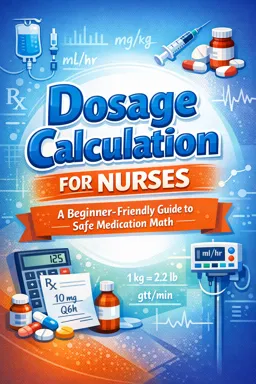
Dosage Calculation for Nurses: A Beginner-Friendly Guide to Safe Medication Math
This free ebook introduces the practical medication-math skills nurses use to interpret orders, read labels, calculate doses, and communicate results clearly. It focuses on building a reliable method rather than memorizing isolated formulas.
Build confidence with core calculation skills
Learn how units, medication labels, fractions, decimals, ratios, and rounding affect dosage decisions. The guide explains common nursing conversions across metric and household measures and shows how dimensional thinking can help keep calculations organized.
Apply math to common medication routes
Work through the principles behind oral liquids, tablets, capsules, injectable medications, reconstitution, and patient-specific weight-based dosing. Explore how ordered doses, available concentrations, and final volumes connect in a calculation.
Understand IV and infusion calculations
Review IV flow rates in mL/hr and gtt/min, tubing drop factors, concentrations, dilutions, and titrated drips. These sections emphasize checking that units match before calculating and documenting results according to clinical policy.
Keep safety at the center
Medication calculations require more than correct arithmetic. This ebook highlights essential safety habits:
- Confirm the medication order, patient factors, and available product label.
- Track units at every step and convert before combining values.
- Use appropriate rounding rules and verify whether a result is clinically reasonable.
- Perform independent checks and follow local policies for high-alert medications.
- Clarify incomplete, unclear, or unusual orders before administration.
Important note
This educational resource supports foundational learning and practice. It does not replace supervision, drug references, institutional procedures, professional judgment, or required double-check processes.
How do nurses calculate a tablet dose from an available strength?
Divide the ordered dose by the dose available per tablet, then verify units, rounding rules, and label instructions.
What is the difference between mL/hr and gtt/min in IV calculations?
mL/hr is pump-based volume delivery; gtt/min is a gravity-flow calculation that uses the tubing drop factor.
How is a weight-based medication dose calculated in mg/kg?
Multiply the prescribed mg/kg dose by the patient's weight in kilograms, then check maximum-dose limits and the medication concentration.
This ebook includes:

9 content chapters

Digital certificate of course completion (Free)

Exercises to train your knowledge

100% free, from content to certificate
Ready to get started?

 recommended
In the app you will also find...

Over 5,000 free courses
Programming, English, Digital Marketing and much more! Learn whatever you want, for free.

Study plan with AI
Our app's Artificial Intelligence can create a study schedule for the course you choose.

From zero to professional success
Improve your resume with our free Certificate and then use our Artificial Intelligence to find your dream job.
You can also use the QR Code or the links below.