
Divide the weight in pounds by 2.2. For example, 154 lb ÷ 2.2 = 70 kg.

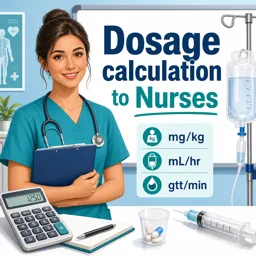
Duration of the online course: 47 minutes
4.9

(8)
Build confidence in nursing dosage calculation with a free online course: weight conversions, pediatric dosing, IV drip rates, and practice questions.
Medication safety often comes down to one skill nurses use every shift: accurate dosage calculation. This free online course helps you strengthen that skill with clear explanations and realistic practice so you can calculate doses with confidence, reduce errors, and communicate numbers clearly on the unit. Whether you are preparing for clinicals, returning to bedside care, or simply want a refresher, you will practice the same decision points nurses face when verifying an order and preparing to administer a medication.
You will start by building a reliable foundation in conversions used in daily nursing work, including moving between pounds and kilograms so patient weights can be used correctly for dosing. From there, you will apply weight-based calculations in both adult and pediatric scenarios, focusing on why mg/kg dosing matters, how safe ranges guide clinical judgment, and how to avoid common pitfalls that can occur when units are mixed or rounded incorrectly. Case-style questions keep the focus on real workflow: translating the provider’s order, converting weight, and calculating the correct amount per dose and across a full day.
The course also supports safe infusion management by guiding you through IV flow concepts and drip-rate calculations. You will connect mL per hour orders to drops per minute and learn to account for different tubing types and drop factors, including the practical differences between macrodrip and microdrip sets. By understanding what parts of IV tubing do and how flow is controlled, you will be better prepared to set rates manually when needed and to double-check pump settings with quick mental math.
Throughout, the emphasis stays on accuracy, dimensional thinking, and checking your work so calculations become a repeatable process instead of a stressful guess. If you are looking for a practical nursing course that turns dosage math into a dependable clinical skill, this training gives you the practice and confidence to calculate, verify, and administer medications more safely.

47 minutes of online video course

Digital certificate of course completion (Free)

Exercises to train your knowledge

100% free, from content to certificate
How do nurses convert a patient’s weight from pounds to kilograms for medication calculations?
Divide the weight in pounds by 2.2. For example, 154 lb ÷ 2.2 = 70 kg.
How is an IV drip rate calculated in drops per minute?
Use: mL/hr × drop factor (gtt/mL) ÷ 60. For 125 mL/hr with 10 gtt/mL tubing, the rate is about 21 gtt/min.
How many 500 mg tablets are needed for a 750 mg acetaminophen dose?
Divide the ordered dose by the tablet strength: 750 mg ÷ 500 mg = 1.5 tablets per dose.
Ready to get started?Download the app and get started today.
Install the app now
to access the course
Over 5,000 free courses
Programming, English, Digital Marketing and much more! Learn whatever you want, for free.

Study plan with AI
Our app's Artificial Intelligence can create a study schedule for the course you choose.

From zero to professional success
Improve your resume with our free Certificate and then use our Artificial Intelligence to find your dream job.
You can also use the QR Code or the links below.




Free CourseVirology
4.8
(23)

28h59m

25 exercises
Free CourseCritical Care Nursing
4.7

(19)
1h02m
7 exercises

Free CourseFundamentals of Nursing
4.6
(21)
1h33m
14 exercises

Free CourseCertified Nursing Assistant Skills
4.5
(37)
3h41m
12 exercises
Free CourseNursing Fundamentals
4.4
(21)
13h33m
35 exercises

Free CourseLearn HIPAA, Ethics and Legal Tort Law for Nursing
3.8
(8)
1h00m
6 exercises
Carry knowledge in your pocket.
Download the Cursa app.
There are hundreds of free courses available, with a free certificate of completion that is saved in your mobile image gallery.
Download the app to access the Course Completion Certificate for Free.


+ 10 million
students

Free and Valid
Certificate

60 thousand free
exercises

4.8/5 rating in
app stores

Free courses in
video and ebooks

Course comments: Dosage calculation to Nurses
omnia elkhlouf
very good