
A free ebook on home candle making, covering wax types, wick selection, fragrance basics, pouring, troubleshooting, and safe use.
Free ebook content
-

Safe Home Candle Making Setup: Tools, Workspace, and Handling Hot Wax
+ Exercise: Which setup best reduces burn risk and spills when moving from melting to pouring candles at home?
-
Temperature Awareness and Process Control for Consistent Candles
+ Exercise: Which approach best improves consistency when making candles at home?


-
Wax Types for Home Candle Making: Soy, Paraffin, and Beeswax Choices
+ Exercise: When a candle smells strong in the jar but much weaker while burning, which performance concept best explains the difference being observed?
-
Wicks Made Simple: Selecting Wick Type, Size, and Burn Behavior
+ Exercise: During wick testing, which observation most strongly suggests the wick is too small or too cool for the candle system?
-
Containers vs. Molds: Choosing Forms, Preparing Surfaces, and Releasing Cleanly
+ Exercise: When making a molded (pillar) candle, what is the best approach to handle shrinkage that can create sinkholes near the wick?
-
Fragrance Basics: Loading, Mixing, and Scent Performance
+ Exercise: You’re testing a candle that smells strong when unlit but has weak hot throw during burning. Based on the fragrance basics, what is the most appropriate next focus to improve hot throw?
-
Dye and Appearance Control: Color, Opacity, and Visual Finish
+ Exercise: To avoid speckling or streaking when coloring candle wax, which workflow best ensures the dye incorporates evenly?
-
Pouring, Cooling, and Curing: Getting Strong Scent and Smooth Tops
+ Exercise: A finished candle has a noticeable crater around the wick after cooling. Which top-finishing method is most appropriate to restore the fill height?
-
Troubleshooting Candle Problems: Tunneling, Frosting, Sinkholes, and Soot
+ Exercise: When troubleshooting a candle issue, which approach best supports controlled retesting to identify the real cause?
-
Quality Checks and Safe Use Guidance for Finished Homemade Candles
+ Exercise: During a controlled test burn of a container candle, which situation should make you end the session early and document the result?
About the free ebook
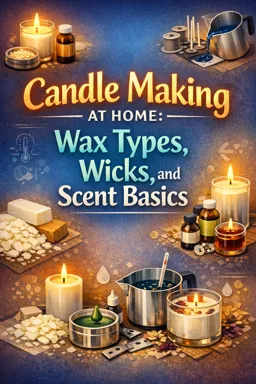
Candle Making at Home: Wax Types, Wicks, and Scent Basics
This free ebook introduces the practical skills behind making reliable, attractive homemade candles. Learn how to set up a safer workspace, handle hot wax carefully, and control temperatures throughout melting, mixing, pouring, cooling, and curing.
Make informed material choices
Explore the working characteristics of soy, paraffin, and beeswax, including how each wax can affect appearance, scent throw, burn behavior, and ease of use. The guide explains how container candles and molded candles require different preparation and finishing approaches.
Build a candle that burns well
Wick selection is central to candle performance. Understand how wick type and size influence melt pools, tunneling, flame behavior, and soot. You will also learn the basics of fragrance loading, blending wax and fragrance at an appropriate stage, and supporting scent performance through correct cooling and curing.
Create a polished finish
Use color and appearance choices with greater confidence, whether you want an opaque, translucent, natural, or richly dyed result. Clear process control helps reduce common issues such as rough tops, sinkholes, frosting, and uneven surfaces.
Improve through testing
Homemade candles benefit from careful observation. This ebook shows how to identify likely causes of tunneling, soot, weak scent, and other common problems, then make targeted adjustments. It also covers basic quality checks and safe-use guidance for finished candles.
Designed for home makers and aspiring craft sellers, this resource supports safer, more consistent candle-making decisions from the first pour to the final burn test.
Which wax is best for making scented container candles at home?
Soy and paraffin blends are common choices; the best option depends on your desired scent throw, finish, and testing results.
How do I stop a homemade candle from tunneling?
Use a correctly sized wick, keep it centered, and allow enough burn time for the melt pool to reach the container edge.
Why does my candle have sinkholes or a rough top after cooling?
These issues often result from pouring or cooling too quickly; adjusting pour temperature and cooling conditions can help.
This ebook includes:

10 content chapters

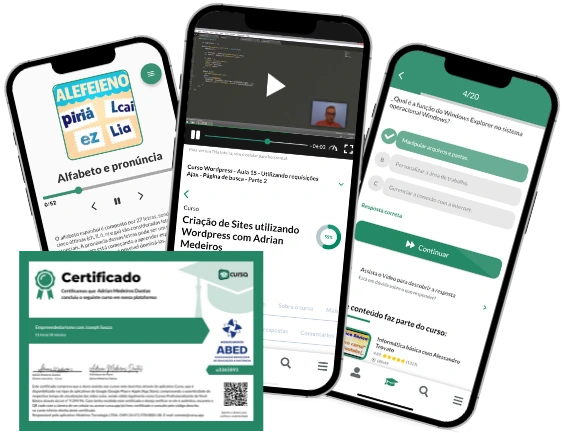
Digital certificate of course completion (Free)

Exercises to train your knowledge

100% free, from content to certificate
Ready to get started?

 recommended
In the app you will also find...

Over 5,000 free courses
Programming, English, Digital Marketing and much more! Learn whatever you want, for free.

Study plan with AI
Our app's Artificial Intelligence can create a study schedule for the course you choose.

From zero to professional success
Improve your resume with our free Certificate and then use our Artificial Intelligence to find your dream job.
You can also use the QR Code or the links below.