

Free ebook on Business Intelligence foundations, covering BI concepts, data models, team roles, architectures, governance, and reliable dashboards.
Free ebook content
-

Business Intelligence Foundations: What BI Delivers and How It’s Used
+ Exercise: A team needs a BI deliverable that provides a row-level list of items requiring immediate action (for example, exceptions to fix in daily operations). Which output is the best fit?
-
Core BI Vocabulary: Facts, Dimensions, Measures, and Grain
+ Exercise: You need to report the number of orders by territory using a fact table at order-line grain (one row per order_id + line_number). Which approach correctly counts orders without overcounting multi-line orders?
-
OLTP vs OLAP: Why Operational Databases and Analytics Systems Differ
+ Exercise: Why do analytics systems often use denormalized, wide tables instead of the highly normalized schemas common in operational databases?


-
From Raw Data to BI-Ready Data: Warehouses, Marts, and the Semantic Layer
+ Exercise: In a layered analytics data pipeline, which layer primarily centralizes metric formulas and consistent business filters so the same KPI is calculated the same way across tools and teams?
-
BI Team Roles and Handoffs: Analyst, Analytics Engineer, Data Engineer
+ Exercise: A team notices multiple dashboards calculating “Net Revenue” differently and performance is degrading due to heavy BI-tool calculations. Which action best prevents this issue going forward?
-
Common BI Architectures: Small Business Setups to Modern Cloud Stacks
+ Exercise: A team’s dashboards are slowing the production database during business hours, but they still need near-real-time reporting from that same operational database. Which BI architecture pattern best addresses this need?
-
Data Modeling for BI: Star Schemas, Conformed Dimensions, and Join Behavior
+ Exercise: In a star schema dashboard, why is a left join from the fact table to a dimension often safer than an inner join?
-
Governance, Access Control, and Metric Consistency in BI Programs
+ Exercise: Which approach best prevents teams from getting different answers to the same business question as BI usage scales?
-
Reliability and Quality in BI: Testing, Data Validation, and Monitoring
+ Exercise: When setting up automated data validation in BI, which approach best reduces incidents caused by ambiguous expectations?
-
Delivering BI Outcomes: From Requirements to Dashboards and Decision Support
+ Exercise: Which set of deliverables best represents the workflow for turning a business question into reliable decision support in BI?
About the free ebook
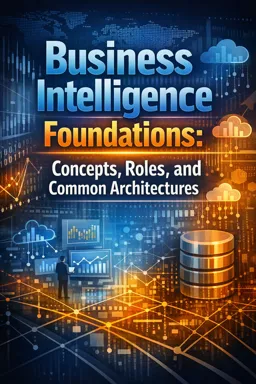
Business Intelligence Foundations: Concepts, Roles, and Common Architectures
This free ebook introduces the principles that turn operational data into reliable decision support. Learn how business intelligence connects data, definitions, models, dashboards, and governance so teams can answer business questions with confidence.
Build a practical BI vocabulary
Clarify the concepts behind useful reporting, including facts, dimensions, measures, grain, semantic layers, data warehouses, and data marts. Understand why transactional systems and analytical systems serve different purposes, and how BI-ready data is prepared for exploration and reporting.
Understand the people and architecture behind analytics
Explore how analysts, analytics engineers, and data engineers collaborate from requirements through delivery. The ebook explains common BI architectures, from streamlined small-business environments to modern cloud data stacks, helping readers recognize the trade-offs among simplicity, scalability, cost, and control.
Create trustworthy metrics and dashboards
Learn the foundations of dimensional modeling, including star schemas, conformed dimensions, and join behavior. See why governance, access control, testing, validation, and monitoring are essential for consistent metrics and dependable reporting.
Turn data work into business outcomes
Use these foundations to connect stakeholder needs with clear metrics, well-modeled data, and dashboards that support timely decisions. This ebook focuses on the shared language and operating practices that make BI programs more reliable and valuable.
- Distinguish operational data processing from analytical processing.
- Recognize the roles and handoffs in a BI team.
- Apply core principles for data quality, governance, and metric consistency.
- Understand how BI architecture and modeling influence dashboard outcomes.
What is the difference between OLTP and OLAP in business intelligence?
OLTP systems record day-to-day transactions, while OLAP systems organize data for analysis, aggregation, and reporting.
Why is data grain important in a BI data model?
Grain defines what one row represents, preventing incorrect joins, duplicate counts, and misleading measures.
What does a semantic layer do in a BI stack?
A semantic layer centralizes metric definitions and business logic so reports use consistent calculations.
This ebook includes:

10 content chapters

Digital certificate of course completion (Free)

Exercises to train your knowledge

100% free, from content to certificate
Ready to get started?

 recommended
In the app you will also find...

Over 5,000 free courses
Programming, English, Digital Marketing and much more! Learn whatever you want, for free.

Study plan with AI
Our app's Artificial Intelligence can create a study schedule for the course you choose.

From zero to professional success
Improve your resume with our free Certificate and then use our Artificial Intelligence to find your dream job.
You can also use the QR Code or the links below.