
Free ebook on practical R programming for data analysis, from importing and transforming data to ggplot2 charts and R Markdown reports.
Free ebook content
-

R Programming Foundations for Data Analysis
+ Exercise: In a script-first workflow in RStudio, which action best supports reproducible results when you change your code?
-
Working with Data Frames in R: Tibbles, Indexing, and Inspection
+ Exercise: When cleaning the sales tibble, how can you reliably detect invalid date strings in order_date?
-
Importing Real-World Files into R (CSV, Excel, and Text Data)
+ Exercise: When importing a real-world delimited text file into R, which approach best improves reliability and helps prevent silent data issues?


-
Data Transformation with Tidy Principles Using dplyr
+ Exercise: In a dplyr workflow, what is the main effect of using group_by(customer_id, month) followed by summarise(...) when building a customer-by-month table?
-
Reshaping and Combining Data: Joins, Bindings, and Pivoting
+ Exercise: You have an orders table and a customers table. Some orders have customer_id values that do not exist in customers. You want to keep all orders, but clearly flag missing customer attributes after merging. What approach best achieves this?
-
Clear Data Visualization in R with ggplot2
+ Exercise: In ggplot2, how should you apply an aesthetic like alpha when you want every point to have the same transparency regardless of the data?
-
From Analysis to Shareable Results: R Markdown Reporting Workflow
+ Exercise: In an R Markdown report, which chunk option is best when you want the code to run but hide both the code and its output (e.g., for a setup chunk that sets global defaults)?
-
A Practical End-to-End R Data Analysis Project
+ Exercise: Why does the workflow recompute revenue and profit after cleaning the data instead of trusting the imported totals?
About the free ebook
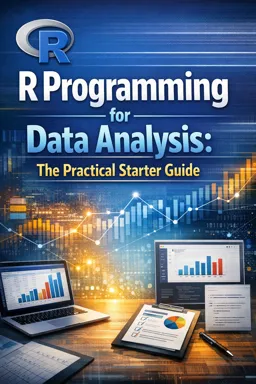
R Programming for Data Analysis: The Practical Starter Guide
Build practical R skills for turning raw data into clear, useful analysis. This free ebook introduces a hands-on workflow for working with datasets, applying tidy data principles, creating visualizations, and sharing reproducible results.
Learn a practical R workflow
Start with core R programming concepts and learn how to inspect data frames and tibbles with confidence. You will work with common real-world file formats, including CSV, Excel, and text files, then prepare data for analysis using clear, repeatable steps.
- Import and inspect structured datasets
- Filter, select, sort, summarize, and mutate data with dplyr
- Combine datasets with joins and bindings
- Reshape data using pivoting techniques
- Create readable charts with ggplot2
- Produce shareable analysis documents with R Markdown
Move from raw files to meaningful results
The ebook emphasizes the decisions that make analysis dependable: checking data types, handling missing values, choosing appropriate transformations, and communicating findings clearly. Rather than treating code as isolated commands, it presents R as a complete data-analysis environment.
Apply your knowledge in an end-to-end project
A practical project brings the workflow together, from importing source data through transformation, visualization, and reporting. By following the examples, you can develop a reusable foundation for business intelligence, reporting, research, and data science tasks.
Use this guide as a reference while practicing in R, adapting the techniques to your own datasets and analytical questions.
How do I import CSV and Excel files into R?
The ebook explains importing CSV, Excel, and text files, then inspecting their structure and data types.
What R functions are used for data transformation with dplyr?
It covers common dplyr operations for selecting, filtering, sorting, creating, grouping, and summarizing variables.
How can I create a reproducible report in R?
The guide introduces an R Markdown workflow for combining analysis code, visualizations, and written findings.
This ebook includes:

8 content chapters

Digital certificate of course completion (Free)

Exercises to train your knowledge

100% free, from content to certificate
Ready to get started?

 recommended
In the app you will also find...

Over 5,000 free courses
Programming, English, Digital Marketing and much more! Learn whatever you want, for free.

Study plan with AI
Our app's Artificial Intelligence can create a study schedule for the course you choose.

From zero to professional success
Improve your resume with our free Certificate and then use our Artificial Intelligence to find your dream job.
You can also use the QR Code or the links below.