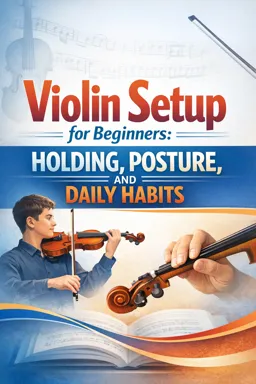
Rest the violin on the collarbone, support it with the shoulder rest and chin rest, and keep the instrument angled slightly to the left without gripping it tightly with the left hand.

Duration of the online course: 5 hours and 39 minutes
New
Play violin with confidence: technique, rhythm and shifting in a free online course with practical lessons and exercises—ideal for beginners to advanced players.
If you have always wanted to play the violin, this free online course guides you from your very first setup to confident, expressive playing. You will start by building the foundations that make everything else easier: how to hold the instrument comfortably, how to place it in relation to your body, and how to use the bow with control so each string speaks clearly. With the right posture and relaxed coordination, you will reduce tension and develop a sound you can trust.
As you progress, the course helps you connect what you do with your hands to what you hear. You will learn the parts of the violin, understand tuning details, and recognize how strings and pitch work together, so your practice becomes more musical and less guesswork. Step by step, you will move from open strings to finger placement, building intonation through repetition, listening, and focused exercises that reinforce accuracy. The lessons gradually bring more notes into your playing until the fingerboard feels familiar rather than intimidating.
To turn technique into music, you will work with pieces and performance demos that show how practice translates into real playing. Rhythm and timing receive careful attention as you develop a steady pulse, understand note values and time signatures, and gain comfort reading basic notation. Along the way, you will strengthen your musicianship with scales and arpeggios that improve tone, tuning, and finger independence, while bowing studies help you shape phrases and articulate with clarity.
When you are ready to go beyond first position, the course introduces shifting and third position in a clear, supportive way. You will train your ear and hand to move with intention, then extend your range with higher-position scales and exercises. The later lessons bring exciting techniques that unlock new colors and repertoire: controlled spiccato, clean staccato, double stopping and chords, and harmonics. By the end, you will have a well-rounded toolkit that supports continued growth, whether your goal is to play for enjoyment, join an ensemble, or build a strong musical foundation for the future.

5 hours and 39 minutes of online video course

Digital certificate of course completion (Free)

Exercises to train your knowledge

100% free, from content to certificate
How do you hold a violin correctly when starting to play?
Rest the violin on the collarbone, support it with the shoulder rest and chin rest, and keep the instrument angled slightly to the left without gripping it tightly with the left hand.
What are the violin strings in order from lowest to highest pitch?
The strings are G, D, A, and E. The E string is the thinnest and has the highest pitch.
What advanced violin techniques are covered after first position?
The course progresses to third position and shifting, scales and arpeggios, slurred bows, spiccato, staccato, double stops, harmonics, and scale techniques.
Ready to get started?Download the app and get started today.
Install the app now
to access the course
Over 5,000 free courses
Programming, English, Digital Marketing and much more! Learn whatever you want, for free.

Study plan with AI
Our app's Artificial Intelligence can create a study schedule for the course you choose.

From zero to professional success
Improve your resume with our free Certificate and then use our Artificial Intelligence to find your dream job.
You can also use the QR Code or the links below.



Free CourseViolin complete course
5

(1)

8h21m

9 exercises
Free CourseViolin
4.9
(10)
2h03m
49 exercises
Free CourseViolin
4.9
(15)
1h35m
10 exercises
Free CourseLearn To Play The Violin
New
1h14m
17 exercises
Free CourseViolin Bowing Fundamentals
New
5h19m
12 exercises
Free CourseBasic Violin exercises
New
48m
6 exercises
Free CourseViolin Course for Beginners
New
1h00m
6 exercises
Carry knowledge in your pocket.
Download the Cursa app.
There are hundreds of free courses available, with a free certificate of completion that is saved in your mobile image gallery.
Download the app to access the Course Completion Certificate for Free.


+ 10 million
students

Free and Valid
Certificate

60 thousand free
exercises

4.8/5 rating in
app stores

Free courses in
video and ebooks