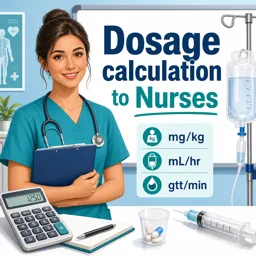


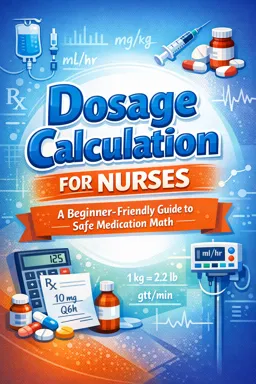
Dosage calculation is the process nurses use to determine the correct amount of medication to administer safely based on an order, available drug strength, patient factors, and route.

1

1


Understanding Dosage Calculation: Essential Formulas and Tips for Nurses
Master essential formulas and tips for accurate dosage calculation—crucial for safe and effective nursing practice.

Step-by-Step Guide to Accurate Dosage Calculation in Nursing Practice
Learn step-by-step dosage calculation to ensure safe, accurate medication administration in nursing practice.

Safe Medication Administration: The Importance of Accurate Dosage Calculation in Nursing
Accurate dosage calculation ensures safe medication delivery and reduces errors—an essential skill every nurse must master for patient safety.

Mastering Dosage Calculation: A Crucial Skill for Nursing Professionals
Learn essential methods and tips for accurate medication dosing in nursing—boost patient safety with strong calculation skills.
Develop essential healthcare mathematics skills with our selection of free online Dosage Calculation courses. These educational courses are designed for nursing students, healthcare learners, pharmacy assistants, medical professionals, and anyone who wants to improve accuracy when calculating medication doses. Study online through structured lessons, complete practical exercises, and receive free certification after finishing your chosen course.
Dosage calculation is an important part of safe medication administration. These free courses help learners understand the mathematical methods used to determine appropriate quantities, strengths, volumes, and administration rates. Educational content may cover basic arithmetic, fractions, decimals, percentages, ratios, proportions, unit conversion, formula methods, and dimensional analysis.
Lessons can also introduce common clinical calculations involving tablets, capsules, oral liquids, injectable medications, body weight, and intravenous therapy. By studying dosage calculation online, you can review concepts at your own pace and strengthen the numerical reasoning required in nursing, pharmacy, and other healthcare fields.
Every course in this listing is free and includes educational exercises to support active learning. The exercises allow you to test calculation methods, identify areas for revision, and gain confidence with medication math. Eligible completed courses also provide free certification, helping you document your continuing education and demonstrate your commitment to professional development.
These online learning opportunities are suitable for nursing students preparing for examinations, healthcare professionals refreshing foundational knowledge, pharmacy learners, caregivers, and beginners interested in clinical mathematics. Course availability and lesson depth may vary, allowing you to select the educational resource that best matches your learning goals.
To access the courses, exercises, and free certification, you must install the Cursa application. Android users can install it from Google Play by selecting Download for Android. iPhone users can install it from the App Store by selecting Download for iOS / iPhone.
Start learning today with free online Dosage Calculation courses and build practical skills for safer, more accurate medication calculations.
What is dosage calculation in nursing?
Dosage calculation is the process nurses use to determine the correct amount of medication to administer safely based on an order, available drug strength, patient factors, and route.
How do nurses calculate medication doses?
A common formula is: Desired dose ÷ Available dose × Quantity = amount to administer. Always verify units, concentration, route, and ordered dose.
What is the basic IV drip rate formula?
For gravity IV tubing: drops per minute = total volume in mL × drop factor in drops/mL ÷ time in minutes.
How do you calculate an IV infusion rate in mL per hour?
Divide the total volume in mL by the infusion time in hours. For example, 1,000 mL over 8 hours equals 125 mL/hour.
Why are unit conversions important in dosage calculations?
Medication orders and labels may use different units. Accurate conversion, such as 1 g = 1,000 mg or 1 mg = 1,000 mcg, helps prevent dosing errors.
What are the most common dosage calculation errors?
Common errors include confusing mg and mcg, using the wrong concentration, misplacing decimals, skipping conversions, and not checking whether the result is reasonable.
Can beginners learn nursing dosage calculations online?
Yes. Beginner-focused dosage calculation courses can teach formulas, conversions, tablet and liquid doses, IV rates, dimensional analysis, and medication-safety checks through practice problems.

Complete any course and issue your certificate via the app — at no cost.

Download the app! to have access to more than 4,000 Online Courses + Certificate, all free!
Download the app! 100% free courses.


Carry knowledge in your pocket.
Download the Cursa app.
There are hundreds of free courses available, with a free certificate of completion that is saved in your mobile image gallery.
Download the app to access the Course Completion Certificate for Free.


+ 10 million
students

Free and Valid
Certificate

60 thousand free
exercises

4.8/5 rating in
app stores

Free courses in
video and ebooks