
Exercises
Wood continually responds to its environment by absorbing and releasing moisture. This quiz examines how moisture content affects dimensional stability, how grain orientation influences shrinkage, and how to measure and manage wood movement. You will also assess practical construction methods for tabletops, breadboard ends, and frame-and-panel assemblies, along with acclimation, drying defects, and expansion calculations.
Answer the questions below and check the explanation for each answer.
0/14 answered
Auto audio on: the next questions will be read aloud when you click Continue.
Below the fiber saturation point, changes in bound water within the cell walls cause wood to shrink or swell. Removing free water above this point produces little dimensional change.
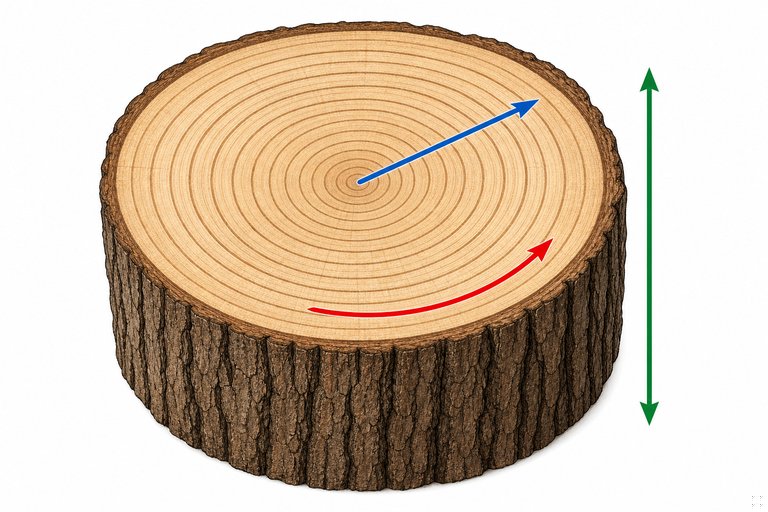
Tangential movement occurs parallel to the growth rings. It is generally greater than radial movement and much greater than longitudinal movement.
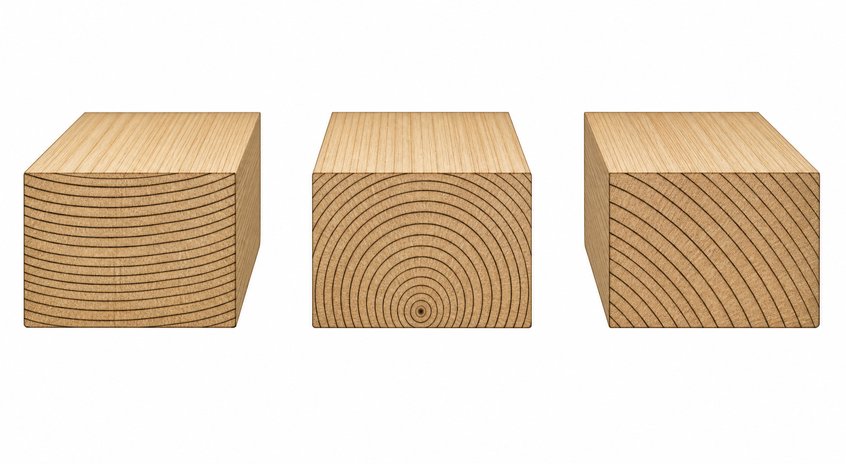
The center board has growth rings meeting its face at roughly 60–90 degrees, which identifies quartersawn stock. This orientation generally provides better dimensional stability across its width.
At equilibrium moisture content, or EMC, wood is balanced with the surrounding temperature and relative humidity. It will change again if those environmental conditions change.

A pin-type meter passes a small electrical current between its pins. Because electrical resistance varies with moisture content, the instrument can use that resistance to estimate moisture levels.
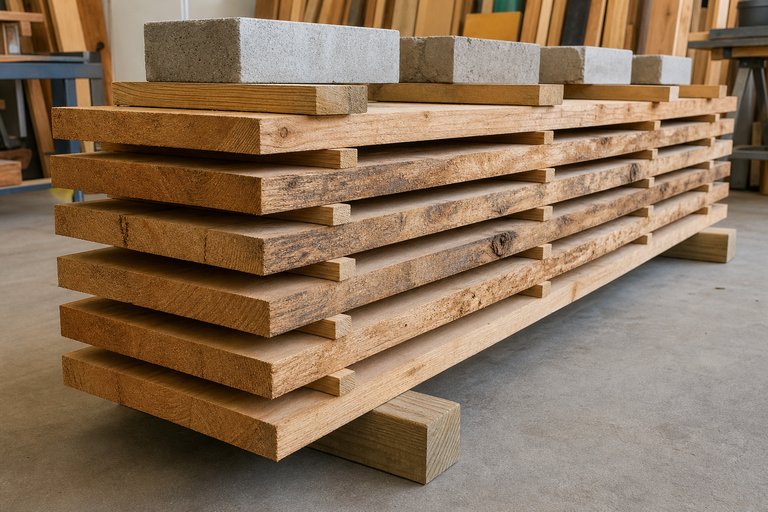
Stickers create evenly spaced air channels between boards. This promotes more uniform moisture exchange and reduces uneven drying or acclimation.
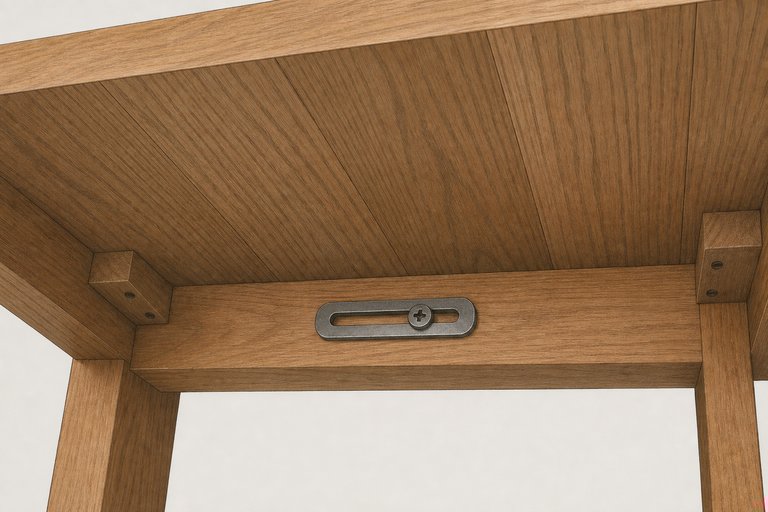
The elongated slot allows the fastening screw to shift as the solid-wood top changes width. The top remains secured while avoiding excessive stress, splitting, or warping.
A breadboard end should restrain the panel while accommodating seasonal width changes. Anchoring the center and allowing movement toward the edges helps prevent splits and joint failure.
Multiply 400 mm by 0.0025 and then by 4: 400 × 0.0025 × 4 = 4 mm. This estimate helps determine appropriate movement allowances.
Stable readings taken over time indicate that moisture exchange has slowed and the stock is approaching equilibrium with the workshop. The target should also be suitable for the project's final location.
Moisture escapes rapidly through end grain. A sealer slows that loss so the ends dry more nearly at the rate of the rest of the wood, reducing end checks and splits.
Higher relative humidity causes wood to adsorb more moisture until it reaches a new, higher equilibrium moisture content. This commonly produces swelling across the grain.
Case-hardening develops when the surface dries and sets too quickly while the core remains wetter. Later shrinkage of the core leaves internal stresses that may distort parts when they are resawn.
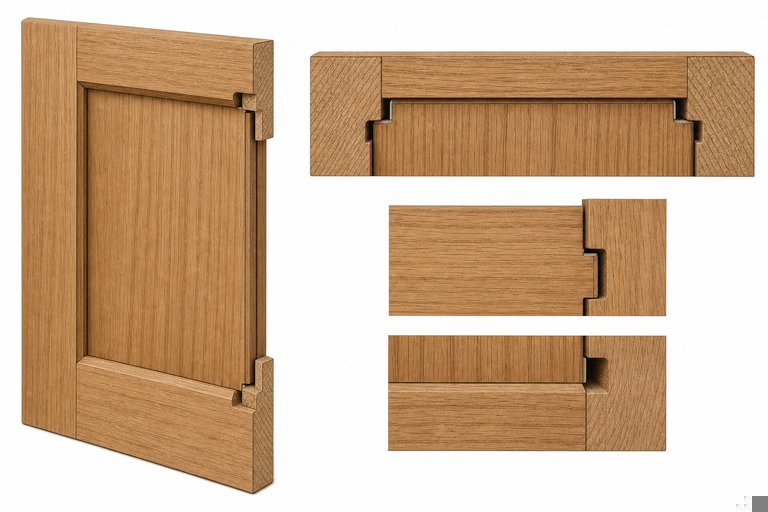
A solid-wood panel must float in its grooves because its width changes seasonally. The surrounding frame provides support while the concealed clearance accommodates movement.

Free CourseBasic Skills in Woodworking
5

(1)

4h47m

23 exercises

Free CourseWoodworking for beginners
5
(1)
2h48m
15 exercises

Free CourseModeling Furniture in Sketchup
5
(1)
1h07m
2 exercises

Free CourseWoodworking Masterclass
5
(1)
4h47m
11 exercises

Free CourseWoodworking for beginners
5
(54)
6h39m
22 exercises

Free CourseCarpentry tips
1
(1)
3h08m
22 exercises

Free CourseHow to be a Woodworker
New
5h12m
35 exercises

Free CourseDIY tutorial
New
5h28m
25 exercises
Thousands of online courses in video, ebooks and audiobooks.
To test your knowledge during online courses
Generated directly from your cell phone's photo gallery and sent to your email

Download our app via QR Code or the links below:.



Carry knowledge in your pocket.
Download the Cursa app.
There are hundreds of free courses available, with a free certificate of completion that is saved in your mobile image gallery.
Download the app to access the Course Completion Certificate for Free.


+ 10 million
students

Free and Valid
Certificate

60 thousand free
exercises

4.8/5 rating in
app stores

Free courses in
video and ebooks