
Exercises
Build confidence in Python programming fundamentals with this beginner-friendly quiz. Test your understanding of arithmetic operator precedence, the print() and input() functions, variables, single-line comments, and for-loop syntax. You will also review core data types and operations, including creating and appending to lists, identifying tuples, finding string length with len(), and understanding string concatenation. Whether you are new to coding or revising essential Python concepts, this quiz offers a quick way to check your knowledge of the language's basic syntax and features.
Answer the questions below and check the explanation for each answer.
0/11 answered
Auto audio on: the next questions will be read aloud when you click Continue.
Python follows the order of operations (PEMDAS/BODMAS), so it multiplies before adding. The expression 4 * 2 is evaluated first, resulting in 8, then 3 + 8 = 11.
The print() function is used in Python to display output on the screen. Functions like echo() are used in other programming languages.
The input() function prompts the user for input and reads a line from the user, returning it as a string.
Lists in Python are created using square brackets []. Curly braces create dictionaries, and parentheses are used for tuples.
The len() function returns the number of items in an object. For the string 'Python', it has 6 characters.
The correct way to start a for loop in Python is using for x in y:. The syntax is simpler than languages like C or Java.
Variable declaration in Python is simple and done by assigning a value using the equals sign: x = 10. Types are inferred automatically.
A single-line comment in Python is initiated by the # symbol. Other symbols like // or /* */ are used in languages like C++ and Java.
To add an item to a list in Python, you use the append() method. The add() method is for sets, not lists.
In Python, when you add two strings, they are concatenated. Therefore, '5' + '5' results in '55'.
A tuple in Python is defined with parentheses: (1, 2, 3). Lists use square brackets and sets use curly braces.
Free CourseIntroduction to algorithms
5

(11)

30h53m

22 exercises
Free CourseBasic Programming Concepts
5
(4)
6h34m
14 exercises
Free CoursePython Data Structures and Algorithms: Learn Efficient Programming
5
(2)
27h59m
40 exercises
Free CourseLogical programming using C language
4.7

(3)
9h55m
25 exercises
Free CourseProgramming logic
4.5
(27)
6h56m
19 exercises
Free CourseLogical Programming in C
New
6h48m
19 exercises
Thousands of online courses in video, ebooks and audiobooks.
To test your knowledge during online courses
Generated directly from your cell phone's photo gallery and sent to your email

Download our app via QR Code or the links below:.


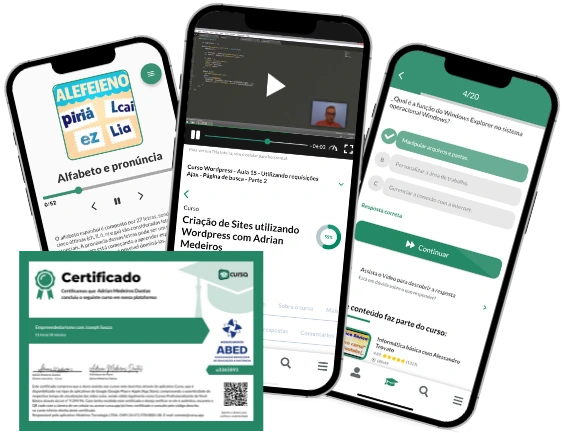
Carry knowledge in your pocket.
Download the Cursa app.
There are hundreds of free courses available, with a free certificate of completion that is saved in your mobile image gallery.
Download the app to access the Course Completion Certificate for Free.


+ 10 million
students

Free and Valid
Certificate

60 thousand free
exercises

4.8/5 rating in
app stores

Free courses in
video and ebooks