
Exercises
Challenge your understanding of intermediate Japanese grammar with this focused quiz. Practice essential concepts including the usage of kedo, expressing ability and potential actions, polite requests, the volitional form, and possibility with kamoshirenai. You will also review important particles such as ni, ga, and those used for listing examples, along with the Japanese equivalent of “to be” for inanimate objects. Ideal for Japanese learners who want to check their grammar knowledge, strengthen sentence comprehension, and identify topics to revisit.
Answer the questions below and check the explanation for each answer.
0/10 answered
Auto audio on: the next questions will be read aloud when you click Continue.
'Kedo' is used to contrast two ideas, often similar to but in English.
'Dekiru' is used to express the ability to do something, similar to can in English.
The particle 'ni' is used to indicate direction or destination in this context.
'Ga' is used to mark the grammatical subject of a sentence, highlighting the subject.
The 'masu' form is used to make polite and respectful requests in Japanese.
'Aru' is used for inanimate objects, meaning to exist or there is in English.
The volitional form is used to suggest an action or to invite someone, similar to let's in English.
'Kamoshirenai' is used to express possibility or uncertainty about something.
The particle 'ya' is used to list multiple items, similar to and or etc. in English.
'Koto ga dekiru' is used to express potential or the ability to perform an action. It translates to can do or able to do in English.
Free CourseJapanese Grammar lessons
5

(1)

19h14m

32 exercises
Free CourseKanji lessons
5
(1)
1h10m
1 exercises
Free CourseKanji reading and writing practice
5
(1)
3h54m
11 exercises
Free CourseJapanese Vocabulary N5
5
(5)
4h29m
4 exercises

Free CourseJapanese Vocabulary and Slang
5
(1)
13h36m
27 exercises
Free CourseJapanese basic vocabulary
4.8
(6)
140h00m
1 exercises
Free CourseJapanese
4.8
(61)
5h15m
45 exercises
Free CourseGrammar Lessons for Absolute Beginners
4.8

(4)
7h16m
21 exercises
Thousands of online courses in video, ebooks and audiobooks.
To test your knowledge during online courses
Generated directly from your cell phone's photo gallery and sent to your email

Download our app via QR Code or the links below:.


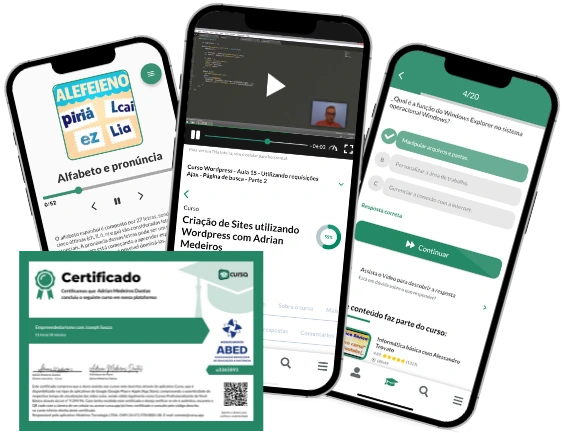
Carry knowledge in your pocket.
Download the Cursa app.
There are hundreds of free courses available, with a free certificate of completion that is saved in your mobile image gallery.
Download the app to access the Course Completion Certificate for Free.


+ 10 million
students

Free and Valid
Certificate

60 thousand free
exercises

4.8/5 rating in
app stores

Free courses in
video and ebooks