
Exercises
Put your intermediate German skills to the test with this German B1 Level Knowledge Test. Explore essential B1 grammar and vocabulary through questions on present, future, and perfect tenses; passive voice; modal verbs such as können; verb conjugation; word order in questions; subordinate clauses; and the use of doch for contradiction. You will also practice translating practical everyday sentences, including expressions of preference, understanding, and living in Germany. This quiz is ideal for learners preparing for B1 exams or anyone who wants to review core German language structures and build confidence in reading and communication.
Answer the questions below and check the explanation for each answer.
0/10 answered
Auto audio on: the next questions will be read aloud when you click Continue.
The sentence .Ich habe keine Lust zu arbeiten. translates to .I don't feel like working., as .keine Lust. means .no desire. or .no inclination..
The future tense in German is formed with the auxiliary verb .werden. followed by the infinitive form of the main verb. Therefore, .Ich werde einen Apfel essen. means .I will eat an apple..
In the passive voice, the sentence changes the focus to the object being acted upon. .Das Buch wird von dem Kind gelesen. means .The book is being read by the child..
In German, .doch. is used as a contradiction to negate a previous statement. Therefore, .Er sagt, es regnet nicht, doch es regnet. rightly indicates contradiction.
The sentence .Sie lebt seit einem Jahr in Deutschland. uses the present tense with .seit. to indicate an action that started in the past and is still continuing.
The conjunction .obwohl. introduces a subordinate clause in German, indicating a contrast. Unlike .aber. or .und., it causes a word order change in a sentence.
The phrase .Ich möchte dieses Buch kaufen. correctly translates to .I would like to buy this book.. .Möchte. indicates polite desire or wish in German.
The correct question format places the verb .kannst. before the subject .du., hence .Kannst du einen Apfel essen?. means .Can you eat an apple?.
The verb .schlafen. is conjugated as .wir schlafen. for the first person plural in the present tense. The root verb is maintained with the appropriate verb end .-en..
The correct question format, .Versteht er die Frage?, employs inversion of the verb .versteht. and the subject .er. to form .Does he understand the question?.

Free CourseGerman Vocabulary
5

(5)

15h53m

15 exercises

Free CourseGerman language A2
5
(2)
9h25m
27 exercises

Free CourseGerman B2
5
(2)
9h26m
3 exercises

Free CourseA2 | Learn German for beginners
4.9
(13)
8h58m
3 exercises

Free CourseGerman A1
4.9
(9)
10h34m
18 exercises

Free CourseGerman for beginners
4.8
(334)
4h10m
19 exercises
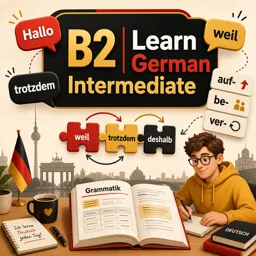
Free CourseB2 | Learn German Intermediate
4.8

(8)
2h12m
1 exercises
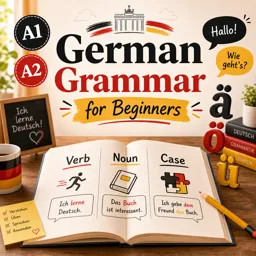
Free CourseGerman Grammar for Beginners
4.7
(11)
20h06m
41 exercises
Thousands of online courses in video, ebooks and audiobooks.
To test your knowledge during online courses
Generated directly from your cell phone's photo gallery and sent to your email

Download our app via QR Code or the links below:.


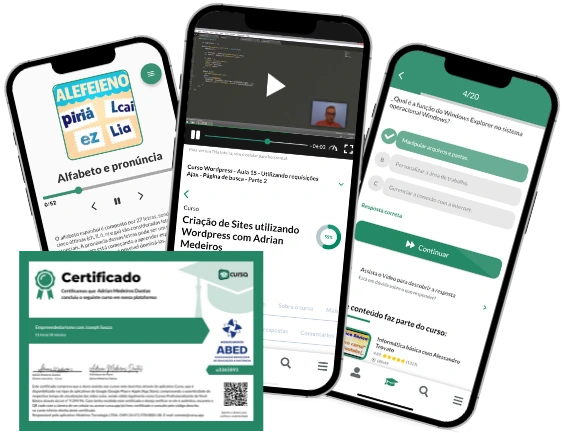
Carry knowledge in your pocket.
Download the Cursa app.
There are hundreds of free courses available, with a free certificate of completion that is saved in your mobile image gallery.
Download the app to access the Course Completion Certificate for Free.


+ 10 million
students

Free and Valid
Certificate

60 thousand free
exercises

4.8/5 rating in
app stores

Free courses in
video and ebooks