
Exercises
Put your poker strategy fundamentals to the test with this Texas Hold'em quiz. Explore key concepts that help players make smarter decisions at the table, including premium starting hands, bluffing, slow playing, tight-aggressive play, and reading opponents' betting patterns. Questions also cover the value of position, button strategy, pot odds, nut flushes, No-Limit Hold'em betting, and tournament concepts such as the bubble. Whether you are learning the basics or refreshing your game-plan, this quiz is a practical way to check your understanding of essential poker terms and strategic decision-making.
Answer the questions below and check the explanation for each answer.
0/10 answered
Auto audio on: the next questions will be read aloud when you click Continue.
A strong starting hand in Texas Hold'em is crucial for increasing your chances of winning. A♠ K♠, known as "Big Slick," is considered one of the strongest starting hands due to its high cards and potential for making a top pair or a strong flush. In contrast, 7♣ 2♠ is one of the weakest hands, and J♦ 10♦ is a decent hand but not as powerful as A♠ K♠.
A bluff in poker is when a player bets or raises with a weak hand to make opponents believe they have a strong hand, hoping they will fold stronger hands. This is a strategy used to deceive opponents and potentially win the pot without having the best cards.
With a nut flush (the best possible flush), the optimal play is to bet or raise to maximize your winnings. This strong hand has a high probability of winning, so you should take an aggressive approach to extract more value from your opponents. Checking to induce a bluff or folding are not ideal in this situation.
The 'tight-aggressive' playing style involves playing few hands, but when a strong hand is dealt, the player bets aggressively to maximize winnings. This means selecting hands carefully but betting forcefully when there is a good chance of winning. This style contrasts with loose or passive play strategies.
Slow play in poker means to play a very strong hand in a deceptive manner. The player may choose to bet conservatively, call rather than raise, or check, to conceal the strength of their hand and induce their opponents to bet more aggressively. By doing this, the player aims to build the pot without alarming opponents of their strong position.
The 'bubble' in tournament poker refers to the point where the next player eliminated will not receive a payout, while all remaining players will. It is a tense stage as players strive to avoid being the last eliminated before the money positions.
When you're on the button, you are in a position of power as you will act last post-flop. If everyone has folded to you, raising with a marginal hand is a strategic play to try to take the blinds uncontested. This move capitalizes on your positional advantage and puts pressure on the blinds to decide if they want to defend with potentially weaker hands.
Pot odds are crucial in deciding whether to call a bet when drawing to a hand. They represent the ratio of the current size of the pot to the size of the bet you must call. By comparing pot odds to the odds of completing your draw, you can determine if the potential return justifies the risk. Thus, Option 2 is the correct choice: call if the potential return is greater than the odds against completing your draw.
In poker, position refers to a player's location relative to the dealer button during a hand. A player's position determines the order in which they act during betting rounds, affecting their strategic decisions and potential to gain information from other players' actions. Being "in position" often provides a strategic advantage, as players can see their opponents' moves before taking action.
In poker, a player who has been consistently tight often plays only strong hands. If such a player suddenly makes a large bet, it is more likely that they have a strong hand and are betting for value, rather than bluffing or making a mistake. Identifying betting patterns and player tendencies is crucial in making informed decisions during the game.
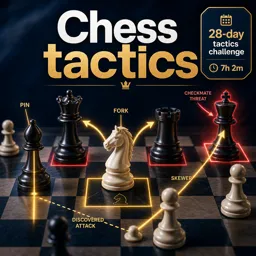
Free CourseChess tactics
4.9

(11)

7h02m

26 exercises
Free CourseBeginner to Chess Master
4.8
(37)
13h55m
24 exercises
Free CourseChess rules for beginners
2
(2)
19m
4 exercises
Free CourseChess course from Beginner to Master
New
156h15m
20 exercises
Free CourseBeginner guide to Chess
New
31m
6 exercises
Free CourseBuilding Chess Habits: Full Grandmaster Training Series
New
63h28m
30 exercises
Thousands of online courses in video, ebooks and audiobooks.
To test your knowledge during online courses
Generated directly from your cell phone's photo gallery and sent to your email

Download our app via QR Code or the links below:.


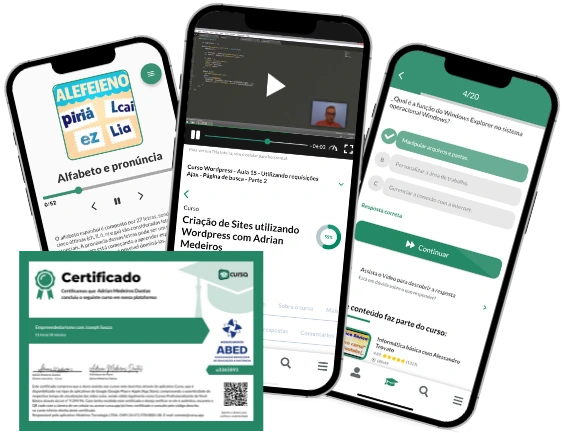
Carry knowledge in your pocket.
Download the Cursa app.
There are hundreds of free courses available, with a free certificate of completion that is saved in your mobile image gallery.
Download the app to access the Course Completion Certificate for Free.


+ 10 million
students

Free and Valid
Certificate

60 thousand free
exercises

4.8/5 rating in
app stores

Free courses in
video and ebooks