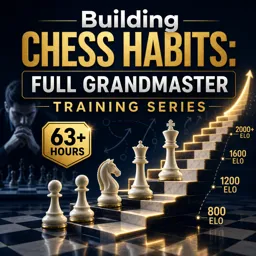
Free online course Building Chess Habits: Full Grandmaster Training Series
Duration of the online course: 63 hours and 28 minutes
New
Improve fast with a free chess course built on winning habits—clean openings, safer defense, and confident conversions. Learn online and level up your play.
In this free course, learn about
Use a simple ruleset to build consistent decision-making, not to find best moves every time
Opening habits: control the center, develop pieces, and castle early for king safety
Tactical habit: when an opponent leaves a piece hanging, take the free material
After castling/development, create luft (pawn move) to prevent back-rank mates
Early moves toward the center improve piece activity, options, and long-term control
Safe premoves: only when recapture/forced replies are virtually guaranteed
Accept missing winning moves if they violate the rules; focus on long-term skill building
When a kingside attack is brewing, slow it down by addressing threats and improving king safety
Conversion habit when up material: trade pieces, avoid complications, and simplify
Default plan when ahead and unsure: make improving/solid moves, often trading safely
Don’t grab early pawns if it breaks development/king safety; prioritize sound setup first
Endgame habit: activate the king and simplify into winning endgames
Positional focus (higher levels): make plans, improve pieces, and target weaknesses
Versus weak pawns: fix the weakness first, then pile up attackers and win it
About the free online course
This free online chess course is designed to help you stop guessing and start playing with repeatable habits you can trust in real games. Instead of memorizing endless lines or hunting for the perfect move every turn, you’ll train a simple rules-based approach that keeps you safe, improves your consistency, and builds the decision-making discipline strong players rely on. The goal is practical improvement: making fewer blunders, handling pressure more calmly, and choosing moves that are solid even when you don’t see a tactic.
You’ll follow the same core ideas through many game situations, progressively raising the difficulty as your skill grows. Early on, you’ll focus on foundational priorities like central control, fast development, and king safety, so your position stops falling apart before the middlegame. As the level increases, the habits evolve to address the problems that actually decide games for developing players: grabbing free material when it’s truly free, avoiding cheap mates and back-rank disasters, defending accurately when a kingside attack is starting, and simplifying intelligently when you’re ahead.
Because the training emphasizes consistency over brilliance, you’ll learn why it can be correct to skip a tempting winning move if it breaks your method or increases risk. That mindset is powerful: it replaces emotional, tactical gambling with a dependable process you can apply under time pressure. You’ll also develop a clear plan for converting advantages—trading safely, improving pieces, choosing reliable moves when you feel stuck, and turning extra material into a win without giving counterplay.
By the end, you’ll have a structured way to think in every phase of the game, from the opening to endgame decisions that add points quickly. If you want a calm, systematic training series that strengthens fundamentals and helps your rating rise through better habits—not just highlights—this course gives you a straightforward path to do it.
Course content
Video class: Building Habits FULL VERSION Part 1 (400 ELO)2h05m
Exercise: In Building Chess Habits, what is the main goal of following simple rules like controlling the center, developing pieces, and castling early?
Video class: Building Habits FULL VERSION Part 2 (400-450 ELO)1h46m
Exercise: According to the habits taught, what is the recommended approach when your opponent leaves a piece hanging for free?
Video class: Building Habits FULL VERSION Part 3 (450-500 ELO)2h04m
Video class: Building Habits FULL VERSION Part 4 (500-540 ELO)2h05m
Exercise: What is the main goal of the “Building Chess Habits” approach?
Video class: Building Habits FULL VERSION Part 5 (540-570 ELO)2h00m
Exercise: What is the main goal of the Building Chess Habits approach?
Video class: Building Habits FULL VERSION Part 6 (570-650 ELO)1h47m
Exercise: In this training approach, what is the recommended priority after castling and completing development to avoid back-rank checkmates?
Video class: Building Habits FULL VERSION Part 7 (650 ELO)1h28m
Exercise: In the Building Chess Habits approach, what is the main reason for choosing moves that control or move toward the center early on?
Video class: Building Habits FULL VERSION Part 8 (650-700 ELO)1h36m
Exercise: What is the main goal of the “Building Chess Habits” approach?
Video class: Building Habits FULL VERSION Part 9 (700-750 ELO)2h02m
Exercise: When are pre-moves considered safe and recommended as a habit?
Video class: Building Habits FULL VERSION Part 10 (750-800 ELO)2h19m
Exercise: What is the main goal of the Building Chess Habits ruleset when playing games?
Video class: Building Habits FULL VERSION Part 11 (800-850 ELO)1h41m
Exercise: In this training approach, what is the main goal even if it means missing some winning moves?
Video class: Building Habits FULL VERSION Part 12 (850-900 ELO)1h17m
Exercise: In the Building Chess Habits approach, what is the main goal when you follow the set of rules each game?
Video class: Building Habits FULL VERSION Part 13 (900-950 ELO)2h09m
Video class: Building Habits FULL VERSION Part 14 (950-1000 ELO)2h31m
Exercise: In the Building Chess Habits approach, what is the main goal when following a set of rules even if you miss some winning moves?
Video class: Building Habits FULL VERSION Part 15 (1000-1050 ELO)1h42m
Exercise: What is the main goal of the habits-based rules in this chess training approach?
Video class: Building Habits FULL VERSION Part 16 (1050-1100 ELO)1h16m
Exercise: In the habits-based approach, what is the main goal even if it means missing some winning moves?
Video class: Building Habits FULL VERSION Part 17 (1100-1150 ELO)2h00m
Exercise: In Level 3, what is the biggest change compared to Level 2 habits?
Video class: Building Habits FULL VERSION Part 18 (1150-1200 ELO)2h09m
Exercise: In the Build Chess Habits approach, what is the main reason you might skip a “winning move” in a game?
Video class: Building Habits FULL VERSION Part 19 (1200-1250 ELO)1h52m
Exercise: In the endgame, which rule is emphasized as one of the most effective habits to improve your results?
Video class: Building Habits FULL VERSION Part 20 (1250-1300 ELO)2h08m
Exercise: When you feel a kingside attack brewing (for example after a move like h4), what is a recommended defensive habit?
Video class: Building Habits FULL VERSION Part 21 (1300-1330 ELO)2h11m
Exercise: In the habits approach, what is the recommended plan when you are up material and want to convert the advantage?
Video class: Building Habits FULL VERSION Part 22 (1330-1380 ELO)1h17m
Exercise: Which habit is emphasized when deciding whether to grab pawns early in the game?
Video class: Building Habits FULL VERSION Part 23 (1380-1400 ELO)2h05m
Exercise: In this training approach, what is the main reason you might intentionally miss a winning move?
Video class: Building Habits FULL VERSION Part 24 (1400-1450 ELO)1h06m
Exercise: In the Building Chess Habits approach, what should you do if you miss a winning move because you're following the rules?
Video class: Building Habits FULL VERSION Part 25 (1450-1500 ELO)1h51m
Exercise: When you are up material, what kind of move is suggested as a reliable “default” if you’re stuck for a plan?
Video class: Building Habits FULL VERSION Part 26 (1500-1550 ELO)1h41m
Exercise: What is the main goal of the Building Chess Habits approach when you miss a winning move?
Video class: Building Habits FULL VERSION Part 27 (1550-1650 ELO)3h32m
Exercise: In Level 4 of Building Chess Habits, what new focus is emphasized to help players improve beyond just openings and tactics?
Video class: Building Habits FULL VERSION Part 28 (1650-1750 ELO)2h45m
Exercise: In this training approach, what is the main goal of following a fixed set of rules (habits) in every game?
Video class: Building Habits FULL VERSION Part 29 (1750-1800 ELO)2h18m
Exercise: When playing against a weak pawn, what should you generally do first to make the weakness permanent?
Video class: Building Habits FULL VERSION Part 30 (1800 ELO)2h22m
Exercise: What is the main goal of the Building Chess Habits training approach?
Video class: Building Habits FULL VERSION Part 31 (1800-1875 ELO)1h49m
Exercise: What is the main goal of the habit-based rules in this chess training series?
Video class: Building Habits FULL VERSION Part 32 (1875-1900 ELO)2h18m
Exercise: When you are up material, what is the recommended plan to convert the advantage safely?