
Exercises
This quiz examines the operation, installation, and troubleshooting of three-phase magnetic motor starters. Topics include contactors, overload relays, control transformers, seal-in circuits, two-wire and three-wire control, reversing starters, interlocks, jogging, IEC terminal designations, and ladder-logic interpretation. The questions combine practical electrical knowledge with visual analysis of common motor-control diagrams and test instruments.
Answer the questions below and check the explanation for each answer.
0/18 answered
Auto audio on: the next questions will be read aloud when you click Continue.
A contactor uses an electromagnetic coil to open or close power contacts, allowing a relatively low-power control circuit to switch the motor's three-phase supply.
An overload relay responds to sustained excessive motor current that can cause overheating. Fuses or circuit breakers provide the required short-circuit protection.
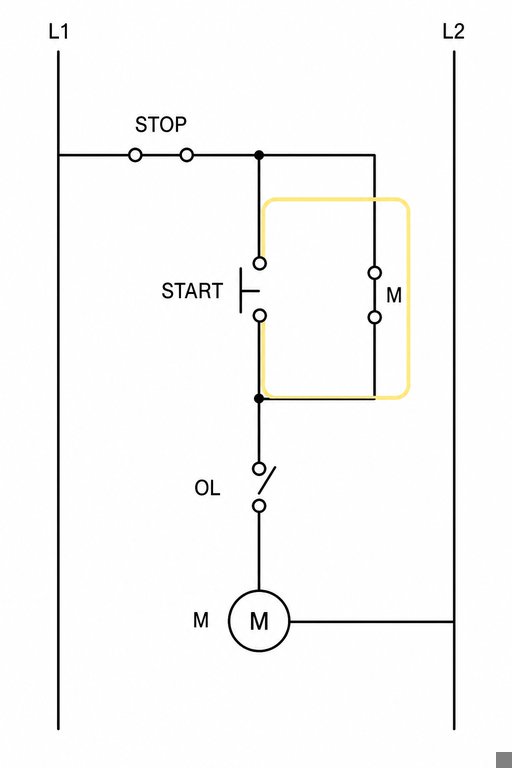
The contactor's normally open auxiliary contact closes when the coil energizes. Because it is connected across START, it provides a holding or seal-in path.
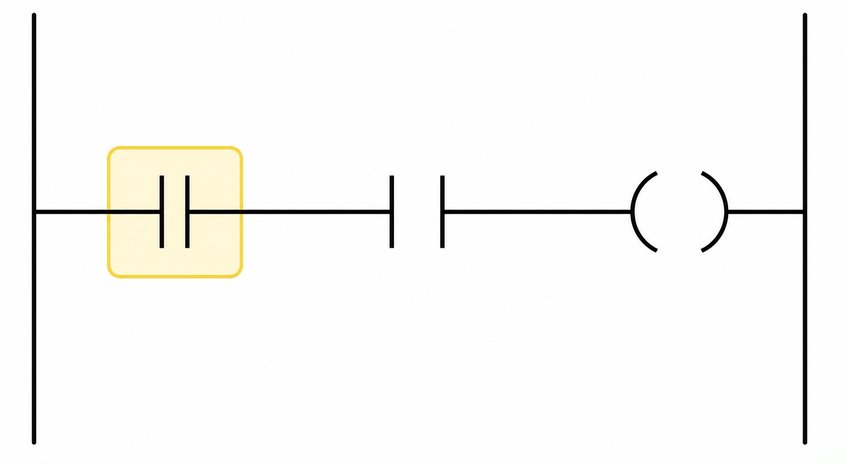
A stop pushbutton is normally closed so current can flow during normal operation. Pressing it opens the control circuit and de-energizes the contactor coil.
A control transformer commonly steps the line voltage down to a standardized control voltage suitable for coils, pushbuttons, pilot lights, and other control devices.
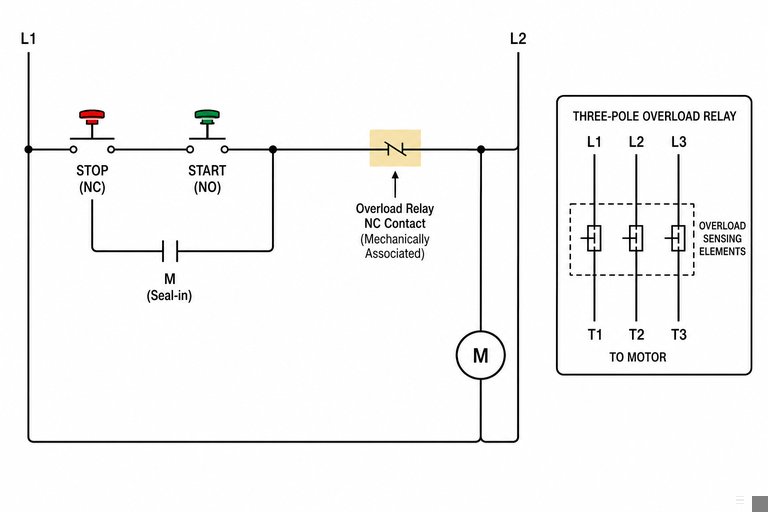
The overload relay's normally closed control contact is wired in series with the contactor coil. A trip opens this contact and de-energizes the starter.
Loss of control power drops out the contactor and opens its seal-in contact. When power returns, the operator must press START again, providing low-voltage protection.
Two-wire control uses a maintained device such as a thermostat, pressure switch, or float switch. If that contact remains closed, the motor may restart when power returns.
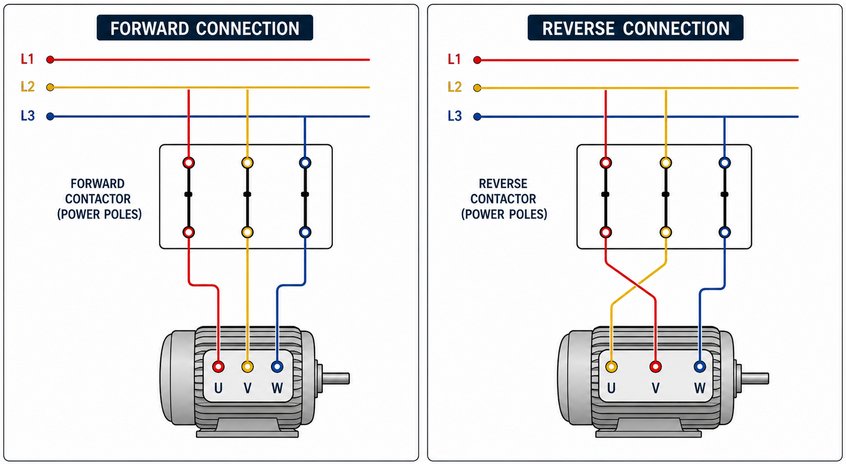
Interchanging any two supply phases reverses the phase sequence. This reverses the rotating magnetic field and therefore the motor's direction.
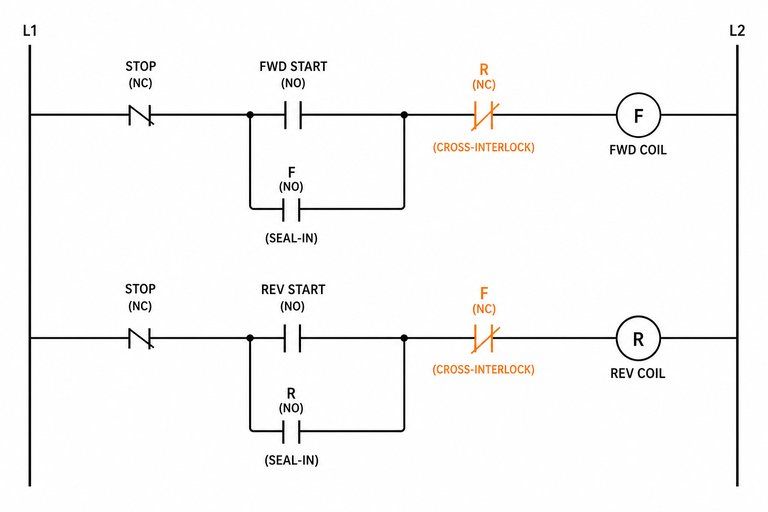
These contacts provide electrical interlocking. When one contactor energizes, its normally closed auxiliary contact opens the circuit to the opposite coil.
A mechanical interlock physically blocks one contactor while the other is closed. It provides protection even if an electrical interlock contact fails or is miswired.
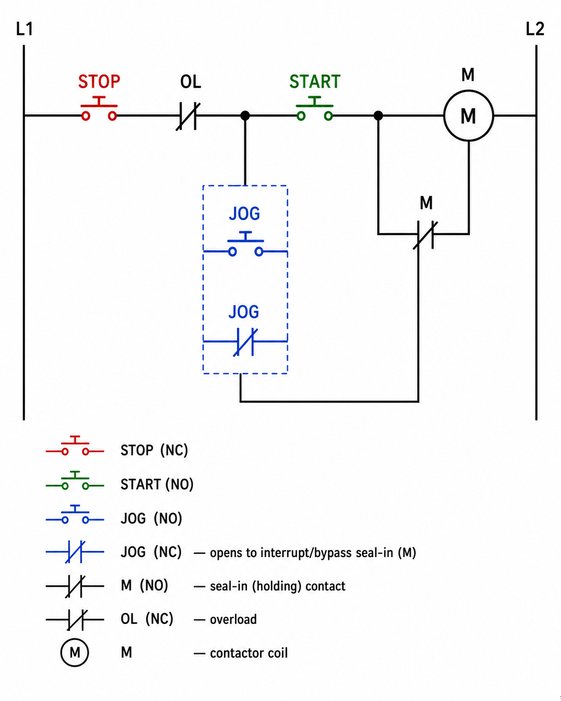
Jogging momentarily energizes the starter while preventing the seal-in path from maintaining the coil. Releasing JOG therefore stops the motor immediately.
Overload settings are based primarily on the motor's nameplate current. The final setting must also follow the relay manufacturer's instructions and applicable electrical requirements.
Loss of one phase is called single-phasing. A loaded motor may continue rotating, but current in the remaining phases rises and can quickly cause damaging heat.
AC-3 applies to starting squirrel-cage motors and opening the circuit while the motor is running. AC-1 primarily applies to non-inductive or slightly inductive loads.
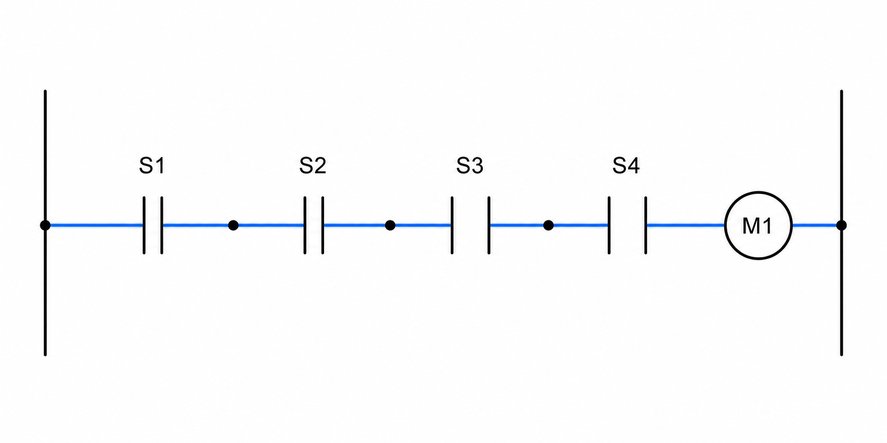
Series contacts implement AND logic: every required path element must be closed before current can reach the coil. Opening any series contact de-energizes it.
IEC designations commonly use 13-14 for a normally open auxiliary contact. A1-A2 identify coil terminals, while 21-22 commonly identify a normally closed contact.
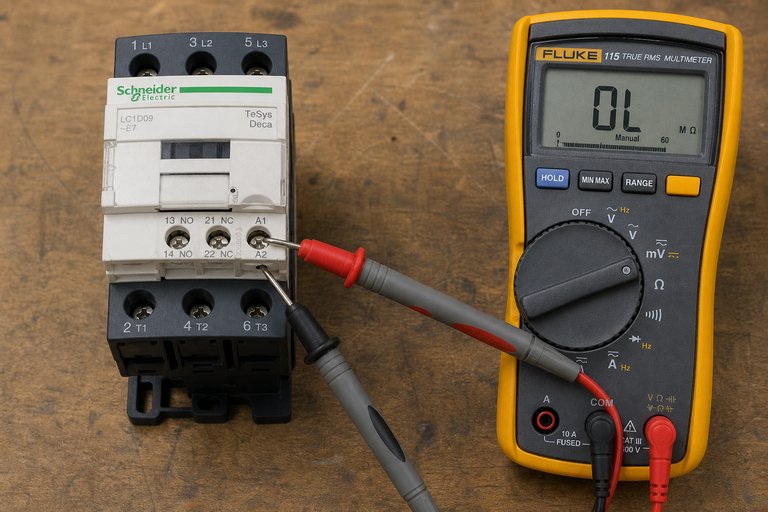
An intact coil should have a finite resistance. An infinite or over-limit reading across isolated coil terminals indicates that the coil winding has an open circuit.

Free CourseInstall Your Own Solar Power System
5

(2)

59m

6 exercises
Free CourseElectronic Circuits Course
5
(7)
43h25m
49 exercises

Free CourseWind Turbines
5
(4)
3h49m
19 exercises
Free CourseEngineering Circuits Analysis
5
(6)
3h11m
20 exercises

Free CourseElectronics - Nanoelectronics: Devices and Materials
4.8
(44)
40h15m
31 exercises
Free CourseBasic electronics
4.8
(23)
6h04m
30 exercises
Free CourseElectrical engineering
4.8
(27)
11h53m
20 exercises

Free CourseElectrical - Fabrication of Silicon
4.8
(26)
35h10m
28 exercises
Thousands of online courses in video, ebooks and audiobooks.
To test your knowledge during online courses
Generated directly from your cell phone's photo gallery and sent to your email

Download our app via QR Code or the links below:.


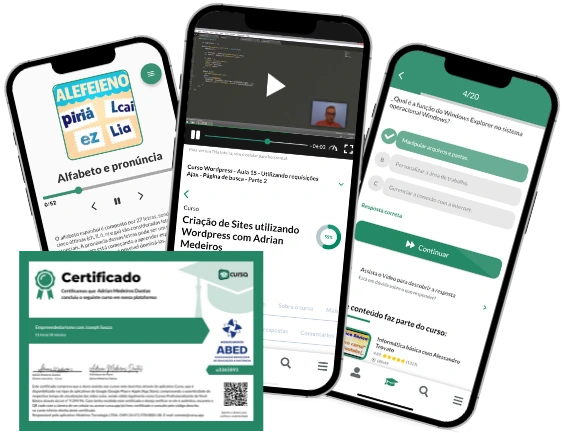
Carry knowledge in your pocket.
Download the Cursa app.
There are hundreds of free courses available, with a free certificate of completion that is saved in your mobile image gallery.
Download the app to access the Course Completion Certificate for Free.


+ 10 million
students

Free and Valid
Certificate

60 thousand free
exercises

4.8/5 rating in
app stores

Free courses in
video and ebooks