
Exercises
This quiz assesses practical knowledge of customer support ticket triage and service-level agreement management. You will apply impact and urgency criteria, distinguish response and resolution targets, identify escalation triggers, route cases by agent skills, manage duplicate tickets, and protect continuity during handoffs. Several questions use realistic ticket queues, timelines, and SLA dashboards to test decisions commonly made in customer support operations.
Answer the questions below and check the explanation for each answer.
0/11 answered
Auto audio on: the next questions will be read aloud when you click Continue.
Initial triage establishes the ticket's category, priority, and destination. This helps the right team respond within the appropriate service target.
Priority is normally based on impact, such as how many users are affected, and urgency, such as how quickly serious harm may occur.
A first-response SLA measures how long the customer waits for the first qualifying response after creating the ticket. It is different from the resolution SLA.
Ticket A combines widespread impact with high urgency because a complete checkout failure prevents all customers from purchasing.
The ticket was created at 9:00 and the first qualifying agent response occurred at 9:18, so the first-response time was 18 minutes.
An SLA clock should be paused only under documented policy conditions. A common example is waiting for information that only the customer can provide.
Escalation is appropriate when significant impact, an approaching deadline, and an unresolved dependency create a serious risk of delay or breach.
The ticket concerns a billing charge and is written in Spanish. Skills-based routing should send it to agents qualified in both the issue category and language.
Consolidating duplicates prevents conflicting work and fragmented communication. Relevant messages and history should remain accessible in the primary case.
A structured handoff preserves continuity and accountability. It reduces repeated questions, duplicated work, and delays for the customer.
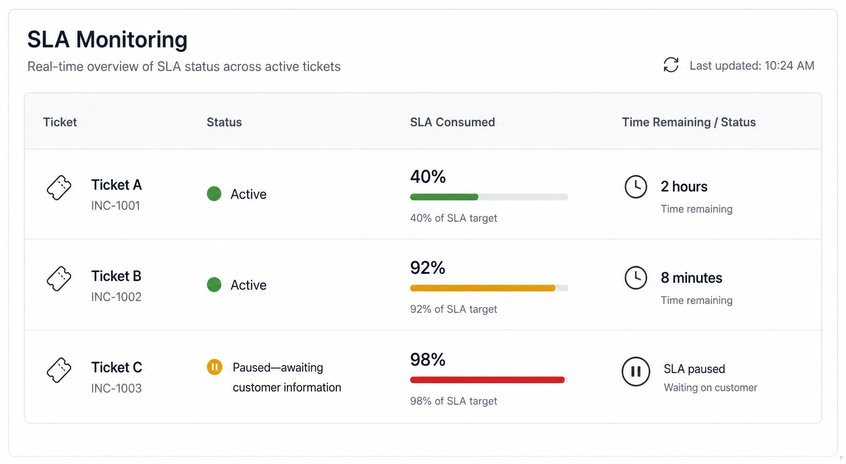
Ticket B is active, has consumed 92% of its SLA allowance, and has only eight minutes remaining. Ticket C is paused under policy, while Ticket A has more time available.
Free CourseCall Center Agent Soft Skills Training: Communication, Empathy, Tone and Call Handling
5

(4)

4h02m

45 exercises
Free CourseCall Center Customer Service Training
4.9
(49)
5h53m
24 exercises
Free CourseCustomer Service
4.7

(50)
2h18m
9 exercises

Free CourseFront office training
4.6
(16)
24m
2 exercises

Free CourseCustomer Service full course
4.6
(47)
1h37m
18 exercises

Free CourseDental recepcionist training
4.5
(11)
26m
3 exercises
Free CourseHospitality Management
4.3
(35)
1h52m
11 exercises
Free CourseStore manager classes
4.2
(5)
2h06m
5 exercises
Thousands of online courses in video, ebooks and audiobooks.
To test your knowledge during online courses
Generated directly from your cell phone's photo gallery and sent to your email

Download our app via QR Code or the links below:.


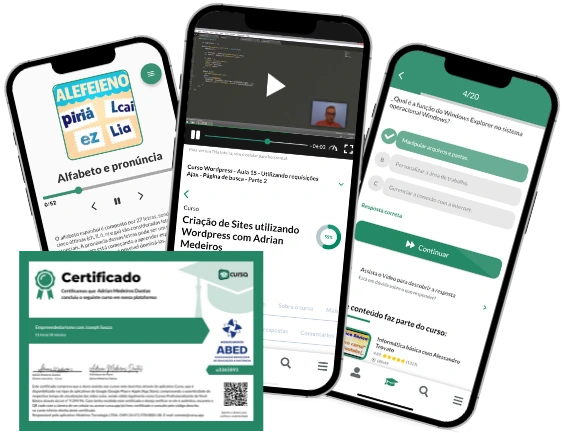
Carry knowledge in your pocket.
Download the Cursa app.
There are hundreds of free courses available, with a free certificate of completion that is saved in your mobile image gallery.
Download the app to access the Course Completion Certificate for Free.


+ 10 million
students

Free and Valid
Certificate

60 thousand free
exercises

4.8/5 rating in
app stores

Free courses in
video and ebooks