
Exercises
Explore the core concepts of machine learning with this Deep Learning Fundamentals Quiz. Test your understanding of neural networks, activation functions, backpropagation, batch normalization, overfitting prevention, and the vanishing gradient problem. Questions also cover convolutional neural networks (CNNs), pooling layers, unsupervised learning, and adaptive optimization methods such as Adam. Ideal for students, aspiring data scientists, and anyone building a foundation in deep learning.
Answer the questions below and check the explanation for each answer.
0/10 answered
Auto audio on: the next questions will be read aloud when you click Continue.
Deep Learning is a subset of machine learning that is based on artificial neural networks with representation learning. It involves the use of neural networks with many layers (hence 'deep') to model complex patterns in data. Option 2 is correct as it accurately describes Deep Learning in the context of machine learning.
The Rectified Linear Unit (ReLU) is a commonly used activation function in neural networks. It is popular because it helps to mitigate the vanishing gradient problem and enables models to converge faster. ReLU is defined as f(x) = max(0, x), which means it outputs zero if the input is negative and outputs the input itself if it is positive.
Backpropagation is a key algorithm used in training neural networks. It involves spreading the error gradient back through the network to update the weights, allowing the model to learn from mistakes and improve its performance on subsequent runs. This process helps in minimizing the error by adjusting weights in the direction that reduces the loss function.
Dropout is a regularization technique used to prevent overfitting in deep neural networks. It works by randomly setting a portion of the neurons to zero during training, which helps in disrupting the 'memorization' of the training data. This encourages the network to learn more robust features instead.
A Convolutional Neural Network (CNN) specializes in processing grid-like data such as images. CNNs are particularly adept at detecting spatial hierarchies in visual data, making them well-suited for image recognition and computer vision tasks. They use layers of convolutions with filters to automatically learn spatial features in the input data.
The Pooling layer is used in a CNN to reduce the spatial size of the feature representations. It works by down-sampling the input along its spatial dimensions, typically using operations like max pooling or average pooling, which helps to reduce the number of parameters and computation in the network.
The primary advantage of using batch normalization is Option 3: Addressing the internal covariate shift by normalizing layer inputs. This technique helps in stabilizing and accelerating the training of deep neural networks by normalizing the input of each layer, allowing for higher learning rates and reducing the sensitivity to initialization methods.
Clustering is an example of unsupervised learning, where the algorithm groups a set of objects in such a way that objects in the same group are more similar than those in other groups. In contrast, Classification is supervised learning, and Reinforcement Learning involves learning an action policy with feedback. Unsupervised learning doesn't provide input-output pairings or feedback.
The vanishing gradient problem occurs in deep learning when gradients become too small, effectively preventing weights from changing their value. This typically happens in deep networks where early layers' gradients shrink exponentially during backpropagation, leading to slow or halted learning.
The AdaGrad algorithm is an extension of the classic stochastic gradient descent method. It adapts the learning rates for each parameter individually, allowing for different step sizes for each parameter based on their historical gradients. This helps in dealing with sparse data by giving appropriate importance to different features.
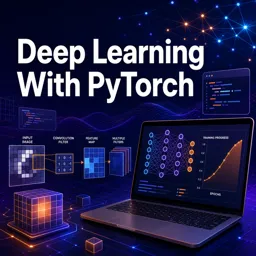
Free CourseDeep Learning With PyTorch
5

(6)

3h39m

19 exercises

Free CourseMachine Learning tutorial
5
(2)
10h20m
6 exercises

Free CourseGoogle Prompting Essentials
4.8
(5)
3h24m
10 exercises

Free CourseData Science
4.8

(4)
5h58m
38 exercises

Free CourseArtificial intelligence
4.7
(69)
12h40m
7 exercises
Free CourseFundamentals of Artificial Intelligence
4.6
(11)
25h26m
34 exercises
Free CourseGenerative AI
4.6
(5)
1h43m
11 exercises
Free CourseArtificial Intelligence Masterclass: Search, Logic, Machine Learning and Deep Learning
4.6
(9)
31h57m
57 exercises
Thousands of online courses in video, ebooks and audiobooks.
To test your knowledge during online courses
Generated directly from your cell phone's photo gallery and sent to your email

Download our app via QR Code or the links below:.



Carry knowledge in your pocket.
Download the Cursa app.
There are hundreds of free courses available, with a free certificate of completion that is saved in your mobile image gallery.
Download the app to access the Course Completion Certificate for Free.


+ 10 million
students

Free and Valid
Certificate

60 thousand free
exercises

4.8/5 rating in
app stores

Free courses in
video and ebooks