Walk into any fabrication shop and you will hear three names over and over: MIG, TIG and stick. They are the workhorse arc welding processes, and beginners often assume the choice comes down to preference or habit.
It does not. Each process solves a different problem, and picking the wrong one for the job makes the work harder than it needs to be. This guide explains what actually separates them.
The common ground: what an arc weld is
All three processes rely on the same basic idea. An electrical arc jumps between an electrode and the workpiece, generating enough heat to melt the metal. The molten metal from both pieces flows together, cools, and solidifies as a single continuous piece.
The complication is that molten metal reacts eagerly with oxygen and nitrogen in the air. Without protection, the weld becomes brittle and full of pores. So every arc welding process needs a way to keep the atmosphere away from the weld pool — and how each process achieves that shielding is the main thing that separates them.
Stick welding (SMAW)
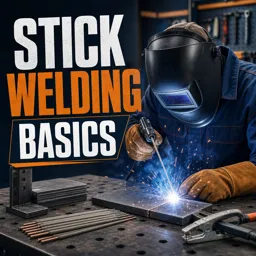
Stick welding, formally shielded metal arc welding, is the oldest and simplest of the three. The electrode is a metal rod coated in a chemical layer called flux.
When the arc strikes, two things happen at once. The metal core melts and becomes filler material for the joint. The flux coating burns and releases a shielding gas, while also forming a layer of slag that floats on top of the cooling weld and protects it as it solidifies. That slag is then chipped off with a hammer and wire brush.
Where it shines: outdoor work and rough conditions. Because the shielding comes from the flux rather than a gas cylinder, wind does not blow the protection away. Stick also handles rusty, painted, dirty or mill-scaled metal better than the other two. The equipment is portable and relatively inexpensive.
Where it struggles: thin material, where the heat tends to burn straight through. It also produces the most spatter and requires slag removal between passes, which slows the work.
MIG welding (GMAW)
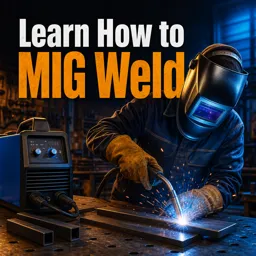
MIG — gas metal arc welding — replaces the hand-fed rod with a continuous wire fed automatically through a gun. A separate cylinder supplies shielding gas, typically argon, carbon dioxide, or a blend, which flows out of the nozzle and blankets the weld pool.
The result is a process you can run continuously. Pull the trigger and hold it, and the wire keeps feeding as you move along the joint. There is no stopping to change rods and no slag to chip.
Where it shines: speed and ease of learning. Most people produce an acceptable MIG weld faster than with either of the other processes. It handles a broad range of thicknesses and is the standard choice for auto body work, general fabrication and production settings.
Where it struggles: wind. Even a light breeze can strip away the shielding gas and ruin the weld, which makes MIG largely an indoor process. It is also less tolerant of dirty or rusty metal, and the gas cylinder reduces portability.
A close relative, flux-cored arc welding, uses a hollow wire filled with flux. It looks like MIG but carries its own shielding, which brings some of stick welding’s outdoor tolerance to a wire-fed machine.
TIG welding (GTAW)
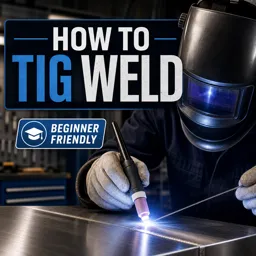
TIG — gas tungsten arc welding — works differently from the other two in one key respect. The electrode is made of tungsten and it does not melt. It only creates the arc.
That means the welder has to add filler material separately, feeding a rod into the pool with the other hand while controlling heat with a foot pedal or thumb control. Shielding comes from inert gas, almost always argon.
This two-handed, foot-controlled coordination is why TIG has a reputation for being difficult. It is also why it produces the cleanest results: the welder has independent control over heat and filler at every moment.
Where it shines: precision and appearance. TIG is the standard for thin materials, stainless steel, aluminium, and any weld that will be visible — exhaust work, bicycle frames, aerospace components, food-grade piping. There is no spatter and no slag.
Where it struggles: speed and tolerance. TIG is the slowest of the three and demands genuinely clean metal. It has the steepest learning curve and the least tolerance for outdoor conditions.
Side-by-side comparison
| Factor | Stick (SMAW) | MIG (GMAW) | TIG (GTAW) |
|---|---|---|---|
| Shielding source | Flux coating | Gas cylinder | Gas cylinder |
| Filler | The electrode itself | Fed wire | Separate hand-fed rod |
| Learning curve | Moderate | Easiest | Steepest |
| Speed | Moderate | Fastest | Slowest |
| Works outdoors | Yes | Poorly | Poorly |
| Tolerates dirty metal | Best | Moderate | Worst |
| Weld appearance | Rough | Good | Best |
| Cleanup needed | Slag chipping | Light spatter | None |
| Thin material | Difficult | Good | Excellent |
Choosing for the job in front of you
A practical way to decide is to ask three questions in order.
- Am I working outside or in wind? If yes, stick or flux-cored. Shielding gas will not survive the breeze.
- How thin is the material? Sheet metal and thin-wall tube point toward TIG. Heavy plate points toward stick or MIG.
- Will the weld be seen? Visible joints favour TIG. Welds that will be ground, painted or hidden do not justify the extra time.
Material matters too. Aluminium is generally welded with TIG or with MIG using a spool gun, since the soft wire tends to tangle in a standard feeder. Stainless steel is most often TIG welded when appearance and corrosion resistance matter. Mild steel accepts all three.
Safety is not optional
Every arc welding process produces intense ultraviolet radiation, and a few unprotected seconds can cause painful eye injury known as arc eye. An auto-darkening helmet with the correct shade rating is essential, as are flame-resistant clothing, leather gloves and closed footwear.
Welding fumes also require attention. Adequate ventilation or local fume extraction should be in place, particularly with galvanised or coated metals, which release hazardous compounds when heated. Keep a fire extinguisher within reach and clear flammable material from the area before striking an arc.
Where to start
For most beginners, MIG is the gentlest entry point: it builds confidence quickly and shows results early. Stick welding is a valuable second skill because it opens up repair work in the field. TIG is worth learning once the fundamentals of puddle control feel natural, since it rewards experience more than the other two.
Whichever you begin with, practice on scrap before committing to a real project, and run beads on flat plate until your travel speed and arc length stay consistent.
If you want structured guidance, Cursa offers free courses on welding and metal fabrication covering technique, joint preparation and workshop safety.