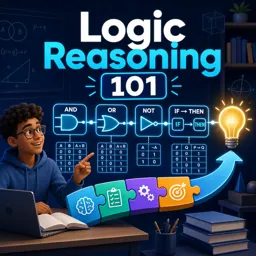
Logical reasoning is often taught through definitions and rules, but one of the fastest ways to strengthen it is by solving puzzles that force your brain to translate language into structure. The goal isn’t to become “good at puzzles” for their own sake—it’s to develop habits that transfer directly to contest problems: tracking constraints, spotting hidden assumptions, and choosing the quickest valid inference.
This article shows how to use classic logic puzzle formats (grids, sequencing, constraint satisfaction, and truth/lie scenarios) as a practical training system. Along the way, you’ll learn a repeatable workflow that can be applied to math-logic questions, argument analysis, and time-pressured tests.
1) Why puzzles work: they compress reasoning into visible steps
Many learners struggle with logical reasoning because the steps stay “in the head.” Puzzles externalize those steps: you must write constraints, test implications, eliminate contradictions, and commit to a consistent model. That makes errors easier to catch and improvements easier to measure.
When you regularly solve puzzles with written structure, you automatically build three contest-ready skills:
- Representation: converting text into diagrams, tables, or timelines.
- Constraint management: remembering what must be true vs. what could be true.
- Inference chaining: deriving new truths from multiple conditions.
2) Four puzzle types that train different reasoning muscles
Not all puzzles train the same ability. Rotating formats prevents plateauing and forces flexible thinking—useful in contests where question styles vary.
A) Logic grids (matching)
These involve pairing categories (e.g., person–city–day) using clues. They build disciplined elimination and consistency checking. Best for learning how to track multiple attributes without losing information.
B) Ordering and sequencing puzzles
These ask you to arrange items in time or rank order. They build sensitivity to “before/after,” adjacency, and position constraints—great preparation for any question that hides a conclusion inside ordering language.
C) Constraint-satisfaction (“schedule” or “assignment”)
These include rules like “A cannot be with B,” “C must be earlier than D,” and “exactly two of {E, F, G} occur.” They train you to search efficiently by building partial scenarios and pruning impossible branches.
D) Truth-tellers and liars / self-referential statements
These train precision with language, negation, and consistency. They’re excellent for spotting hidden assumptions and learning how to formalize statements (especially those involving “exactly one,” “at least,” or “if and only if”).

3) A repeatable 6-step workflow for any logic puzzle
To make puzzle practice transfer to exams, avoid random guessing and use a stable method. Here’s a workflow you can apply across formats:
- Extract entities and categories: list all items involved (people, days, numbers, options).
- Translate each clue into a constraint: rewrite in a compact form (e.g., “A < B”, “C ≠ D”, “If X then Y”).
- Create a representation: grid, timeline, table, or set notation—choose the simplest.
- Mark direct deductions: fill in what’s immediately forced.
- Hunt for “linking” clues: the ones that connect two or more constraints (these generate chains).
- Test scenarios strategically: pick a variable with few options, branch, and eliminate contradictions quickly.
4) Speed without rushing: how to get faster the right way
In contest settings, speed comes from fewer dead ends—not from moving your pencil faster. Use these tactics to reduce wasted effort:
- Prioritize high-impact constraints: clues involving “exactly,” “only,” “must,” or “cannot” often prune many possibilities.
- Write contrapositions when useful: for “If X then Y,” also remember “If not Y then not X.”
- Look for bottlenecks: variables with the fewest legal positions are ideal starting points.
- Stop overbuilding: if a question only needs one inference, don’t complete the entire puzzle unless it’s faster overall.
5) Common traps and how to avoid them
Many errors come from language, not math. Watch for these patterns:
- Confusing “or”: sometimes inclusive (A or B or both), sometimes exclusive (exactly one). If unclear, test both interpretations.
- Negation mistakes: “Not (A and B)” is not the same as “(Not A) and (Not B).”
- Quantifier slips: “All,” “some,” “none,” and “only” have strict meanings—rewrite them in your own words.
- Assuming what isn’t stated: if a rule doesn’t forbid it, it may still be allowed.
6) A practice plan you can follow (free and structured)
A strong routine is short, consistent, and reflective. Try a weekly cycle:
- Day 1–2: 2–3 grid puzzles (focus on clean setup and elimination).
- Day 3–4: 2–3 sequencing/ordering puzzles (focus on positional deductions).
- Day 5: 1 constraint-satisfaction set with branching (focus on pruning).
- Day 6: 3–5 truth/lie mini-puzzles (focus on statement precision).
- Day 7: review mistakes: rewrite the clue you misread and the step where the contradiction first appeared.
For additional study foundations that support logical clarity (reading comprehension, basic math fluency, and structured problem solving), browse https://cursa.app/free-online-basic-studies-courses and the dedicated https://cursa.app/free-courses-basic-studies-online collection.
7) Extending puzzle skill to argument questions
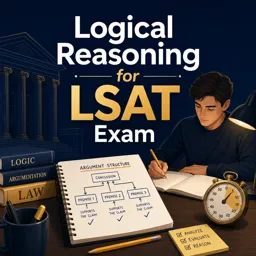
Puzzles and arguments look different, but they share the same core: premises constrain what conclusions are allowed. To transfer your puzzle skill to argumentative reasoning:
- Diagram the claim: write the conclusion at the top, premises below.
- Mark “must” vs. “could”: treat the conclusion like a “forced placement.”
- Search for missing constraints: identify the assumption that would “lock” the conclusion in place.
If you’re preparing for admissions-style logic sections, you can also explore https://cursa.app/free-online-courses/lsat-preparation for targeted practice with time-tested formats.

Conclusion: puzzles aren’t a detour—they’re a simulator
Logic puzzles create a low-stakes environment where you can practice the exact behaviors that drive performance in contests: translating language, managing constraints, and making deductions efficiently. Use a rotation of puzzle types, follow a consistent workflow, review your mistakes carefully, and you’ll notice your reasoning becoming sharper, faster, and more reliable across many question styles.