German A2 Grammar: Building Complex Sentences with Connectors

Learn essential German A2 connectors to build complex sentences, improve fluency, and express ideas clearly with practical tips and examples.

Share on Linkedin Share on WhatsApp

Estimated reading time: 3 minutes

Article image German A2 Grammar: Building Complex Sentences with Connectors

Introduction

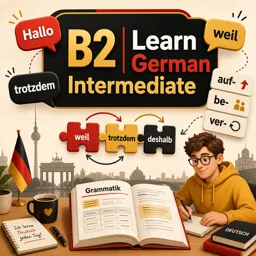
At the A2 level, you can enrich your German by connecting ideas to create more natural, detailed sentences. A key skill is using sentence connectors (Konnektoren), which join clauses and express relationships like cause, contrast, and sequence.

What Are Sentence Connectors?

Connectors link sentences or clauses to provide context and clarity. They help you show how ideas relate, making your speech and writing more coherent and fluent.

Common German Connectors at A2 Level

  • und (and): Adds similar information.
    Ich gehe ins Kino und meine Freundin geht mit.
  • aber (but): Shows contrast.
    Ich mag Pizza, aber ich esse lieber Pasta.
  • denn (because/for): Gives reasons (less formal than weil).
    Ich bleibe zu Hause, denn es regnet.
  • oder (or): Offers alternatives.
    Möchtest du Tee oder Kaffee?
  • dann (then): Describes what happens next.
    Ich frühstücke und dann gehe ich zur Arbeit.
  • deshalb (therefore/that’s why): Indicates cause and effect.
    Es ist kalt, deshalb trage ich eine Jacke.
  • weil (because): Expresses cause, but changes word order.
    Ich lerne Deutsch, weil ich in Deutschland arbeiten möchte.

Important Grammar Tips

  • Connectors like undaberoderdenn do not change the word order.
  • Connectors like weil or obwohl (although) send the conjugated verb to the end of the clause.
    Ich gehe ins Bett, weil ich müde bin.
  • Adverbs like dann usually cause inversion, where the verb comes before the subject.
    Wir essen. Dann gehen wir spazieren.

Practice: Make Your Own Sentences

Try joining these pairs with connectors:

  • Ich habe Geburtstag. Ich mache eine Party. → Ich habe Geburtstag und ich mache eine Party.
  • Es regnet. Ich gehe nicht nach draußen. → Es regnet, deshalb gehe ich nicht nach draußen.
  • Ich lerne Deutsch. Es ist schwer. → Ich lerne Deutsch, aber es ist schwer.

Conclusion

Mastering connectors lets you form complex sentences and speak German more fluently. Practice linking simple sentences and gradually build up your confidence in creating richer expressions!

Building Your Italian A2 Vocabulary: The Key Words and Phrases You Need

Expand your Italian A2 vocabulary with key words, phrases, and practical tips for confident communication in everyday situations.

Exploring Daily Life Topics in Italian A2: Your Guide to Practical Communication

 Master Italian A2 daily life topics with practical tips, vocabulary expansion, and strategies for confident speaking and listening.

How to Improve Your Speaking and Listening Skills at Italian A2 Level

Boost your Italian A2 speaking and listening skills with practical tips, audio resources, and strategies to enhance real-life communication.

Mastering Essential Italian A2 Grammar: Key Structures for Elementary Learners

Learn essential Italian A2 grammar, including irregular verbs, articles, prepositions, passato prossimo, and forming questions for elementary learners.

Mastering Italian C1 Advanced: Deepening Cultural Nuance and Expressive Mastery

Elevate your Italian to C1 with cultural immersion, nuanced grammar, and advanced communication strategies for authentic language mastery.

Italian C1 Advanced: Elevating Your Language Skills Through Authentic Materials

Elevate your Italian to C1 advanced level using authentic materials, practical strategies, and active learning techniques for fluent, confident communication.

Mastering Italian C1: Strategies for Advanced Fluency

Master Italian at the C1 level with strategies for grammar, vocabulary, comprehension, writing, and real-world fluency to reach advanced proficiency.

Navigating Italian C1: Practical Tips for Real-World Communication

Master Italian at the C1 level with practical tips for idioms, pronunciation, formal and informal language, complex texts, and real-life communication.