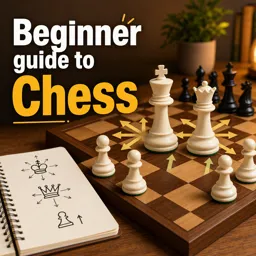


Chess has a reputation for being difficult, but the basic rules fit on a single page. If you know how each piece moves and have a few guiding ideas for the opening, you can enjoy your first games right away. This beginner-friendly guide walks you through the board, the pieces, the special moves and some simple principles that will help you avoid early mistakes.
The board and the setup
A chessboard has 64 squares in an eight-by-eight grid, alternating between light and dark. Each player starts with 16 pieces: one king, one queen, two rooks, two bishops, two knights and eight pawns. Place the board so that each player has a light square at the right-hand corner. The queen goes on her own color: the white queen on a light square and the black queen on a dark square.
White always moves first, and then players alternate turns. The goal is to checkmate the opponent’s king, which means attacking it in a way that cannot be escaped.
How each piece moves
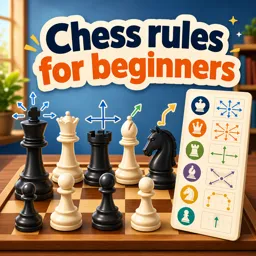
| Piece | How it moves | Good to know |
|---|---|---|
| King | One square in any direction | Cannot move into check |
| Queen | Any number of squares in a straight line or diagonal | The most powerful piece |
| Rook | Any number of squares horizontally or vertically | Works well on open files |
| Bishop | Any number of squares diagonally | Stays on one color for the entire game |
| Knight | An "L" shape: two squares in one direction, then one to the side | The only piece that can jump over others |
| Pawn | Forward one square (two on its first move); captures diagonally | Promotes when it reaches the far side |
Every piece except the pawn captures the same way it moves, by landing on the square of an opponent’s piece. Pawns are different: they move straight ahead but capture one square diagonally forward.
Special moves beginners often miss
Three rules surprise many newcomers, so it is worth learning them early:
- Castling: the king moves two squares toward a rook, and the rook jumps to the other side of the king. You can castle only if neither piece has moved, the squares between them are empty, and the king is not in check or passing through an attacked square.
- En passant: if an opponent’s pawn moves two squares and lands beside your pawn, you may capture it as if it had moved only one square, but only on your very next move.
- Promotion: when a pawn reaches the opposite end of the board, it must become a queen, rook, bishop or knight. Most players choose a queen.
Check, checkmate and draws
When a king is under attack, it is in check, and the player must respond immediately. You can move the king, block the attack or capture the attacking piece. If none of these options is possible, it is checkmate and the game ends.
Not every game has a winner. A stalemate occurs when the player to move has no legal move but is not in check, and the game is a draw. Games can also end in a draw by agreement, by repetition of the same position, or when neither side has enough material to checkmate.
Three opening principles
You do not need to memorize long sequences to play a sensible opening. Focus on these ideas instead:
- Control the center. Pawns and pieces that influence the central squares have more room to move. Moving a central pawn forward on your first turn is a common start.
- Develop your pieces. Bring knights and bishops out early, and avoid moving the same piece several times in the opening unless there is a clear reason.
- Keep your king safe. Castle early to tuck the king behind a wall of pawns and connect your rooks.
It also helps to avoid bringing your queen out too early. She is powerful, but she can be chased around by smaller pieces, costing you valuable time.
Rough piece values
Players often use a simple point scale to decide whether a trade is good. A pawn is worth about one point, a knight or bishop about three, a rook about five and a queen about nine. The king has no value because losing it ends the game. This scale is only a guide, since position and tactics can change a piece’s real worth, but it helps beginners avoid giving up a rook for a pawn.
Habits that improve your game quickly
- Before each move, ask yourself what your opponent is threatening.
- Check whether the piece you are moving leaves something undefended.
- Play slowly at first; speed comes with experience.
- Review your games afterward and look for moments where you missed a threat.
- Solve short tactical puzzles to train pattern recognition.
Conclusion
Chess rewards patience and curiosity. Once you know how the pieces move and follow a few opening principles, you are ready to play and learn from every game. If you enjoy strategy and board games, explore the related courses on Cursa to keep developing your logic, planning and decision-making skills.