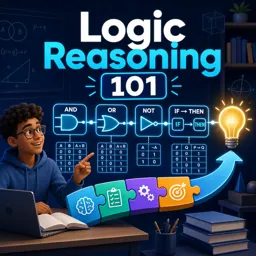
Logical Reasoning looks “theoretical” from the outside, but the fastest progress comes from treating it like a skill: you diagnose patterns, practice deliberately, and track errors like an athlete tracks training blocks. This article gives you a structured plan to study mathematical and argumentative reasoning without relying on memorization—so you can perform under time pressure in exams and contests.
1) Start with a “logic toolbox” (the minimum you must recognize instantly)
Before solving dozens of questions, build automatic recognition of the common building blocks that appear in arguments and formal statements. Aim for instant familiarity with:
- Connectives: “and”, “or”, “if…then”, “only if”, “unless”, “either…or”, “not both”.
- Quantifiers: “all”, “some”, “none”, “most”, “exactly one”, “at least / at most”.
- Argument anatomy: conclusion, premises, background, and hidden assumptions.
- Common traps: shifting terms, ambiguous pronouns, scope confusion (“not all” vs “all not”).
Make a one-page reference sheet (digital or paper) with these items and examples you’ve personally rewritten into clearer forms. The goal is not to “know definitions”—it’s to recognize structures immediately when they appear.
2) Learn translation: convert English into a precise statement
Many errors come from misreading everyday language. Translation practice is a high-return drill because it improves both mathematical logic and argument questions.
Use a simple method:
- Underline indicators (if, only if, unless, all, some, must, cannot).
- Name key ideas with letters (e.g., P: “passes the exam”, S: “studies”).
- Write the structure (e.g., “Only if S, P” becomes P → S).
- Test with a quick counterexample to verify direction.
Mini-drill (do it fast): Rewrite these in a more precise way:
(a) You can graduate only if you complete the project.
(b) Unless you practice, you won’t improve.
(c) Not all solutions are efficient.
3) Build an “error log” that targets reasoning—not just answers
To improve reliably, track mistakes by reason type. After every practice set, record:
- Question type: assumption, inference, contradiction, quantifiers, conditional chains, etc.
- Failure mode: misread quantifier, reversed conditional, missed a hidden premise, diagram error, time panic.
- Fix: one sentence stating the rule you violated and the correct pattern.
Over time, your error log becomes a personalized syllabus. Instead of “I got 7 wrong,” you’ll see “I reverse ‘only if’ twice per set” or “I confuse ‘some’ with ‘most’.” That’s actionable.

4) Use two modes of practice: untimed precision + timed execution
Reasoning performance has two separate skills:
- Precision mode (untimed): you prove to yourself you can do it correctly, step by step.
- Execution mode (timed): you maintain accuracy under constraints.
A practical split is 70/30 at the beginning (more precision), then gradually move to 40/60 as accuracy stabilizes. In precision mode, you must write the full reasoning chain; in timed mode, you practice choosing the fastest valid method(diagram vs. elimination vs. direct inference).
5) Strengthen arguments by mastering assumptions (without turning it into debate)
Assumption work is central to many contests and admissions-style reasoning tasks, but it’s often taught too abstractly. Use this concrete method:
- Find the conclusion (what is being claimed).
- Find the support (why they think it’s true).
- Spot the gap (what would have to be true for the support to guarantee the conclusion).
- Negate-test candidates: if a statement is necessary, negating it should collapse the argument.
Train with “gap sentences”: After reading an argument, write one sentence starting with “This reasoning assumes that…”. Even if you don’t see options, you’re building the instinct that multiple-choice questions reward.
6) Learn to diagram only when it saves time
Diagrams are powerful for conditional chains and constraints, but over-diagramming can slow you down. A simple rule:
- Diagram when relationships stack (A → B → C), when you see “unless / only if,” or when multiple conditions interact.
- Don’t diagram when the task is mostly verbal (strengthen/weaken with a single missing link) and elimination is faster.
Practice making diagrams “thin”: use minimal symbols and avoid rewriting the whole prompt. The best diagrams are quick, not pretty.
7) A weekly routine you can repeat (and scale up)
Here’s a simple cycle that fits most learners and keeps progress measurable:
- Day 1: Translation drills + 10–15 mixed questions (untimed).
- Day 2: Assumption/gap practice + review error log.
- Day 3: Conditional/quantifier focus set + diagram speed drill.
- Day 4: Timed mini-section + deep review (why each wrong option is wrong).
- Day 5: Mixed timed set + redo previously missed questions.
- Day 6: Light day: flash review of your toolbox + 5 hard questions slowly.
- Day 7: Rest or full review of the week’s top 3 recurring mistake patterns.
Keep the routine stable for a few weeks. Change content focus (e.g., quantifiers this week, assumptions next week), not the entire structure—consistency is what makes improvement visible.

8) Where to continue learning (free course paths)
To deepen your practice, explore the Logical Reasoning course list and build a playlist that matches your error log categories. Start here: https://cursa.app/free-courses-basic-studies-online. If you want a broader foundation that supports reasoning performance (reading clarity, study habits, and core skills), browse: https://cursa.app/free-online-basic-studies-courses.
If your goals include exams that heavily emphasize formal argument analysis, you can also use targeted practice resources under: https://cursa.app/free-online-courses/lsat-preparation. Even if you’re not taking that exam, the training style can be excellent for sharpening assumption, inference, and flaw recognition.
Conclusion
A strong Logical Reasoning strategy is simple: build fast recognition of structures, translate language precisely, track mistakes by reasoning pattern, and split practice into precision and execution. Do that consistently, and your progress becomes predictable—because you’re training the causes of errors, not just collecting more questions.