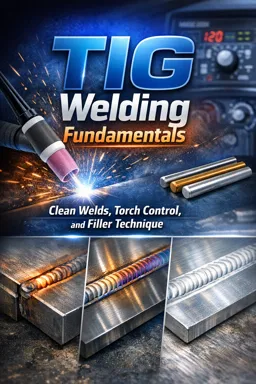

Free ebook on TIG welding fundamentals: clean welds, torch control, filler technique, gas shielding, setup, and defect prevention.
Free ebook content
-

TIG Welding Fundamentals: Safety, Workspace Setup, and Cleanliness Standards
+ Exercise: When setting up ventilation for TIG welding, which approach best controls fumes without causing weld contamination?
-
TIG Torch Anatomy and Consumables for Clean Welds
+ Exercise: You need extra tungsten stick-out to reach a tight corner while keeping shielding coverage consistent. Which torch setup best supports this goal?
-
Shielding Gas Basics: Argon Flow, Coverage, and Oxidation Prevention
+ Exercise: You notice oxidation getting worse even after turning the argon flow up higher than your normal setting. Which adjustment best matches the likely cause and recommended fix?
-
Tungsten Types, Selection, and Preparation for Stable Arc Control
+ Exercise: You’re TIG welding steel on DCEN and want a tight, controllable arc with fewer arc-wander issues. Which tungsten tip preparation best supports this goal?
-
Machine Setup: Polarity, AC Balance Concepts, and Amperage Ranges for Beginners
+ Exercise: When setting up TIG welding on aluminum in AC mode, which adjustment is most likely to help if the puddle looks contaminated and refuses to wet out at the edges despite good gas coverage?


-
Arc Starts, Arc Length, and Torch Angle: The Foundations of TIG Weld Appearance
+ Exercise: During TIG welding, you notice one side of the bead wets in smoothly while the other side stays tall and sharp. Which adjustment most directly addresses this issue?
-
Hand Coordination: Filler Rod Feeding Techniques and Puddle Timing
+ Exercise: During TIG welding, what practice best helps prevent porosity caused by an oxidized filler tip between dips?
-
Joint Fit-Up and Tacking for TIG Welding: Butt, Lap, and Fillet Practice
+ Exercise: When TIG welding, what is the most likely result of an inconsistent or excessive open gap in a joint fit-up?
-
Building Clean Beads on Mild Steel: Heat Control and Bead Consistency
+ Exercise: While practicing straight TIG stringer beads on mild steel, your bead becomes progressively wider and flatter as you move along the plate. What is the best first adjustment to make?
-
Clean TIG on Stainless Steel: Color Control, Sugaring Avoidance, and Crack Prevention
+ Exercise: A stainless TIG bead is showing a wide, dark blue/gray heat tint band around the weld. Which adjustment best addresses the likely cause?
-
TIG on Aluminum Fundamentals: Oxide Management, AC Technique, and Puddle Control
+ Exercise: When a TIG weld puddle on aluminum looks dull or “skin-like” and resists opening, what is the most likely first issue to address?
-
Contamination, Porosity, Oxidation, and Cracking: Diagnosing and Fixing Common TIG Problems
+ Exercise: When TIG weld quality suddenly degrades, what is the best first step in a repeatable reset procedure?
-
Finishing Skills: Crater Fill, Stop/Restart Control, and Bead Blending for Clean Results
+ Exercise: During a TIG weld stop, which sequence best prevents a concave crater and end cracking while keeping the termination clean?
About the free ebook
TIG Welding Fundamentals: Clean Welds, Torch Control, and Filler Technique
Build practical TIG welding skills with this free ebook focused on producing clean, controlled welds. Learn how preparation, shielding gas, tungsten condition, machine settings, and steady hand movement work together to shape weld quality.
Develop a clean-welding process
Explore safe workspace practices and the cleanliness standards that help prevent contamination. The ebook explains how torch components, consumables, argon coverage, and tungsten preparation affect arc stability and weld appearance.
Control the arc, heat, and filler
Strengthen the core movements behind TIG welding: maintaining arc length, choosing a torch angle, managing heat input, and feeding filler rod smoothly into the puddle. Clear guidance supports more consistent beads on mild steel, stainless steel, and aluminum.
Recognize and correct common defects
Learn to identify causes of porosity, oxidation, sugaring, cracking, and contamination. Practical troubleshooting principles help you improve joint fit-up, tack welds, starts and stops, crater filling, and final bead blending.
What you will be able to focus on
- Stable arc control and cleaner bead appearance
- Gas shielding and oxidation prevention
- Tungsten, polarity, and amperage decisions
- Filler timing and coordinated hand movement
- Material-specific TIG considerations
- Defect diagnosis and finishing techniques
Note: TIG welding involves heat, electricity, intense light, and fumes. Use appropriate personal protective equipment and follow applicable safety procedures.
What causes porosity in TIG welds?
Porosity commonly results from poor gas coverage, contaminated base metal or filler, leaks, drafts, or an improperly prepared tungsten.
How can I prevent stainless steel TIG weld sugaring?
Keep surfaces clean, maintain proper shielding, control heat input, and use backside purge protection when the joint requires it.
Why does my TIG tungsten become contaminated?
Tungsten is often contaminated when it touches the filler rod or weld puddle, or when inadequate shielding allows oxidation.
This ebook includes:

13 content chapters

Digital certificate of course completion (Free)

Exercises to train your knowledge

100% free, from content to certificate
Ready to get started?

 recommended
In the app you will also find...

Over 5,000 free courses
Programming, English, Digital Marketing and much more! Learn whatever you want, for free.

Study plan with AI
Our app's Artificial Intelligence can create a study schedule for the course you choose.

From zero to professional success
Improve your resume with our free Certificate and then use our Artificial Intelligence to find your dream job.
You can also use the QR Code or the links below.