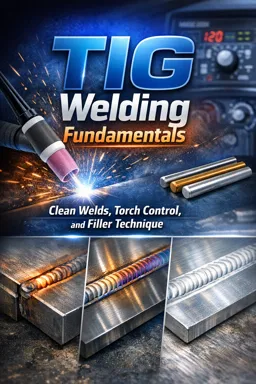
Stainless-Specific Priorities: Why Color Matters
On stainless steel, weld appearance is not just cosmetic. The surface color around the bead is a quick indicator of how much oxidation occurred during welding, which correlates with how much the chromium-rich protective layer was disturbed. Excessive oxidation can reduce corrosion resistance, especially in aggressive environments.
What the colors generally indicate (practical interpretation)
- Bright/silver to very light straw: typically indicates good shielding and controlled heat input.
- Straw to light blue: often acceptable for many non-critical uses, but suggests higher heat input and/or marginal shielding.
- Dark blue, purple, gray, or sooty: indicates heavy oxidation from too much heat, poor gas coverage, or both; corrosion resistance is more likely compromised.
Use color as feedback: if you are chasing “silver,” you are usually chasing the right combination of tight arc length, adequate gas coverage, and minimal time at high temperature.
Heat Input Control on Stainless: The Real Goal
Stainless holds heat and distorts readily, and it oxidizes quickly when overheated. Your goal is to keep the weld zone hot enough to fuse, but not hot for longer than necessary.
Practical levers you can use (without changing basic machine theory)
- Travel speed: slightly faster travel reduces time-at-temperature and helps keep colors lighter.
- Bead size discipline: avoid “overbuilding” the bead; extra reinforcement usually means extra heat and darker colors.
- Interpass temperature awareness: if the part is getting progressively hotter, pause and let it cool so the next section doesn’t oxidize more.
- Sequence and tacking: short weld segments and more tacks can reduce distortion and restraint-related cracking risk.
Practice Structure: Stainless Sheet/Plate Beads with Color Control
This practice is designed to build repeatable stainless beads while actively managing oxidation color and bead profile. Use clean stainless coupons (sheet or plate) and keep your process consistent so you can see cause-and-effect.
Step-by-step: “Color-controlled straight beads” drill
- Set up for consistency: clamp the coupon flat, mark a straight guideline, and plan a bead length you can complete without stopping.
- Start with a tight arc length: keep the arc short and stable; a longer arc spreads heat, increases oxidation, and often darkens color.
- Confirm gas coverage behavior: position the torch so the gas envelope stays over the puddle and the cooling bead. If the bead darkens immediately behind the torch, suspect inadequate coverage or moving the torch away too quickly.
- Establish a small, controlled puddle: aim for the smallest puddle that still wets both sides of the bead path. Oversized puddles are a common cause of blue/gray heat tint.
- Add filler deliberately (don’t “paint”): add filler to control bead profile and reduce undercut. On stainless, filler also helps moderate the puddle by adding mass, which can reduce overheating of the base metal edges.
- Maintain steady travel: avoid micro-pauses. Pausing in one spot is a fast way to create a dark halo and excessive heat tint.
- Finish without overheating the crater: reduce heat smoothly at the end and add a small amount of filler to avoid a concave crater (a common crack starter on stainless).
What to look for after each bead
- Color band width: a narrow heat tint band usually indicates lower heat input and better control.
- Color intensity: darker colors suggest too much heat, poor coverage, or lingering too long at the end.
- Bead profile: a slightly convex, well-supported bead is often preferable to a wide, flat bead that required excessive heat to spread.
Gas Coverage on Stainless: Keeping the Shield Where It Matters
Stainless is unforgiving when the molten puddle or hot metal is exposed to air. The key is not only having shielding gas, but keeping it covering the puddle and the bead as it cools through oxidation-sensitive temperatures.
- Listen to the audio with the screen off.
- Earn a certificate upon completion.
- Over 5000 courses for you to explore!

Download the app
Practical habits that improve coverage
- Keep the torch centered over the puddle: drifting off-center exposes one edge, often showing as uneven color (one side darker).
- Don’t outrun your shielding: moving too fast with poor torch positioning can leave the cooling bead outside the gas envelope.
- Protect the stop/start area: restarts often show the worst oxidation because the bead is reheated and the torch may not be settled yet.
Deliberate Filler Use: Bead Profile, Heat Management, and Crack Resistance
On stainless, filler is not just “adding metal.” It is a tool to shape the bead, support edges, and reduce the risk of defects tied to overheating.
Practical filler principles for stainless beads
- Use filler to prevent undercut: if the toes are washing away, add filler sooner and keep the puddle smaller.
- Avoid starving the puddle: autogenous (no-filler) welds on stainless can be more crack-prone in some joint conditions and can produce concave profiles that concentrate stress.
- Don’t overfill: excessive reinforcement usually means excessive heat and slower travel, which can darken colors and increase distortion.
Back Purging: Preventing Sugaring and an Oxidized Root
When welding stainless joints where the backside of the weld is exposed to air (common in tube, pipe, and certain sheet joints), the root side can oxidize heavily. This rough, crusty oxidation is often called sugaring. Sugaring is not just ugly—it can severely reduce corrosion resistance and create a rough surface that traps contaminants.
When back purging is worth doing
- Butt joints with full penetration where the root will be exposed to service environment.
- Tube/pipe welds where the inside surface must remain smooth and corrosion-resistant.
- Sanitary or corrosion-critical work where internal oxidation is unacceptable.
Practical outcomes to target
- No crusty, granular root surface: the root should look smooth and metallic rather than rough and gray.
- Consistent root color: a clean root indicates the backside was protected during the critical cooling period.
Step-by-step: Simple back purge setup for a small butt joint
- Seal the purge volume: tape or use purge dams to close openings so purge gas can displace air. The goal is a small, controllable volume.
- Add a purge inlet and a vent: introduce purge gas on one side and allow a small vent on the other so air can escape rather than pressurizing the joint.
- Pre-purge before welding: allow enough time for the purge gas to displace air. Rushing this step is a common cause of sugaring even if you purge during welding.
- Maintain purge during welding and initial cooling: keep purge flowing while the root is molten and as it cools. Stopping too early can still oxidize the root.
- Check the root after a short test weld: do a small sample weld and inspect the backside. If you see rough gray oxidation, improve sealing, increase purge time, or reduce leaks before continuing.
Common purge problems and what they look like
| Symptom | Likely cause | Practical fix |
|---|---|---|
| Root is rough/granular (sugaring) | Air present at root during welding | Improve sealing, extend pre-purge time, ensure a vent path |
| Root is partially clean, partially sugared | Leaks or uneven purge flow | Find leaks, reduce purge volume, stabilize purge routing |
| Root looks oxidized near the end of the weld | Purge stopped too early or vent blocked | Maintain purge longer; confirm vent is open |
Hot Cracking Avoidance: Filler Choice, Heat Control, and Restraint
Stainless can be susceptible to hot cracking (solidification cracking) when the weld metal is solidifying and is pulled apart by shrinkage stresses. This risk increases with high heat input, certain joint conditions, and excessive restraint.
General filler selection principles (kept intentionally broad)
- Match filler to base metal family and service: use a filler intended for the stainless grade/application rather than “whatever is on hand.”
- Prefer fillers known for crack resistance in stainless: many stainless fillers are formulated to reduce cracking tendency compared to autogenous welds or mismatched fillers.
- When in doubt, follow a qualified recommendation: if the job is corrosion-critical or code-related, select filler based on a proven procedure or supplier guidance.
Step-by-step: Practical habits that reduce hot cracking risk
- Avoid a wide, overheated puddle: keep the puddle compact; wide puddles increase shrinkage stress and can promote centerline cracking.
- Use enough filler to avoid a concave bead: concavity concentrates stress and can crack as the weld contracts.
- Control the crater at the end: taper heat down and add a final small dab of filler so the crater is filled and supported.
- Reduce restraint where possible: overly rigid clamping and tight fit-ups that cannot move can force the weld to crack as it shrinks.
- Use smart weld sequencing: stagger welds, use short segments, and alternate sides (when applicable) to balance shrinkage.
Restraint and joint fit-up: what to avoid
- Forcing parts into alignment with heavy clamping: if the joint is under stress before welding, it will be under more stress during solidification.
- Zero-gap fit-up on joints needing penetration: overly tight joints can require more heat to achieve fusion, increasing oxidation and cracking risk.
- Long continuous welds on thin stainless without breaks: continuous heat builds distortion and stress; use stitch strategy when appropriate.
Quick Troubleshooting: Color, Root Condition, and Cracks
| Issue | What you see | Most common corrections |
|---|---|---|
| Excessive heat tint | Wide dark blue/gray band | Reduce time-at-temperature (faster travel), keep puddle smaller, improve gas coverage over cooling bead |
| Uneven color side-to-side | One toe darker | Re-center torch, stabilize hand position, ensure consistent coverage across both edges |
| Sugaring on root | Rough, crusty gray root | Back purge with better sealing, longer pre-purge, maintain purge through cooling |
| End crater crack | Small crack at weld termination | Fill crater with filler, taper heat down smoothly, avoid abrupt stop |
| Centerline crack tendency | Fine crack along bead center | Reduce heat input, adjust filler choice to a more crack-resistant option, reduce restraint and improve sequencing |