

Free ebook on nursing fundamentals, covering safe bedside skills, vital signs, comfort care, mobility, documentation, and communication.
Free ebook content
-

Nursing Fundamentals for Safe Bedside Practice: Safety, Roles, and Clinical Communication
+ Exercise: During routine vital signs, you find BP 86/50 and HR 118 and the patient looks pale. What is the safest next step?
-
Nursing Fundamentals: Vital Signs Measurement and Trend Recognition
+ Exercise: A post-op patient’s respiratory rate has risen steadily over several hours while SpO2 remains stable on low-flow oxygen. What is the most appropriate nursing response?
-
Nursing Fundamentals: Pain Assessment, Comfort Measures, and Reassessment
+ Exercise: A nurse is caring for a nonverbal, intubated patient who appears restless and grimaces during turning. What is the most appropriate approach to assess pain and evaluate the response to comfort measures?
-
Nursing Fundamentals: Hygiene, Skin Care, and Bedside Comfort Care
+ Exercise: During bedside hygiene, which approach best supports infection prevention while also improving early detection of skin breakdown?


-
Nursing Fundamentals: Mobility Assistance, Transfers, and Fall Prevention
+ Exercise: While assisting a patient to ambulate, the patient suddenly reports new lightheadedness. What is the safest immediate action?
-
Nursing Fundamentals: Intake and Output, Hydration Status, and Daily Weights
+ Exercise: A patient’s 24-hour I&O shows a net fluid balance of -1200 mL, but their daily weight increased from 70.0 kg to 71.2 kg. Which interpretation best fits this mismatch?
-
Nursing Fundamentals: Basic Oxygen Therapy Concepts and Respiratory Support Awareness
+ Exercise: A patient on oxygen via simple face mask becomes more short of breath and the SpO2 trend is decreasing. Before increasing the oxygen setting, what is the most appropriate nursing action?
-
Nursing Fundamentals: Specimen Collection and Point-of-Care Basics for Accurate Results
+ Exercise: Which action best reduces contamination risk when collecting a urine specimen for culture from an indwelling urinary catheter?
-
Nursing Fundamentals: Documentation Essentials and Shift Communication for Continuity of Care
+ Exercise: Which documentation entry best demonstrates objective, action-oriented charting that links assessment, intervention, and reassessment (AIR loop) for an abnormal SpO2 after ambulation?
About the free ebook
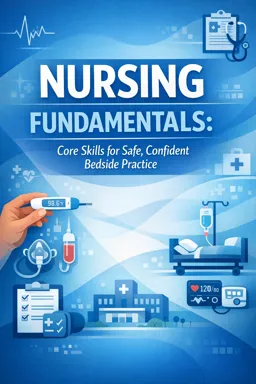
Nursing Fundamentals: Core Skills for Safe, Confident Bedside Practice
This free online ebook builds a practical foundation for safe, attentive bedside nursing. It focuses on the everyday clinical skills that support patient comfort, accurate observation, clear communication, and continuity of care.
Build safe habits at the bedside
Learn how safety awareness, professional roles, and structured communication guide nursing actions. The ebook emphasizes observing the patient as a whole, recognizing changes promptly, following local policies, and escalating concerns through the appropriate clinical chain.
Strengthen assessment and comfort care
Explore essential approaches to measuring vital signs, recognizing meaningful trends, assessing pain, supporting hygiene, protecting skin integrity, and providing respectful comfort care. Practical guidance highlights the value of reassessment and accurate reporting after an intervention.
Support mobility, hydration, and breathing awareness
Develop a clearer understanding of safe transfers, fall-prevention measures, intake and output tracking, daily weights, hydration observations, and basic oxygen therapy awareness. These skills help nurses identify risks and contribute to timely, coordinated care.
Improve accuracy and continuity
The ebook also addresses specimen collection, point-of-care testing awareness, documentation, and shift communication. It reinforces the importance of confirming patient identity, recording facts objectively, and communicating relevant changes clearly.
For learning and supervised practice
This resource supports nursing students, new care team members, and professionals refreshing core concepts. It complements clinical instruction, organizational procedures, and supervision; it does not replace local policies, scope-of-practice requirements, or clinical judgment.
- Apply patient-safety principles in routine care.
- Recognize observations that require prompt reporting.
- Document and communicate care with clarity.
How can nurses recognize meaningful vital-sign trends?
Compare current findings with baseline values, repeat questionable readings, assess symptoms, and report concerning changes promptly.
What should be documented after a pain intervention?
Record the assessment findings, intervention provided, patient response, reassessment, and any needed follow-up or escalation.
Why are daily weights important in nursing care?
Consistent daily weights can reveal fluid-balance changes and should be measured using the same method whenever possible.
This ebook includes:

9 content chapters

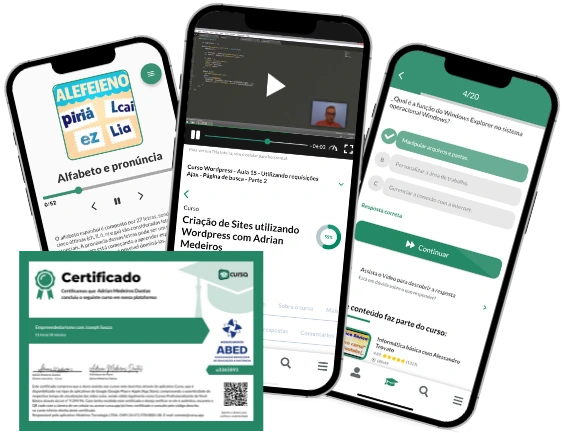
Digital certificate of course completion (Free)

Exercises to train your knowledge

100% free, from content to certificate
Ready to get started?

 recommended
In the app you will also find...

Over 5,000 free courses
Programming, English, Digital Marketing and much more! Learn whatever you want, for free.

Study plan with AI
Our app's Artificial Intelligence can create a study schedule for the course you choose.

From zero to professional success
Improve your resume with our free Certificate and then use our Artificial Intelligence to find your dream job.
You can also use the QR Code or the links below.