Exercises
Explore how major Christian traditions and theologians have explained the saving significance of Christ's life, death, and resurrection. This quiz examines Christus Victor, ransom, satisfaction, penal substitution, moral influence, governmental, and recapitulation models. It also covers key biblical passages, theological terminology, Eastern Christian emphases, and the value of treating atonement models as complementary rather than automatically exclusive.
Answer the questions below and check the explanation for each answer.
0/14 answered
Auto audio on: the next questions will be read aloud when you click Continue.

Christus Victor interprets Christ's saving work as a victory over sin, death, and hostile spiritual powers, liberating humanity from their dominion.
Anselm argued that sin dishonors God and disrupts the proper moral order. Humanity owes satisfaction but cannot adequately provide it, so the God-man offers satisfaction on humanity's behalf.

Penal substitution specifically emphasizes Christ bearing sin's judicial penalty in the place of sinners. Anselm's account focuses more directly on satisfaction for dishonored divine honor and disrupted order.
The moral influence model emphasizes that Christ's loving self-sacrifice reveals divine love, moves sinners toward repentance, and inspires a transformed life of love and obedience.

Governmental theory treats Christ's suffering as a public demonstration of the seriousness of sin and God's commitment to moral order, enabling God to forgive without abandoning righteous governance.
The ransom model uses the language of captivity and liberation. Its central point is that Christ frees humanity from bondage to sin, death, and evil; not every version requires a literal payment to Satan.

In recapitulation, Christ becomes the new head of humanity and faithfully retraces human existence. His obedience reverses Adam's disobedience and restores human life toward its intended end.
Objective models emphasize what Christ's work accomplishes regarding guilt, justice, reconciliation, or bondage. Subjective models focus on its transforming effect within people, such as awakening love or repentance.
Colossians 2:15 depicts Christ disarming hostile rulers and authorities and triumphing over them. This victory language is foundational for Christus Victor interpretations.

Passover includes sacrifice, protection, deliverance, and covenant identity. Christian interpretation can therefore draw several related atonement themes from it without restricting it to one model.
Propitiation emphasizes the appeasement or turning away of righteous wrath. Expiation emphasizes cleansing or removing sin and guilt. The concepts may be closely related in atonement theology.
Aquinas did not confine the atonement to one mechanism. He explained Christ's Passion through interconnected categories such as merit, satisfaction, sacrifice, redemption, and efficient causality.
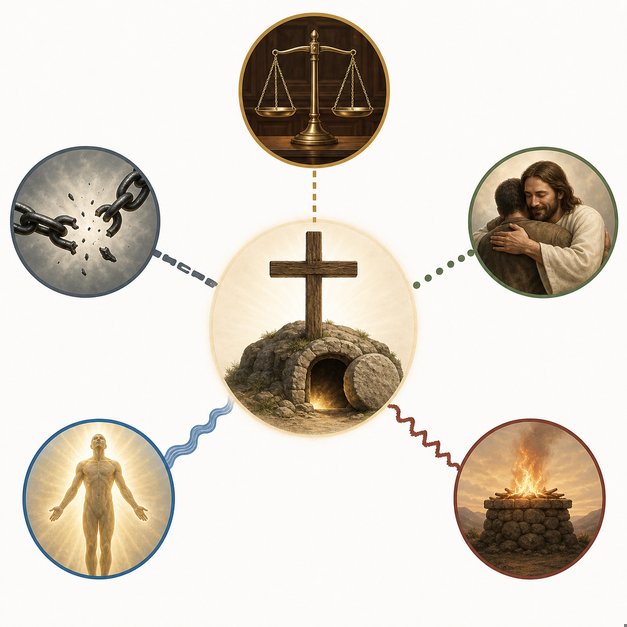
Scripture uses legal, sacrificial, relational, military, and healing imagery. Several models can therefore be complementary, although their particular claims still require careful evaluation.

Eastern Christian theology often emphasizes salvation as healing, liberation from corruption and death, and participation in divine life through Christ. The incarnation, death, and resurrection form one saving movement.
Thousands of online courses in video, ebooks and audiobooks.
To test your knowledge during online courses
Generated directly from your cell phone's photo gallery and sent to your email

Download our app via QR Code or the links below:.



Carry knowledge in your pocket.
Download the Cursa app.
There are hundreds of free courses available, with a free certificate of completion that is saved in your mobile image gallery.
Download the app to access the Course Completion Certificate for Free.


+ 10 million
students

Free and Valid
Certificate

60 thousand free
exercises

4.8/5 rating in
app stores

Free courses in
video and ebooks