
Exercises
Learn to choose Spanish demonstratives accurately according to distance, gender, and number. This quiz covers the este, ese, and aquel families; neuter forms such as esto and eso; demonstratives used without nouns; agreement with special feminine nouns; and current spelling conventions. The questions combine practical scenes with increasingly challenging grammar distinctions.
Answer the questions below and check the explanation for each answer.
0/14 answered
Auto audio on: the next questions will be read aloud when you click Continue.

Este refers to a masculine singular object close to the speaker. The book is in the speaker's hands.

Esas agrees with the feminine plural noun sillas and indicates that the chairs are near the listener rather than the speaker.

Aquellas expresses distance from both participants and agrees with the feminine plural noun montañas.
Esta is feminine singular and refers to something associated closely with the speaker, such as the shirt the speaker is wearing.
Eso is a neuter demonstrative. It can refer to an idea, statement, event, or unidentified matter rather than to a specific masculine or feminine noun.
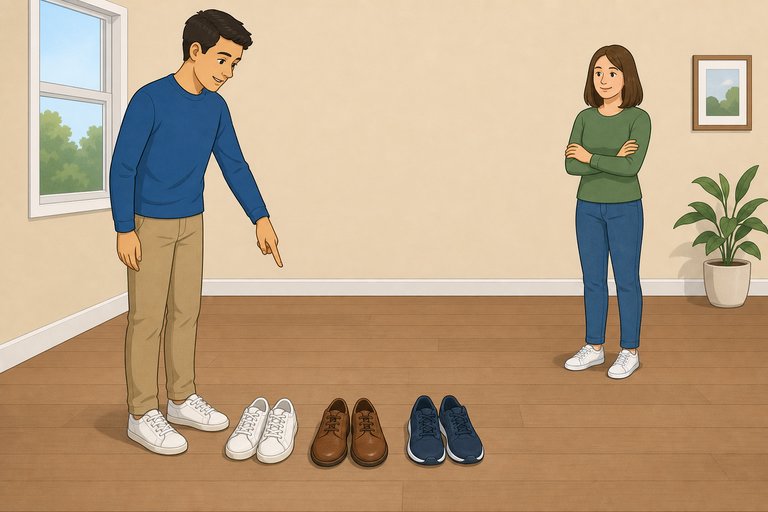
Estos indicates proximity to the speaker and agrees with the masculine plural noun zapatos.
Both words must be masculine plural: aquellos edificios. Spanish demonstratives agree with their nouns in gender and number.

Ese replaces the understood masculine singular noun vestido and indicates proximity to the listener. It normally carries no written accent.
Current standard spelling normally writes demonstratives without an accent mark, whether they accompany a noun or replace one. An accent is not required to distinguish pronoun use.
Eso is the neuter form in the ese series. Neuter demonstratives do not have plural forms and do not directly modify nouns.

Aquella taza is correct because the object is far from both the speaker and the listener. Aquella also agrees with feminine singular taza.
Eso can refer to the entire news item or statement. The gendered forms ese and esta would normally replace identifiable nouns.
Estas is correct because águilas is feminine plural. The singular expression el águila uses el for sound reasons, but the noun remains feminine.
Aquellos agrees with masculine plural días and can express remoteness in time. The preposition de is already placed before the demonstrative.
Free CourseSpanish for Kids
5

(3)

53m
Free CourseSpanish course A2
5
(4)
11h23m
Free CourseSpanish Verbs for beginners
5
(4)
3h42m

15 exercises
Free CourseSpanish course A1
4.8
(11)
10h51m
6 exercises
Free CourseSpanish
4.8
(406)
6h22m
11 exercises
Free CourseSpanish full course B1
4.8
(5)
1h29m
15 exercises
Free CourseSpanish for Beginners: Essential Grammar and Vocabulary (Season 1)
4.7

(7)
5h23m
20 exercises

Free CourseSpanish
4.7
(56)
8h55m
27 exercises
Thousands of online courses in video, ebooks and audiobooks.
To test your knowledge during online courses
Generated directly from your cell phone's photo gallery and sent to your email

Download our app via QR Code or the links below:.


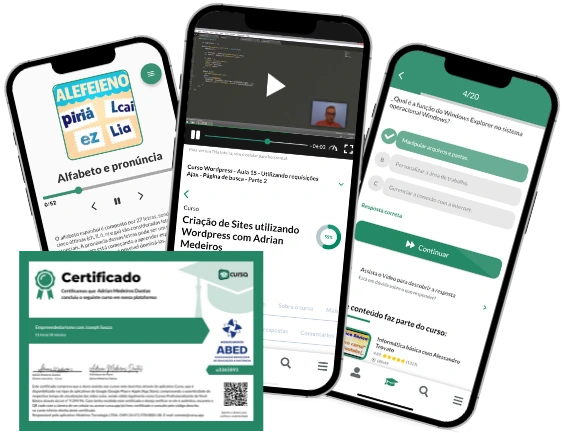
Carry knowledge in your pocket.
Download the Cursa app.
There are hundreds of free courses available, with a free certificate of completion that is saved in your mobile image gallery.
Download the app to access the Course Completion Certificate for Free.


+ 10 million
students

Free and Valid
Certificate

60 thousand free
exercises

4.8/5 rating in
app stores

Free courses in
video and ebooks