
Exercises
Challenge your command of the Spanish subjunctive mood with this advanced grammar quiz. Practice selecting correct forms of hablar, ser, ir, entender, and poder in realistic sentence contexts. Questions cover key subjunctive triggers, impersonal expressions, doubt and uncertainty, conditional clauses, the imperfect subjunctive, present perfect subjunctive, and past perfect subjunctive. Strengthen your understanding of when and how to use the subjunctive accurately in spoken and written Spanish.
Answer the questions below and check the explanation for each answer.
0/10 answered
Auto audio on: the next questions will be read aloud when you click Continue.
In the sentence, the phrase Es importante que signals the use of the subjunctive mood. The correct subjunctive form for the verb hablar for the subject tú is hables. So, the correct answer is option 2: hables.
In Spanish, the 'si' clause that describes hypothetical or contrary-to-fact situations uses the imperfect subjunctive. Here, the correct form of the verb 'ser' in the imperfect subjunctive is fuera, because it expresses a hypothetical situation. Therefore, the correct sentence is: 'Si yo fuera millonario, viajaría por todo el mundo.'
The subjunctive mood is properly used in Option 3 'Quiero que me digas la verdad.' because it expresses a desire or wish for someone else to perform an action, which is when the subjunctive is typically used.
In Option 1, it should be 'Es probable que llueva mañana.' and in Option 2, 'Ojal' should have an accent 'Ojalá'.
The subjunctive form is used to express doubt or uncertainty. In the sentence 'No parece que ______ (nosotros) a llegar a tiempo,' the context suggests a situation of uncertainty, hence the subjunctive mood is appropriate. The correct subjunctive form for 'ir' in the nosotros form is vayamos. Therefore, the correct option is Option 1) vayamos.
The present perfect subjunctive is used to express doubt or emotion about actions that have been completed. In option Es increíble que hayan terminado el proyecto, the verb hayan terminado is in present perfect subjunctive, expressing surprise or incredulity about the completion of the project.
En esta oración, se utiliza el modo subjuntivo porque la frase expresa duda. La expresión dudo que indica incertidumbre o posibilidad, lo que requiere el uso del subjuntivo en español. Por lo tanto, la forma correcta del verbo entender en este contexto es entiendan.
The subjunctive mood is often triggered by expressions of uncertainty, doubt, or possibility. When a sentence expresses a situation that is not guaranteed or is a hypothetical outcome, such as 'Quizás llueva mañana' (Perhaps it will rain tomorrow), it uses the subjunctive mood. This mood helps convey the speaker's perception of uncertainty or subjectivity.
The past perfect subjunctive in Spanish is formed using hubiera or hubiese plus the past participle of the verb. In this case, the verb comer in past perfect subjunctive is hubieran comido. Therefore, the correct sentence is: 'Ellos hubieran comido antes de llegar.'
The correct use of the subjunctive after an impersonal expression is in Option 2: Es necesario que tomen su medicina. The phrase Es necesario que requires the use of the subjunctive mood, making tomen the correct form. In Option 1, tomas is in the indicative mood, and in Option 3, tomará is in the future tense, neither of which are correct here.
The correct past subjunctive form of poder in the sentence is pudiera. The structure Si yo pudiera is used in the subjunctive mood to express hypotheticals or contrary-to-fact situations in the past. In this sentence, it indicates that if the speaker had the ability to help, they would do so, making option 3 the correct choice.
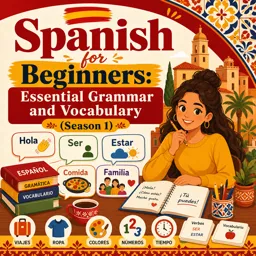
Free CourseSpanish for Beginners: Essential Grammar and Vocabulary (Season 1)
5

(5)

5h23m

20 exercises
Free CourseSpanish for Kids
5
(3)
53m
Free CourseSpanish course A2
5
(4)
11h23m
Free CourseSpanish Verbs for beginners
5
(3)
3h42m
15 exercises
Free CourseSpanish course A1
4.8
(11)
10h51m
6 exercises
Free CourseSpanish
4.8
(405)
6h22m
11 exercises
Free CourseSpanish full course B1
4.8
(5)
1h29m
15 exercises
Free CourseSpanish
4.7

(56)
8h55m
27 exercises
Thousands of online courses in video, ebooks and audiobooks.
To test your knowledge during online courses
Generated directly from your cell phone's photo gallery and sent to your email

Download our app via QR Code or the links below:.


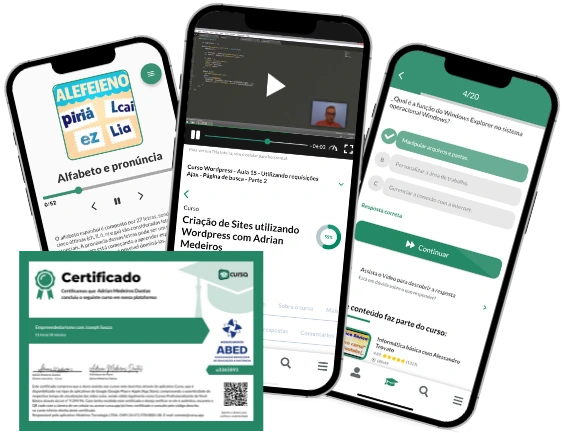
Carry knowledge in your pocket.
Download the Cursa app.
There are hundreds of free courses available, with a free certificate of completion that is saved in your mobile image gallery.
Download the app to access the Course Completion Certificate for Free.


+ 10 million
students

Free and Valid
Certificate

60 thousand free
exercises

4.8/5 rating in
app stores

Free courses in
video and ebooks