
Exercises
Explore how right-hand nail preparation affects tone, articulation, control, and comfort on the classical guitar. This quiz covers flesh-and-nail contact, practical shaping and polishing methods, nail length, roughness testing, plucking location, attack angle, apoyando, thumbnail design, and safe responses to damage. The questions combine foundational principles with visual and practical situations useful for developing a clear, consistent sound.
Answer the questions below and check the explanation for each answer.
0/15 answered
Auto audio on: the next questions will be read aloud when you click Continue.
The flesh can provide secure contact and warmth before the string travels across the nail. A smooth nail then controls the release, supporting clarity and projection without requiring a harsh sound.
In a typical classical stroke, the string initially meets the flesh near the nail and then glides across the polished nail edge. The two contacts occur so closely that they function as one continuous release.
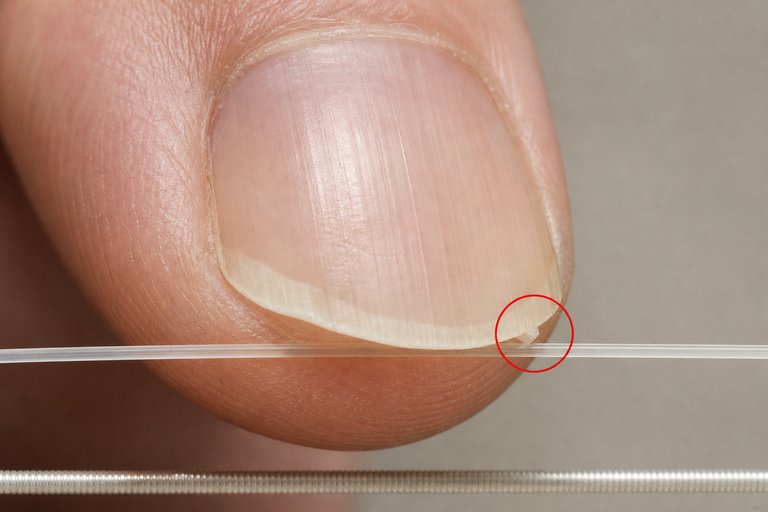
A jagged corner interrupts the string's smooth path across the nail. It can catch the string, delay the release, and add scraping or clicking sounds to the note.
Shaping often leaves microscopic scratches. Progressively finer abrasives remove those marks, and polishing creates a smooth surface that lets the string release cleanly and quietly.
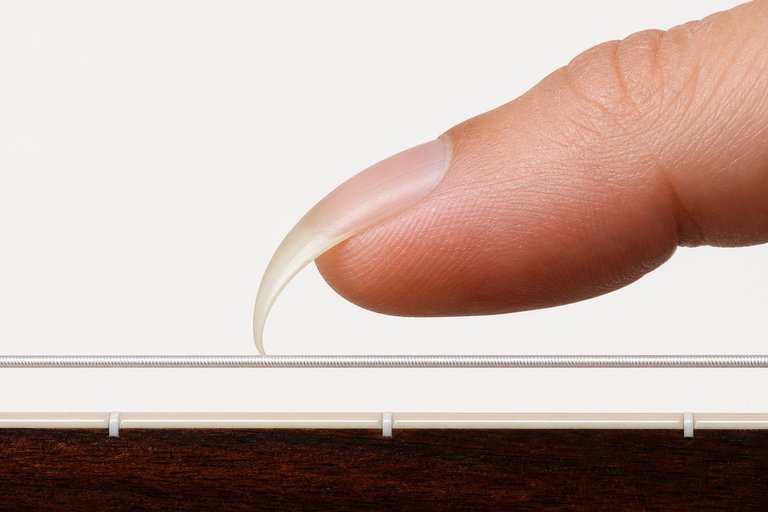
A pronounced hook can trap the string rather than guiding it smoothly off the nail. This increases resistance, interferes with timing, and may create unwanted noise.
Excessive length can increase leverage and make the string travel too far before release. The result may be slower response, greater fragility, catching, or a pronounced nail click.
The string slides across the underside and edge during release. Polishing these areas removes fine scratches and burrs, helping produce a smoother response and cleaner tone.
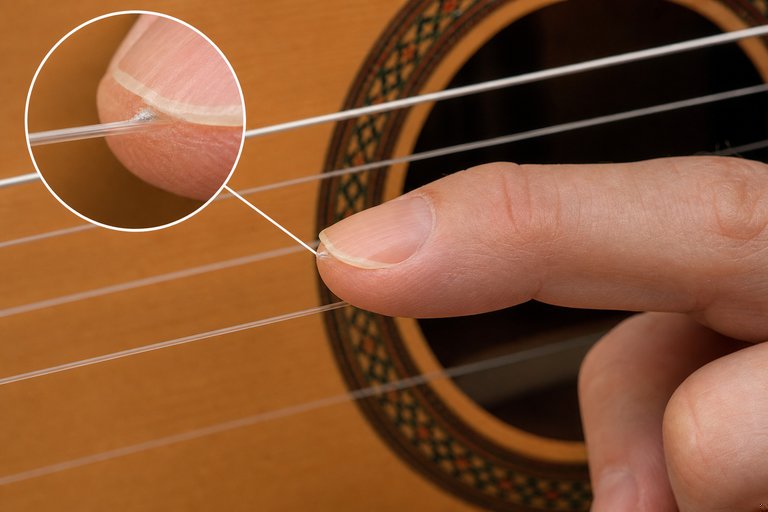
Slowly drawing the nail across a string is a practical way to detect irregularities. Repeated catching at one location usually indicates a rough spot that requires careful smoothing and polishing.
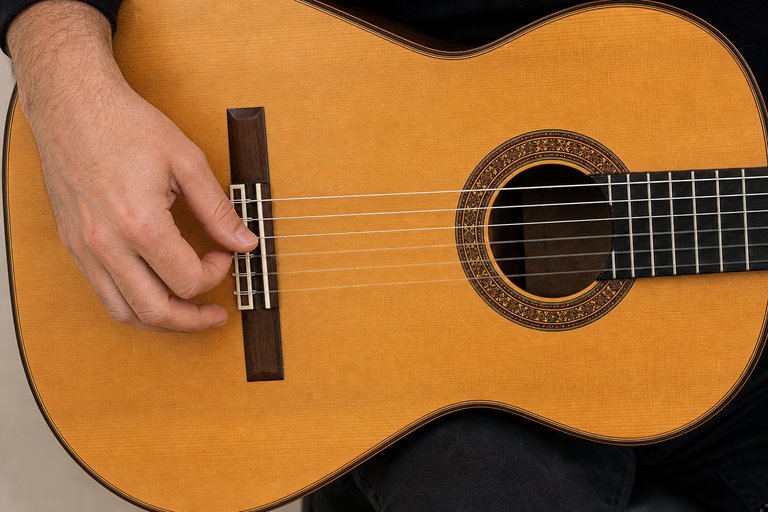
Near the bridge, the string feels stiffer and the pluck emphasizes more upper harmonics, creating a brighter color. The fundamental pitch remains determined by string length, tension, and mass.
Plucking over or near the fingerboard generally emphasizes a rounder, warmer color because the string is more flexible there and the balance of harmonics differs from a bridge-area pluck.
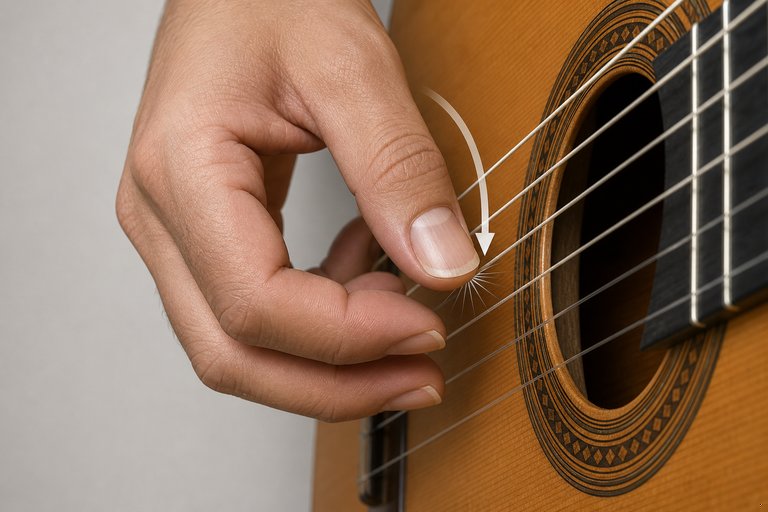
A broad, abrupt collision between nail and string can create resistance and impact noise. A suitable hand position and polished nail ramp let the string travel across the nail more smoothly.
In apoyando, the plucking finger follows through until it rests on the neighboring string. In tirando, the finger releases without coming to rest on that adjacent string.
The thumb moves in a different direction and normally meets the strings at a different angle from i, m, and a. Its ideal length and contour must therefore be evaluated according to its own contact and release path.
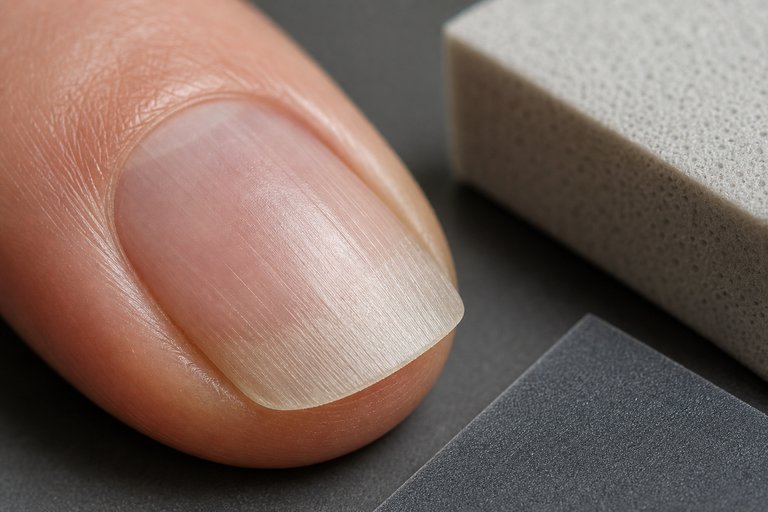
Fine scratches can create friction and noise even when the overall shape looks correct. A finer abrasive followed by polishing removes these marks without unnecessarily changing the established contour.
A deep or painful split may involve living tissue and should not be treated like a minor rough edge. Stop stressing it, keep it protected and clean, and obtain professional care when the injury is significant or concerning.

Free CoursePopular Guitar Lessons For Beginners
5

(28)

3h23m

17 exercises

Free CourseGuitar for beginners
4.9
(81)
1h23m
7 exercises

Free CourseGuitar course for Beginners
4.9
(20)
4h10m
25 exercises

Free CourseGuitar lessons from Beginner to Advanced
4.8

(4)
1h17m
10 exercises

Free Course30 Day Ukelele course
4
(1)
3h31m
23 exercises

Free CourseBeginner Acoustic Guitar Lessons
New
3h41m
32 exercises
Free CourseBeginner Acoustic Guitar
New
2h22m
13 exercises

Free CourseClassical Guitar Repertoire Lessons
New
6h19m
15 exercises
Thousands of online courses in video, ebooks and audiobooks.
To test your knowledge during online courses
Generated directly from your cell phone's photo gallery and sent to your email

Download our app via QR Code or the links below:.


Carry knowledge in your pocket.
Download the Cursa app.
There are hundreds of free courses available, with a free certificate of completion that is saved in your mobile image gallery.
Download the app to access the Course Completion Certificate for Free.


+ 10 million
students

Free and Valid
Certificate

60 thousand free
exercises

4.8/5 rating in
app stores

Free courses in
video and ebooks