PIMA names the right-hand fingers: P is the thumb, i is index, m is middle, and a is ring finger.

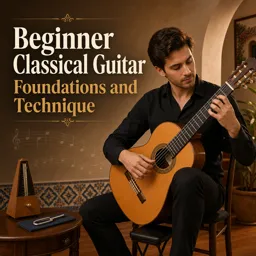
Duration of the online course: 3 hours and 19 minutes
New
Build classical guitar technique fast with a free online course—better tone, accurate fingerpicking, reading music, rhythm, and practice habits for beginners.
Learning classical guitar as a complete beginner can feel overwhelming: strange hand positions, sore fingers, confusing tuning, and a sound that never quite matches what you hear in your head. This course is designed to remove that friction from day one, giving you a clear, beginner-friendly path to a comfortable setup, clean notes, and confident technique. You will learn how to hold the guitar so your body stays relaxed, how to keep the neck stable for better control, and how to tune accurately even if you have never tuned by ear before.
A major focus is building a dependable right hand. You will understand how classical guitar fingers work, how to use PIMA efficiently, and how to contact the string in a way that produces a warm, consistent tone. Practical guidance on nails helps you shape sound without strain, while targeted adjustments improve clarity, volume, and control. You will also develop accuracy through prep-and-play habits that train your fingers to land with intention, not guesswork.
To support that sound, the course develops the left hand with smart, progressive drills that strengthen independence and coordination. Exercises such as spider patterns, vertical finger hops, and opposing motion build control across the fretboard, helping you reduce unwanted noise and increase reliability. Legato skills are covered so hammer-ons and slurs feel solid and audible rather than weak or delayed, giving you smoother phrasing and better musical flow.
Rhythm is treated as a skill you can train, not a talent you either have or do not. You will work on pick-free strumming, including flamenco-inspired motions and rasgueado foundations, and you will learn a dependable everyday pattern you can refine into a more professional feel. Metronome use is explained in a practical way, so timing improves without becoming stressful, and you know exactly when it helps most during the learning process.
Beyond technique, you will gain fretboard and reading fundamentals that unlock independence. You will learn how notes relate through half steps and whole steps, how to locate pitches quickly, and how standard classical notation maps onto the guitar. You will also become comfortable with common markings, including finger indicators that make passages easier to execute. By the end, you will have a stronger tone, better coordination, and a practice approach that keeps you improving consistently.

3 hours and 19 minutes of online video course

Digital certificate of course completion (Free)

Exercises to train your knowledge

100% free, from content to certificate
What does PIMA mean in classical guitar technique?
PIMA names the right-hand fingers: P is the thumb, i is index, m is middle, and a is ring finger.
What is the difference between free stroke and rest stroke on classical guitar?
A free stroke plucks a string without landing on another string; a rest stroke finishes by coming to rest on the adjacent string.
When should I use a metronome when learning classical guitar pieces?
Start using a metronome once you can play a short section correctly and slowly, then increase tempo gradually while keeping the rhythm even.
Ready to get started?Download the app and get started today.
Install the app now
to access the course
Over 5,000 free courses
Programming, English, Digital Marketing and much more! Learn whatever you want, for free.

Study plan with AI
Our app's Artificial Intelligence can create a study schedule for the course you choose.

From zero to professional success
Improve your resume with our free Certificate and then use our Artificial Intelligence to find your dream job.
You can also use the QR Code or the links below.



Free CoursePopular Guitar Lessons For Beginners
5

(28)

3h23m

17 exercises
Free CourseGuitar for beginners
4.9
(81)
1h23m
7 exercises
Free CourseGuitar course for Beginners
4.9
(20)
4h10m
25 exercises
Free CourseGuitar lessons from Beginner to Advanced
4.8

(4)
1h17m
10 exercises
Free Course30 Day Ukelele course
4
(1)
3h31m
23 exercises
Free CourseBeginner Acoustic Guitar Lessons
New
3h41m
32 exercises
Free CourseBeginner Acoustic Guitar
New
2h22m
13 exercises
Free CourseClassical Guitar Repertoire Lessons
New
6h19m
15 exercises
Free CourseSongwriting Course
New
1h16m
8 exercises
Free CourseIntermediate Guitar Course
New
6h30m
43 exercises
Carry knowledge in your pocket.
Download the Cursa app.
There are hundreds of free courses available, with a free certificate of completion that is saved in your mobile image gallery.
Download the app to access the Course Completion Certificate for Free.


+ 10 million
students

Free and Valid
Certificate

60 thousand free
exercises

4.8/5 rating in
app stores

Free courses in
video and ebooks