
Exercises
Put your mastery of the French subjunctive to the test with this advanced quiz. Explore when le subjonctif is required after expressions of doubt, improbability, proposal, negation, and concession, and learn to distinguish it from the indicative. Questions cover correct and incorrect usage in context, including irregular and essential forms of aller, faire, pouvoir, and vivre. You will practice recognizing subjunctive triggers such as « je ne pense pas que », « il est improbable que », and « bien que », while identifying sentences where the mood is inappropriate. Ideal for upper-intermediate and advanced French learners who want to refine grammar accuracy and confidence.
Answer the questions below and check the explanation for each answer.
0/10 answered
Auto audio on: the next questions will be read aloud when you click Continue.
The subjunctive mood is used in French to express doubt, necessity, or emotion. In option 2, Il doute que ce soit impossible, the expression Il doute que introduces doubt, requiring the subjunctive form soit. The other options use indicative mood because they express certainty or belief.
The subjunctive form of aller that matches the subject tu is ailles. In French, the expression Je propose que triggers the use of the subjunctive mood. Therefore, the correct completion of the sentence is Je propose que tu ailles avec nous.
In the subjunctive mood, the verb faire is conjugated as fasse for the third person singular. The subjunctive is often used after verbs expressing doubt or uncertainty, such as croire que. Hence, the correct conjugation in this context is fasse.
The subjunctive mood is used in French to express doubt, wishes, or uncertainty, and it often follows certain conjunctions or expressions of necessity and emotion. In option 2, J'espère qu'elle peut venir à la fête, the verb peut is in the indicative mood, and hope (j'espère) typically does not trigger the subjunctive in French, making its use here incorrect. The sentence should maintain the indicative mood as is.
In French, the phrase 'Je ne pense pas que...' (I don't think that...) often triggers the subjunctive mood, as it expresses doubt or uncertainty. Option 3, elle comprenne la leçon, uses the subjunctive form of the verb 'comprendre' which is required in this context. Options 1 and 2 use the indicative mood, which is not appropriate in this case.
In French, the subjunctive mood is used after expressions of doubt or improbability, such as Il est improbable que. The correct subjunctive form of pouvoir for ils is puissent. Therefore, the sentence should be: Il est improbable qu'ils puissent réussir sans étudier.
The subjunctive is used to express doubt, necessity, or emotions. In option 3, the sentence "Je suis sûr que tu es capable de le faire" uses the indicative mood because "sûr" suggests certainty, which doesn't require the subjunctive. Thus, this sentence does NOT use the subjunctive correctly.
In French, after expressions like bien que (although), the subjunctive is used. For the verb vivre, the subjunctive for nous is vivions.
The subjunctive mood is often used in French when there's doubt, uncertainty, or necessity. In option 1, puissse is correct because there's uncertainty. In option 3, ait tort is also correct with doubt. However, in option 2, the use of semble suggests certainty, which typically uses the indicative mood, thus as raison is correctly in indicative and doesn't fit the pattern of inappropriate subjunctive usage.
The subjunctive mood is often used in French to express doubt, possibility, or emotion. In option 2, Il est possible qu'il arrive demain, the possibility that he may arrive requires the use of the subjunctive arrive, rather than the indicative mood.

Free CourseTEF/TCF French for Canada Immigration (A1–C2) Complete Prep Course
5

(3)

21h48m

37 exercises

Free CourseImprove Your French Conversation and Vocabulary
5
(5)
3h05m
18 exercises

Free CourseAdvanced French
5
(1)
1h37m

Free CourseFrench for beginners
5
(3)
5h18m
13 exercises

Free CourseFrench A1 for beginners
5
(2)
4h52m
4 exercises

Free CourseLearn French A2
5
(1)
2h58m
10 exercises

Free CourseFrench lessons B1
5
(1)
6h47m
3 exercises

Free CourseFrench lessons A1
4.9
(17)
9h13m
7 exercises
Thousands of online courses in video, ebooks and audiobooks.
To test your knowledge during online courses
Generated directly from your cell phone's photo gallery and sent to your email

Download our app via QR Code or the links below:.


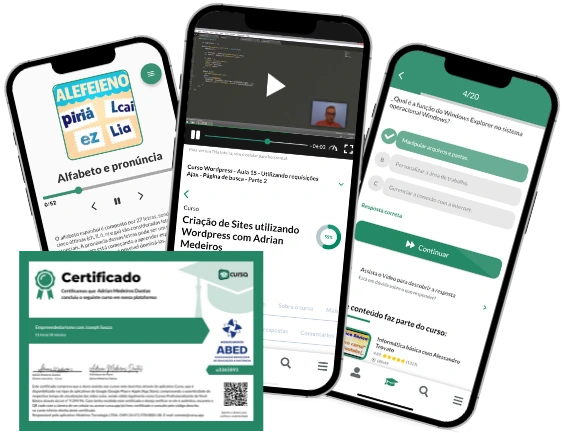
Carry knowledge in your pocket.
Download the Cursa app.
There are hundreds of free courses available, with a free certificate of completion that is saved in your mobile image gallery.
Download the app to access the Course Completion Certificate for Free.


+ 10 million
students

Free and Valid
Certificate

60 thousand free
exercises

4.8/5 rating in
app stores

Free courses in
video and ebooks