
Exercises
Explore the foundations of sustainable farming with this educational quiz. Answer questions on practices that protect soil, conserve water, reduce chemical pesticide use, and support long-term agricultural productivity. Topics include erosion control, crop rotation, conservation tillage, organic farming, agroforestry, biodiversity, and responsible livestock management. Whether you are a student, gardener, farmer, or environmental learner, this quiz helps you assess your understanding of how agriculture can produce food while caring for natural resources and ecosystems.
Answer the questions below and check the explanation for each answer.
0/10 answered
Auto audio on: the next questions will be read aloud when you click Continue.
Rotating crops and embracing diversity is a principle of sustainable farming because it helps maintain soil health, reduce pests and diseases, and enhance ecosystem biodiversity. This practice contributes to a more resilient and sustainable agricultural system, unlike using GMOs or excessive chemical fertilizers that can have negative environmental impacts.
Cover cropping is a practice that helps prevent soil erosion. By planting crops that cover the soil, such as grasses or legumes, the soil structure is improved, root systems stabilize the soil, and the cover reduces the impact of raindrops, preventing erosion.
Drip irrigation is an agricultural method that conserves water by allowing it to drip slowly to the roots of plants, minimizing evaporation and runoff, and targeting water directly where it is needed. This method is highly efficient compared to overhead sprinklers or flood irrigation.
Integrated pest management (IPM) is an environmentally friendly approach to managing pests. It uses a combination of techniques such as biological control, habitat manipulation, and resistant varieties to reduce reliance on chemical pesticides. This method focuses on long-term prevention of pests and their damage rather than merely eliminating them.
Organic farming primarily aims to maintain and improve soil health by using natural fertilizers and techniques. This practice helps in enhancing Improved soil fertility and structure by promoting the growth of beneficial microorganisms and reducing soil erosion, thus leading to sustainable agriculture.
Agroforestry is a land management approach that integrates trees and shrubs with crop and animal farming systems. This method aims to combine both agricultural and forestry techniques to create more diverse, productive, profitable, healthy, and sustainable land-use systems. Unlike just planting trees for wood production or clearing forests, agroforestry involves the strategic use of trees to enhance agricultural production while maintaining ecological balance.
Crop rotation is a farming method that involves growing different types of crops in the same area in sequenced seasons. This practice helps in maintaining soil fertility and reducing soil erosion and pest buildup. By rotating crops, farmers can ensure that the same nutrients are not depleted repeatedly, promoting sustainable agricultural practices.
Conservation tillage aims primarily to reduce soil erosion and preserve soil moisture. This farming practice minimizes soil disturbance, which helps maintain the soil structure, increases water retention, and reduces erosion caused by wind and water. It contrasts with traditional tillage, which can often lead to loss of soil integrity and fertility.
Biodiversity is crucial in sustainable agriculture because it creates resilience to pests and diseases. Diverse ecosystems can naturally regulate pest populations and reduce the spread of diseases, lowering the need for chemical interventions and enhancing ecological balance. This leads to more stable agricultural systems and better adaptation to changing environmental conditions.
Rotational grazing supports sustainable livestock management by allowing pastures to recover and promoting biodiversity. It involves moving livestock between different pastures, giving grasses time to regrow and reducing soil erosion. This method improves soil health, water retention, and forage availability, making it an environmentally friendly option compared to continuous grazing or confined feeding operations.
Free CourseHow to be a Farmer
5

(1)

2h02m

13 exercises
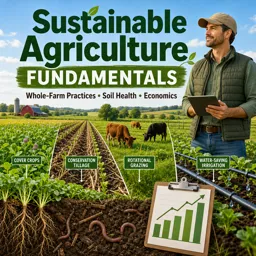
Free CourseSustainable Agriculture Fundamentals: Whole-Farm Practices, Soil Health and Economics
5
(3)
22m
8 exercises
Free CourseAgribusiness Management: Finance, Marketing, Supply Chain and Sustainability
5
(5)
2h02m
10 exercises
Free CourseAgriculture complete
4.9
(7)
1h58m
6 exercises
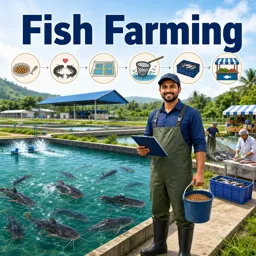
Free CourseFish Farming
4.8
(6)
54m
7 exercises
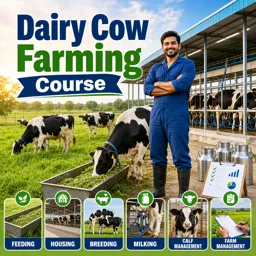
Free CourseDairy Cow farming course
4.8
(9)
4h41m
25 exercises
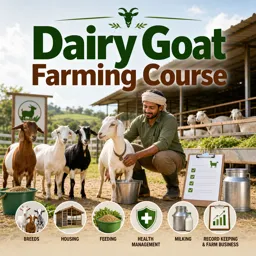
Free CourseDairy Goat Farming course
4.7

(10)
4h48m
26 exercises
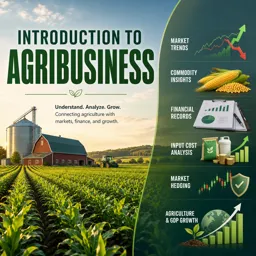
Free CourseIntroduction to Agribusiness
4.2
(5)
2h09m
7 exercises
Thousands of online courses in video, ebooks and audiobooks.
To test your knowledge during online courses
Generated directly from your cell phone's photo gallery and sent to your email

Download our app via QR Code or the links below:.



Carry knowledge in your pocket.
Download the Cursa app.
There are hundreds of free courses available, with a free certificate of completion that is saved in your mobile image gallery.
Download the app to access the Course Completion Certificate for Free.


+ 10 million
students

Free and Valid
Certificate

60 thousand free
exercises

4.8/5 rating in
app stores

Free courses in
video and ebooks