
Exercises
Explore how corporations distribute cash to shareholders through dividends and share repurchases. This quiz covers payout calculations, dividend dates, residual dividend policy, signaling effects, stock dividends, repurchase methods, sustainable growth, legal constraints, and the conditions under which debt-financed buybacks increase earnings per share. Questions combine conceptual knowledge with practical calculations and visual interpretation.
Answer the questions below and check the explanation for each answer.
0/15 answered
Auto audio on: the next questions will be read aloud when you click Continue.
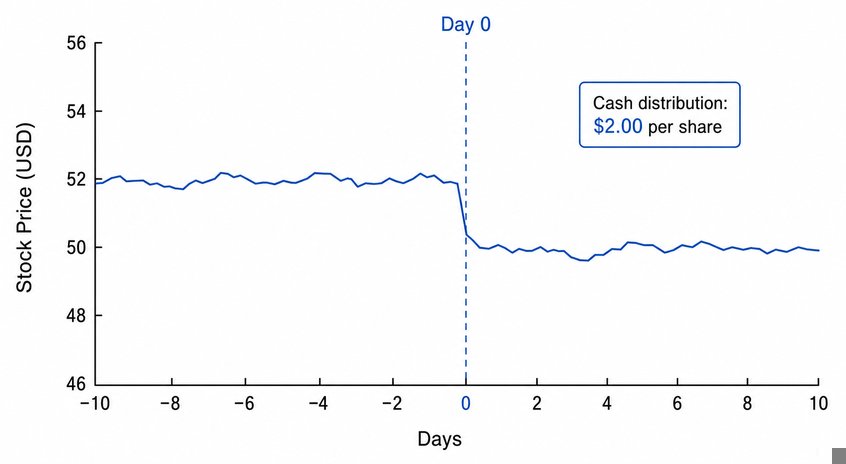
On the ex-dividend date, new buyers are no longer entitled to the declared dividend. All else equal, the stock price therefore tends to fall by approximately the dividend amount.
The equity required for investment is 60% of $80 million, or $48 million. The residual available for dividends is therefore $70 million minus $48 million, which equals $22 million.
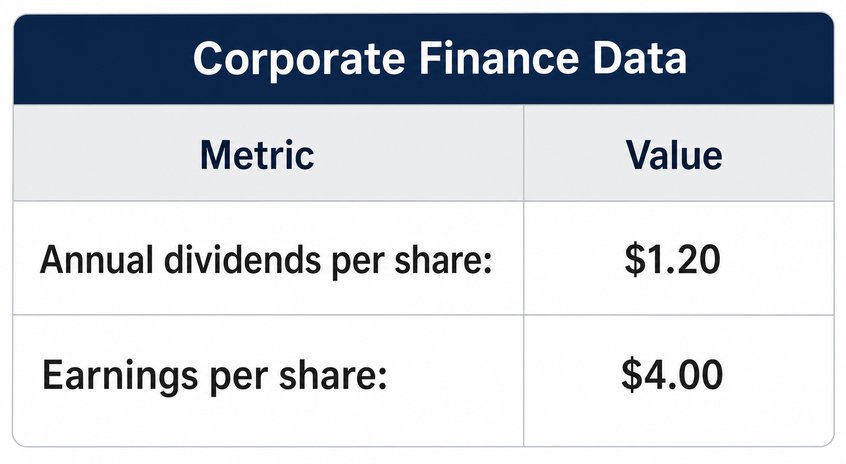
The dividend payout ratio equals dividends per share divided by earnings per share. Thus, $1.20 divided by $4.00 equals 30%.
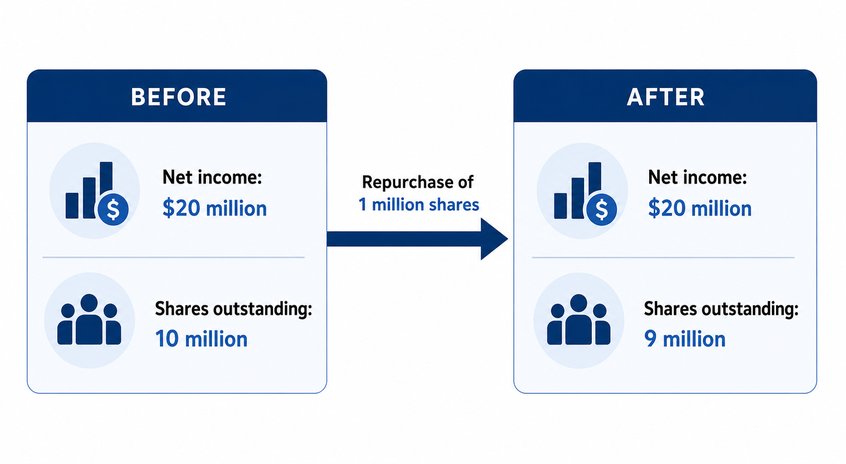
After the repurchase, 9 million shares remain outstanding. EPS becomes $20 million divided by 9 million shares, or approximately $2.22.
With no taxes, transaction costs, or information problems, and with investment policy fixed, investors can sell shares to generate cash. This makes the division between dividends and retained earnings irrelevant to value.
Managers often avoid reducing established dividends. An unexpected cut may therefore signal that management expects lower or less reliable future cash flows, although the actual reason must still be investigated.
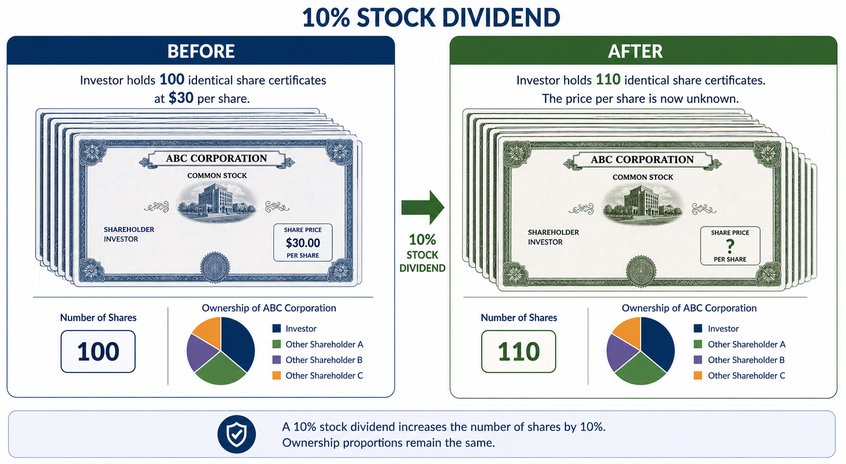
A stock dividend increases the number of shares but proportionally reduces the price per share. The shareholder owns more units representing the same proportional claim, so total wealth is approximately unchanged at issuance.
The board first declares the dividend. The stock then trades ex-dividend before the record date identifies eligible holders, and the company distributes the cash on the payment date.
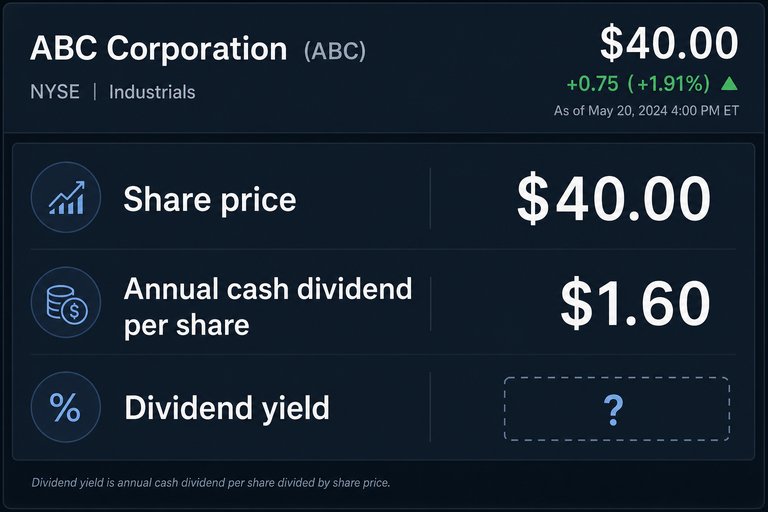
Dividend yield equals annual dividends per share divided by the share price. Therefore, $1.60 divided by $40 equals 4.0%.
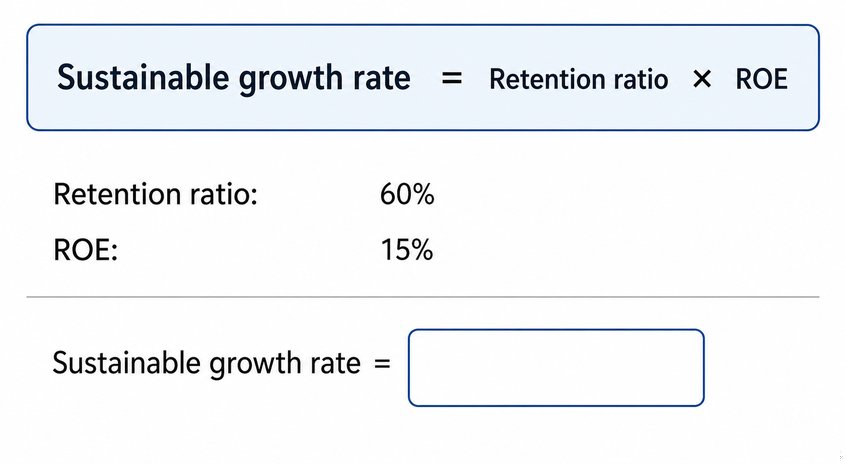
The sustainable growth rate is approximately the retention ratio multiplied by ROE. Multiplying 60% by 15% gives 9%.
An open-market program usually allows the company to buy shares gradually and adjust or suspend purchases. Tender offers specify a defined period and quantity, making them less flexible.
Different investors have different cash-income needs and tax circumstances. They may sort themselves into firms whose dividend policies fit those preferences, creating dividend clienteles.
Accounting profit alone does not guarantee that a dividend may be paid. Corporate law and debt agreements commonly restrict distributions that would impair legal capital or leave the company unable to satisfy its obligations.
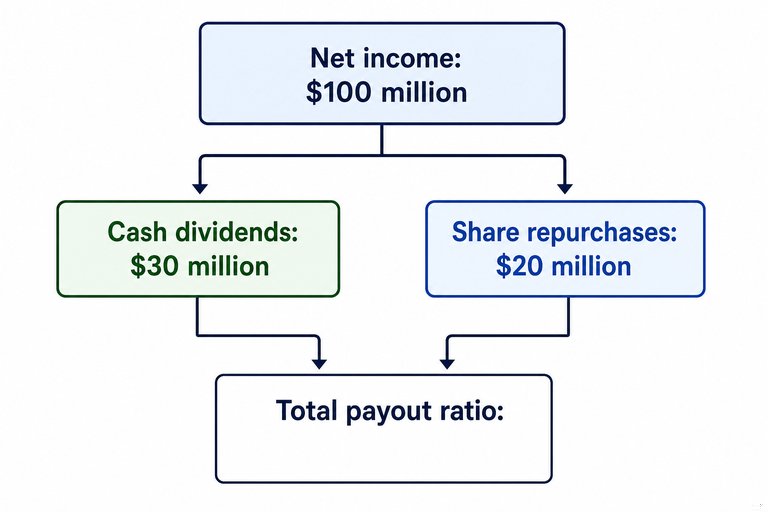
Total payout equals dividends plus share repurchases: $30 million plus $20 million equals $50 million. Dividing by $100 million of net income gives a 50% total payout ratio.
A debt-financed repurchase is mechanically EPS-accretive when the earnings yield on the retired shares exceeds the after-tax cost of borrowing. This does not necessarily mean the transaction creates economic value.
Free CourseCorporate Finance Second Edition
5

(2)

35h06m

26 exercises

Free CourseCorporate Finance MBA Class
4.9
(217)
35h56m
21 exercises
Free CourseCorporate Finance
4.7

(3)
9h50m
43 exercises

Free CourseFinancial management for managers
4.6
(13)
37h30m
8 exercises
Free CourseFinance course
4.3
(3)
24h59m
20 exercises
Free CourseEconometrics
4.2
(12)
18h21m
39 exercises
Thousands of online courses in video, ebooks and audiobooks.
To test your knowledge during online courses
Generated directly from your cell phone's photo gallery and sent to your email

Download our app via QR Code or the links below:.



Carry knowledge in your pocket.
Download the Cursa app.
There are hundreds of free courses available, with a free certificate of completion that is saved in your mobile image gallery.
Download the app to access the Course Completion Certificate for Free.


+ 10 million
students

Free and Valid
Certificate

60 thousand free
exercises

4.8/5 rating in
app stores

Free courses in
video and ebooks