
Exercises
Test your understanding of the core financial statements used to evaluate a company’s performance and financial position. This quiz covers the income statement, balance sheet, and cash flow statement, along with key concepts such as revenues, expenses, liquidity, shareholders’ equity, depreciation, double-entry bookkeeping, the accounting equation, and earnings per share (EPS). You will also identify how investing activities, such as equipment purchases, are reported in cash flow reporting. Ideal for students, aspiring accountants, investors, and anyone building essential financial literacy.
Answer the questions below and check the explanation for each answer.
0/10 answered
Auto audio on: the next questions will be read aloud when you click Continue.
The three major financial statements prepared by companies are the Income Statement, which shows the company's profitability over a period; the Cash Flow Statement, detailing the cash inflows and outflows; and the Balance Sheet, which provides a snapshot of the company's assets, liabilities, and equity at a specific point in time.
The Income Statement is the financial statement that shows the revenues and expenses over a period of time. It provides a summary of how the business incurs its revenues and expenses, detailing the company's profitability. It is also known as the Profit and Loss Statement.
A balance sheet provides a snapshot of a company’s financial position at a specific point in time. It shows the assets, liabilities, and shareholders' equity, offering insight into what the company owns and owes, as well as the amount invested by shareholders.
Shareholders' equity is typically found on the Balance Sheet. The balance sheet is one of the key financial statements and it provides information about a company's assets, liabilities, and equity at a specific point in time. Shareholders' equity represents the difference between a company's total assets and total liabilities.
The Balance Sheet is the financial statement used to assess a company's liquidity. It provides a snapshot of the company's assets and liabilities, allowing you to evaluate its ability to meet short-term obligations. Key figures include current assets and current liabilities, which are crucial for determining the company's liquidity position.
Depreciation expense is reported in the Income Statement as it represents an allocation of the cost of a tangible asset over its useful life. It is considered an operating expense and impacts the net income of a company. The Income Statement reflects a company's financial performance over a specific period, including revenues and expenses, which is why depreciation expense is included there.
The term 'double-entry bookkeeping' refers to the accounting system where two entries are made for each transaction: one debit and one credit in different accounts. This ensures that the accounting equation, Assets = Liabilities + Equity, remains balanced and provides a complete picture of the company’s financial status.
The accounting equation is a fundamental principle in accounting that states Assets are equal to Liabilities plus Shareholders' Equity. Therefore, the correct equation is represented by Option 1: Assets = Liabilities + Shareholders' Equity.
Earnings Per Share (EPS) is a financial metric used to indicate a company's profitability. It is calculated by dividing the net income after taxes by the number of outstanding shares. This measure gives investors an idea of how much profit is being made per share of stock, helping them assess the company's financial health and profitability.
The purchase of equipment is included in the Investing Activities section of the Cash Flow Statement. This section accounts for cash spent on long-term assets like equipment, buildings, or investments in other companies. It reflects the firm's use of capital to grow its capacity or capabilities.
Free CoursePrinciples of Managerial Accounting
5

(1)

4h13m

33 exercises

Free CourseFinancial Accounting management
4.9
(15)
7h04m
19 exercises
Free CourseIntroduction to accounting
4.9
(9)
1h30m
6 exercises
Free CourseAuditing in Accounting
4.8
(10)
6h06m
28 exercises
Free CourseAccounting basics tutorial
4.8

(4)
3h33m
6 exercises

Free CourseFinancial Accounting
4.7
(3)
18h59m
43 exercises
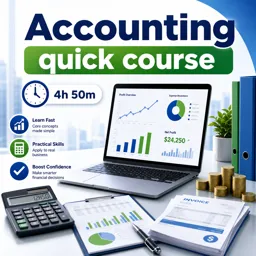
Free CourseAccounting quick course
4.6
(5)
4h50m

Free CourseFinancial Accounting
4.5
(118)
10h14m
31 exercises
Thousands of online courses in video, ebooks and audiobooks.
To test your knowledge during online courses
Generated directly from your cell phone's photo gallery and sent to your email

Download our app via QR Code or the links below:.


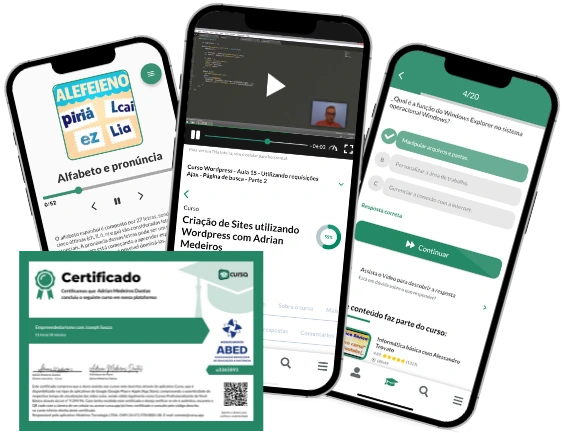
Carry knowledge in your pocket.
Download the Cursa app.
There are hundreds of free courses available, with a free certificate of completion that is saved in your mobile image gallery.
Download the app to access the Course Completion Certificate for Free.


+ 10 million
students

Free and Valid
Certificate

60 thousand free
exercises

4.8/5 rating in
app stores

Free courses in
video and ebooks