“All mammals are warm-blooded. All whales are mammals. Therefore, all whales are warm-blooded.” This short argument is a syllogism, one of the oldest tools in logic, first studied systematically by Aristotle more than two thousand years ago. Syllogisms still show up everywhere: in aptitude tests, law school entrance exams, job assessments, and, more importantly, in everyday arguments you hear and make.
In this article, you will learn how a syllogism is built, how to tell a valid argument from an invalid one, and which common mistakes make arguments look stronger than they are.
What is a syllogism?
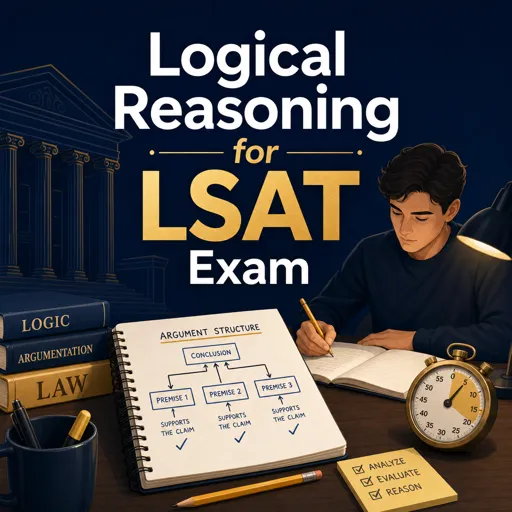
A syllogism is a form of deductive reasoning in which a conclusion is drawn from two premises. If the premises are true and the structure is correct, the conclusion must be true. There is no “probably” involved, which is what distinguishes deduction from inductive reasoning.
The most traditional type is the categorical syllogism, which deals with groups or categories of things. It has three parts:
- Major premise: a general statement (All mammals are warm-blooded).
- Minor premise: a more specific statement (All whales are mammals).
- Conclusion: what follows from the two premises (All whales are warm-blooded).
The three terms
Every categorical syllogism uses exactly three terms, each appearing twice:
| Term | Role | In our example |
|---|---|---|
| Major term | Predicate of the conclusion | warm-blooded |
| Minor term | Subject of the conclusion | whales |
| Middle term | Appears in both premises, never in the conclusion | mammals |
The middle term is the bridge. It connects the minor term to the major term, and most errors in syllogisms happen right here, when the bridge does not actually connect anything.
The four types of categorical statements
Traditional logic classifies categorical statements into four types, labeled with the letters A, E, I, and O:
- A – Universal affirmative: All S are P. (All squares are rectangles.)
- E – Universal negative: No S are P. (No fish are mammals.)
- I – Particular affirmative: Some S are P. (Some students are athletes.)
- O – Particular negative: Some S are not P. (Some birds are not flyers.)
In logic, “some” simply means “at least one.” It does not imply “not all.” So “Some cats are black” is still true even if, hypothetically, every cat were black.
Valid vs. sound: a crucial distinction
These two words are often confused, but they mean different things:
- An argument is valid if the conclusion follows necessarily from the premises. Validity is about structure only.
- An argument is sound if it is valid and all its premises are actually true.
Consider this: “All birds can swim. All penguins are birds. Therefore, all penguins can swim.” The structure is perfectly valid, but the first premise is false (many birds cannot swim), so the argument is not sound, even though the conclusion happens to be true. Now consider: “All cats are animals. All dogs are animals. Therefore, all dogs are cats.” Both premises are true, but the argument is invalid. Logic tests usually ask about validity: you must accept the premises as given and check only whether the conclusion follows.
Testing validity with Venn diagrams
A reliable way to check a categorical syllogism is to draw three overlapping circles, one for each term, and represent the premises:
- Draw three overlapping circles labeled with the minor, major, and middle terms.
- Shade areas that a universal premise says are empty. “All S are M” means the part of S outside M is empty.
- Mark an “x” in areas that a particular premise says contain something. Diagram universal premises first.
- Look at the result without adding anything. If the conclusion is already shown in the diagram, the syllogism is valid. If you would need to add information, it is invalid.
For the “dogs are cats” example, you would see that the “dogs” circle and the “cats” circle are both inside “animals,” but nothing forces them to overlap completely. The conclusion is not guaranteed, so the argument is invalid.
Common fallacies in syllogisms
Undistributed middle
“All roses are flowers. Some flowers fade quickly. Therefore, some roses fade quickly.” The middle term (flowers) is never used to refer to all flowers, so the fast-fading flowers might not include any roses. The bridge does not connect.
Illicit major and illicit minor
These occur when the conclusion makes a claim about all members of a term, while the premises only gave information about some of them. Example: “All lawyers are educated. No doctors are lawyers. Therefore, no doctors are educated.” The premises never told us about every educated person, so the conclusion overreaches.
Two negative premises
From “No A are B” and “No B are C,” nothing follows about the relationship between A and C. A valid categorical syllogism cannot have two negative premises.
Beyond categories: other syllogism types
Not all syllogisms are about groups. Two other common forms appear constantly in reasoning tests:
| Form | Structure | Valid? |
|---|---|---|
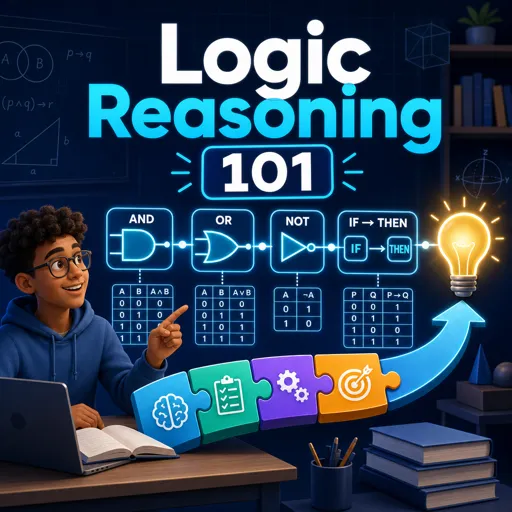
| Modus ponens | If P, then Q. P. Therefore, Q. | Yes |
| Modus tollens | If P, then Q. Not Q. Therefore, not P. | Yes |
| Affirming the consequent | If P, then Q. Q. Therefore, P. | No |
| Denying the antecedent | If P, then Q. Not P. Therefore, not Q. | No |
| Disjunctive syllogism | P or Q. Not P. Therefore, Q. | Yes |
A quick example of affirming the consequent: “If it rains, the street gets wet. The street is wet. Therefore, it rained.” The street could be wet for other reasons, like a burst pipe or street cleaning.
Tips for logic tests
- Ignore real-world knowledge. Treat the premises as true, even if they sound absurd.
- Replace words with letters. Turning “All accountants are careful” into “All A are C” removes bias.
- Find the middle term first and check that it actually links the other two.
- Watch the word “some.” Two “some” premises never lead to a valid conclusion.
- Draw it. A rough Venn diagram takes seconds and prevents most errors.
Conclusion
Syllogisms teach a powerful habit: separating the structure of an argument from whether its claims are true. Once you can spot an undistributed middle or an affirmed consequent, you will notice how often persuasive-sounding arguments in ads, debates, and social media rely on broken logic. That skill is valuable on exams and even more valuable in daily life.
Want to sharpen your reasoning further? Check out the free Logical Reasoning courses on Cursa and practice with more exercises.