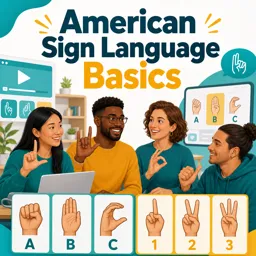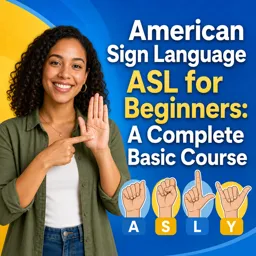


When people first learn American Sign Language (ASL), they often start with the manual alphabet, a set of handshapes that represent the letters of English. Using these handshapes to spell out a word is called fingerspelling. It looks simple, but it is a real part of the language with its own habits and rules. This guide explains what fingerspelling is, when signers use it and how to practice without picking up bad habits.
What Fingerspelling Is (and Is Not)
In ASL, fingerspelling uses one hand to form a handshape for each letter of the English alphabet, one after another. It is a bridge between English and ASL, because it lets signers represent English words that do not have a sign or whose sign is not known to the people involved.
It is important to understand what fingerspelling is not. It is not the main way ASL communicates. ASL is a full language with its own grammar, built on signs, facial expressions, body movement and space. Fingerspelling is one tool inside that language, and good signers use it selectively rather than spelling everything out.
When Do Signers Use It?
Fingerspelling appears in many situations. Common uses include:
- Names of people and places, when there is no established sign.
- Brand names, titles and technical terms that lack a common sign.
- Clarification, such as spelling an English word to make sure the meaning is clear.
- Emphasis or style, where a signer chooses to spell a word for effect.
- Teaching and learning, such as introducing a new vocabulary item in English.
Over time, some frequently spelled words become more compact and stylized, taking on a distinct shape that is recognized as a unit rather than as separate letters. This is a natural feature of the language, and beginners will notice it as they watch fluent signers.
The Basics of Good Form
Clear fingerspelling depends on a few simple habits. Teachers commonly stress the following:
- Use your dominant hand. Right-handed people usually spell with the right hand, left-handed people with the left.
- Hold the hand in a comfortable position near the shoulder, with the palm facing the person you are talking to, so that they can see each handshape clearly.
- Keep the hand relatively still. The fingers change shape, but the hand should not bounce for every letter.
- Keep a steady rhythm. Smooth, even timing makes a word easier to read than rushing some letters and pausing on others.
- Make each handshape distinct. Lazy shapes blur together, especially for letters that look similar.
- Let the hand move slightly sideways for longer words so the viewer can follow the sequence.
Double Letters and Special Cases
Words with repeated letters have a convention of their own. Rather than repeating the same shape awkwardly, signers often make a small movement, such as a slight bounce or a small shift of the hand, between the two identical letters so the viewer sees that the letter appears twice. Some letters also involve movement, rather than a still handshape, so learning them from a good video or a teacher is more reliable than guessing from a drawing.
Reading Is Harder Than Spelling
Many beginners find that understanding fingerspelling is harder than producing it. The reason is that fluent signers spell quickly and smoothly. The key skill is to read the whole word shape rather than waiting for each letter. A few tips can help:
- Do not say each letter aloud in your head. Try to take in the whole word as a pattern.
- Watch the rhythm and flow instead of freezing on one letter.
- Use context. If the topic is a city, the spelled word is probably a place name.
- Ask for repetition politely. Asking someone to spell it again, or more slowly, is normal and expected.
A Simple Practice Routine
Short, regular sessions work better than a single long one. Here is a plan you can follow:
| Step | What to do | Goal |
|---|---|---|
| 1 | Learn the handshapes in small groups of letters | Accurate, distinct shapes |
| 2 | Spell your own name slowly, then smoothly | Steady rhythm |
| 3 | Spell everyday objects around you | Fluency with common words |
| 4 | Practice in front of a mirror or record yourself | Check clarity and hand position |
| 5 | Watch fluent signers and try to read their spelling | Whole-word recognition |
Common Beginner Mistakes
- Spelling too fast too soon. Clarity comes first, and speed follows with practice.
- Spelling instead of signing. If a sign exists, using it is usually better than spelling the English word.
- Bouncing the hand with each letter, which makes the word hard to read.
- Hiding the hand or turning the palm toward yourself.
- Mouthing every letter instead of following natural ASL habits, which a teacher or Deaf signer can guide you on.
Remember that sign languages differ around the world. The one-handed alphabet described here is used in ASL, but other sign languages have their own manual alphabets, and some use two hands. If you plan to learn a different sign language, check which alphabet it uses.
Conclusion
Fingerspelling is a practical entry point into ASL: easy to start, rewarding to improve and useful for names and terms that have no sign. Keep your hand steady, your shapes clear and your rhythm even, and practice reading as much as spelling. Learning from Deaf teachers and fluent signers will help you build natural habits. If you would like structured lessons, you can explore the related sign language and language courses available at Cursa.